Karbon360 is a carbon management platform that turns the invoices a company already keeps into a greenhouse-gas inventory a bank, buyer or verifier will accept.
The carbon management platform, screen by screen
Four things have to happen between a supplier invoice and a figure your customer accepts: the data has to come in, it has to be calculated correctly, it has to be checkable, and it has to come out in the shape someone asked for. This is how each one works.
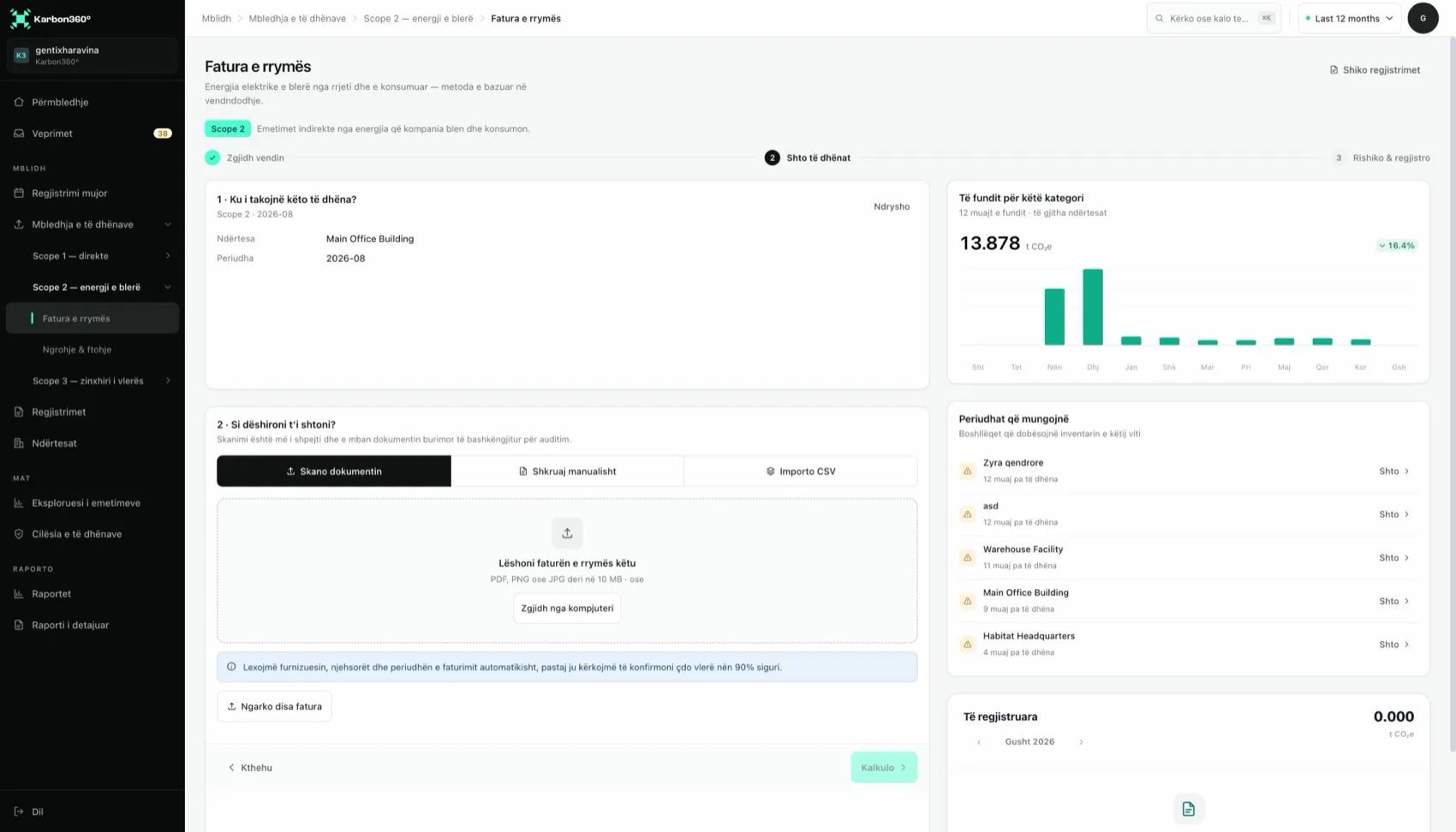
Collect — where the carbon management platform begins
Scan a supplier bill, type it manually, or import a CSV. The platform reads the supplier, the meter and the billing period, and asks you to confirm anything it is less than 90% confident about. The source document stays attached to the record, because that attachment is the evidence a reviewer asks for.
Entry is guided by scope, so nobody has to know whether a diesel invoice belongs in Scope 1 or Scope 2. Missing periods are listed per facility, before a gap becomes a hole in the inventory.
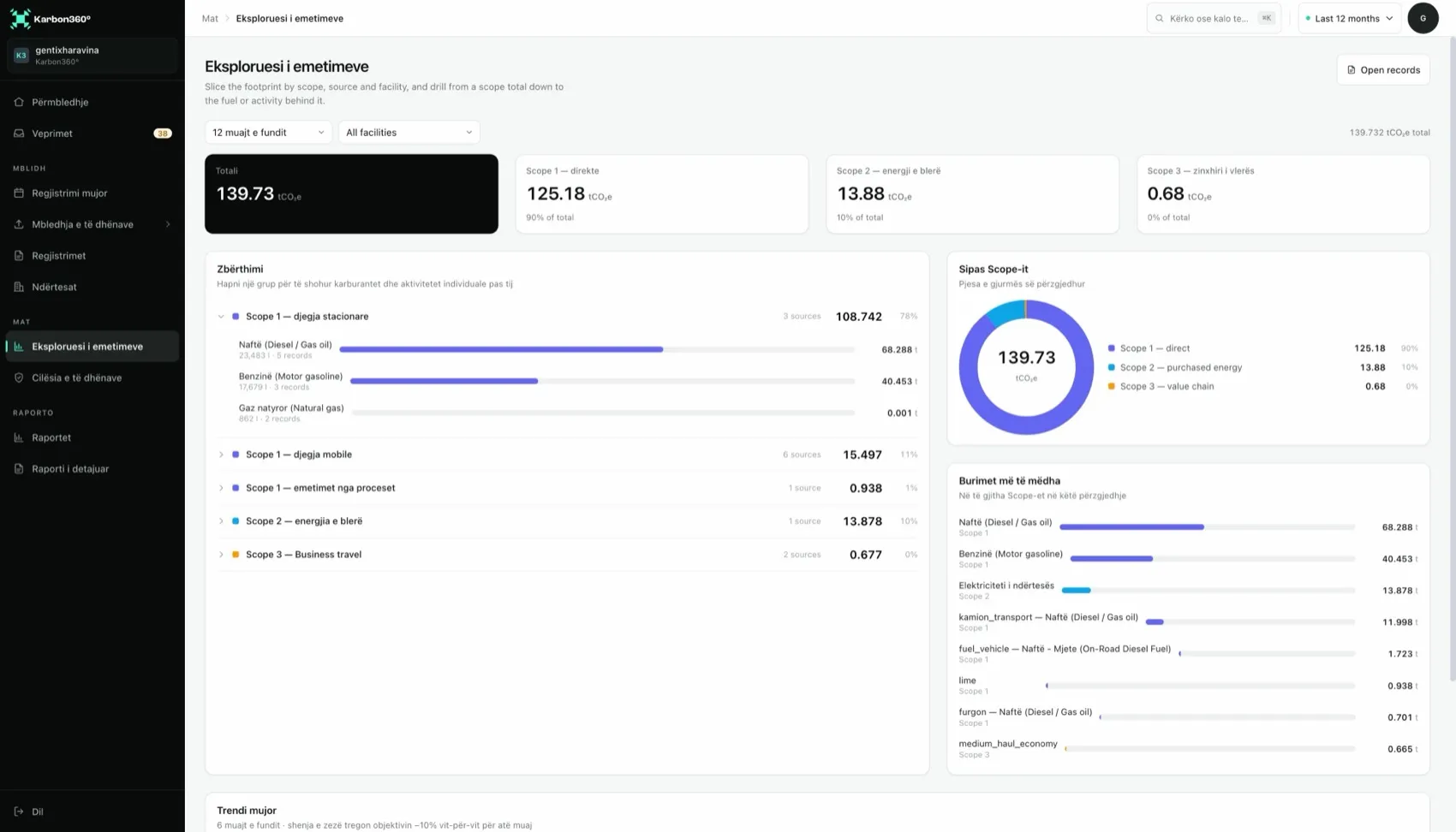
Explore — from a scope total down to the litre
Slice the footprint by scope, by source and by facility, then open any group to see the individual fuels and activities underneath it, with the record count behind every number. Scope 1, 2 and 3 each carry their share of the total on every row, and every figure links straight through to the records that produced it.
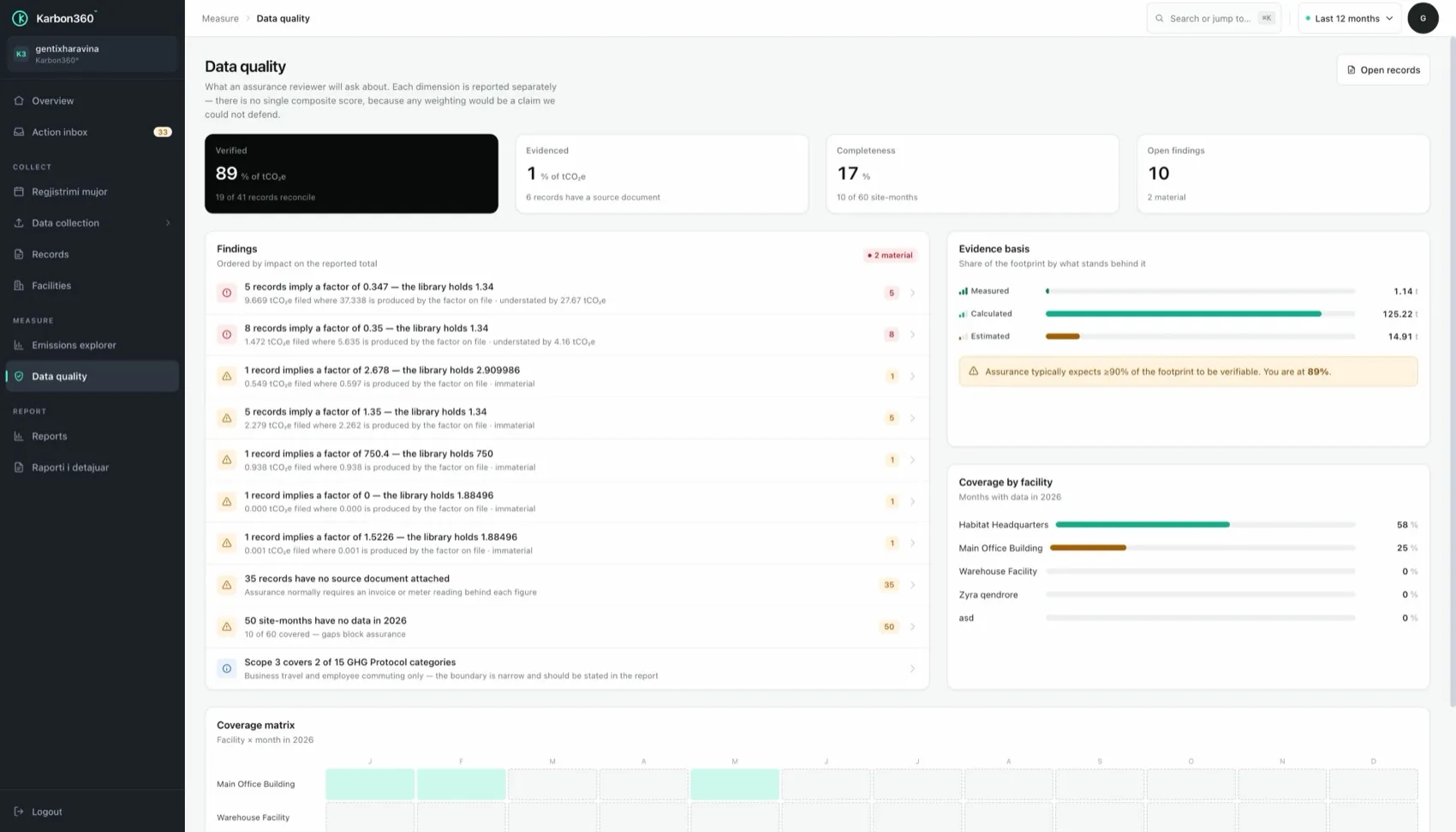
Data quality — the number you are not supposed to like
Quality is reported as separate dimensions rather than one flattering score, because any weighting would be a claim we could not defend. Findings are ordered by how much of the reported total they move. The evidence basis splits the footprint into measured, calculated and estimated. A coverage matrix shows every facility-month that is still empty.
Independent reviewers typically expect at least 90% of a footprint to be backed by documents. The platform measures that share continuously, so the conversation happens months before your reviewer opens the file.
Trace — the arithmetic, on every record
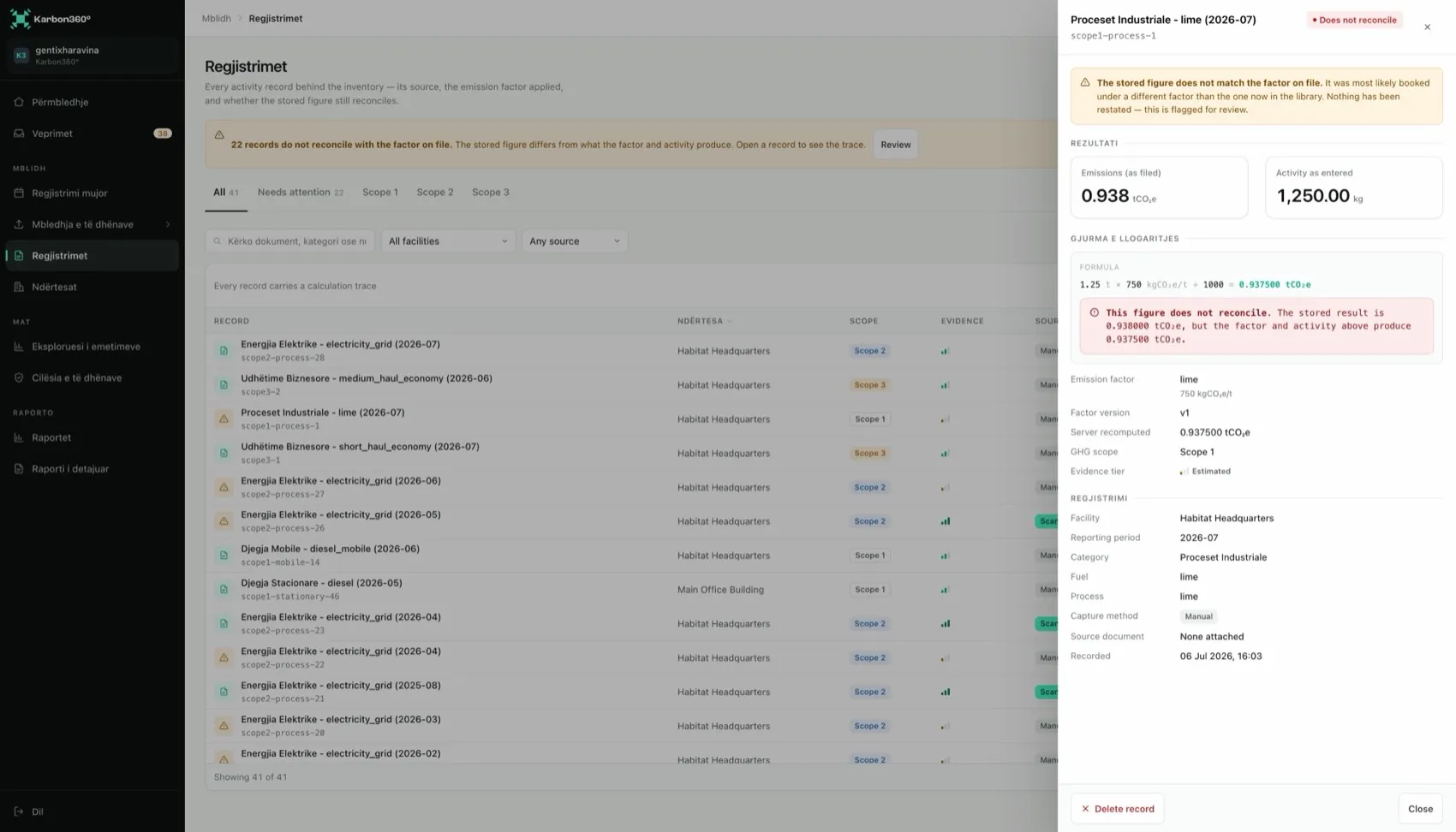
Open any record and the whole chain is there: the activity as entered, the emission factor and its version, the server-side recomputation, the evidence tier, and the source document. If a stored figure stops matching the factor on file, it is flagged for review rather than silently restated — because a quiet correction is exactly what a verifier is looking for.
Report — one inventory, every format they ask for
A CBAM supplier data pack, a customer questionnaire export, or a GHG Protocol inventory for a lender — all drawn from the same underlying data, so the three never drift apart and disagree when someone compares them.
Reports export in English for the EU buyer who asked, while the platform itself runs in Albanian, Macedonian, Bosnian, Serbian, Croatian and Turkish.