Emissions data quality: coverage and reconciliation, reported separately
Emissions data quality in Karbon360 is reported on two separate dimensions, coverage and reconciliation. There is deliberately no single composite grade, because any weighting would be a claim you could not defend to a reviewer.
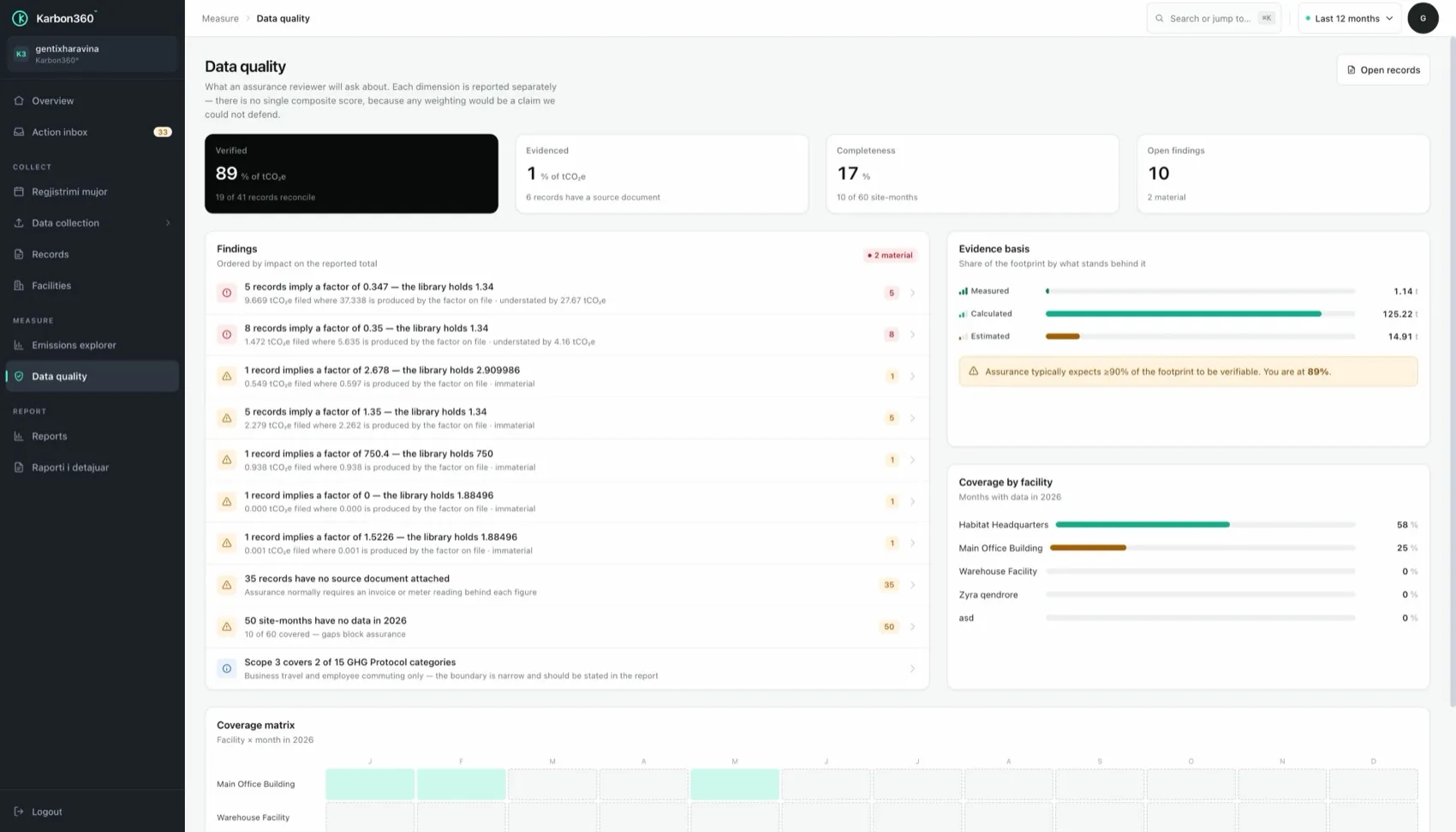
Coverage: how much of the year has data
Coverage shows how many facility-months have data, and what share of your footprint is verified, evidenced or estimated. The coverage matrix lists facilities as rows and months as columns. A filled cell is complete, a half-filled cell means some expected sources are missing, and an empty cell means no data. Every empty cell is a task.
Reconciliation: whether the numbers agree with themselves
Reconciliation lists records whose stored result differs from what their factor and activity data produce. They appear as findings, ranked by impact in kg CO₂e, so the largest problem is always at the top.
Why emissions data quality has no single score
A composite score invites the question of how it was weighted, and no answer to that question survives a verifier. Two plain dimensions do. The report includes the data-quality section, so a reviewer sees that you have nothing to hide: a stated gap is simply a data-collection task, while a hidden gap found by a verifier is a credibility problem.
Working through findings
- Start with the largest-impact finding.
- Open the record and compare quantity, unit and period with the evidence.
- Correct and save. The record is recalculated and the finding clears if it now reconciles.
- If the data is right but the finding remains, contact support.
What the data-quality section of the report shows
The GHG report includes a data-quality section with coverage, reconciliation and the stated boundary. A reviewer can see which months are complete, how much of the footprint is evidenced against estimated, and that nothing was blended into a score. The gaps are named instead of averaged away.
Keep reading
- The calculation trace — the evidence behind each record
- The monthly routine — keeping the inbox at zero
- GHG inventory checklist — what to collect and check before you report