Emission factors: how Karbon360 sources, versions and shows them
Emission factors are the conversion rates that turn activity data into emissions: kilograms of CO₂e per kWh, per litre, per cubic metre or per tonne produced. They are the half of every calculation you do not control, which is why a reviewer's first question is almost always which factor you used.
What emission factors do
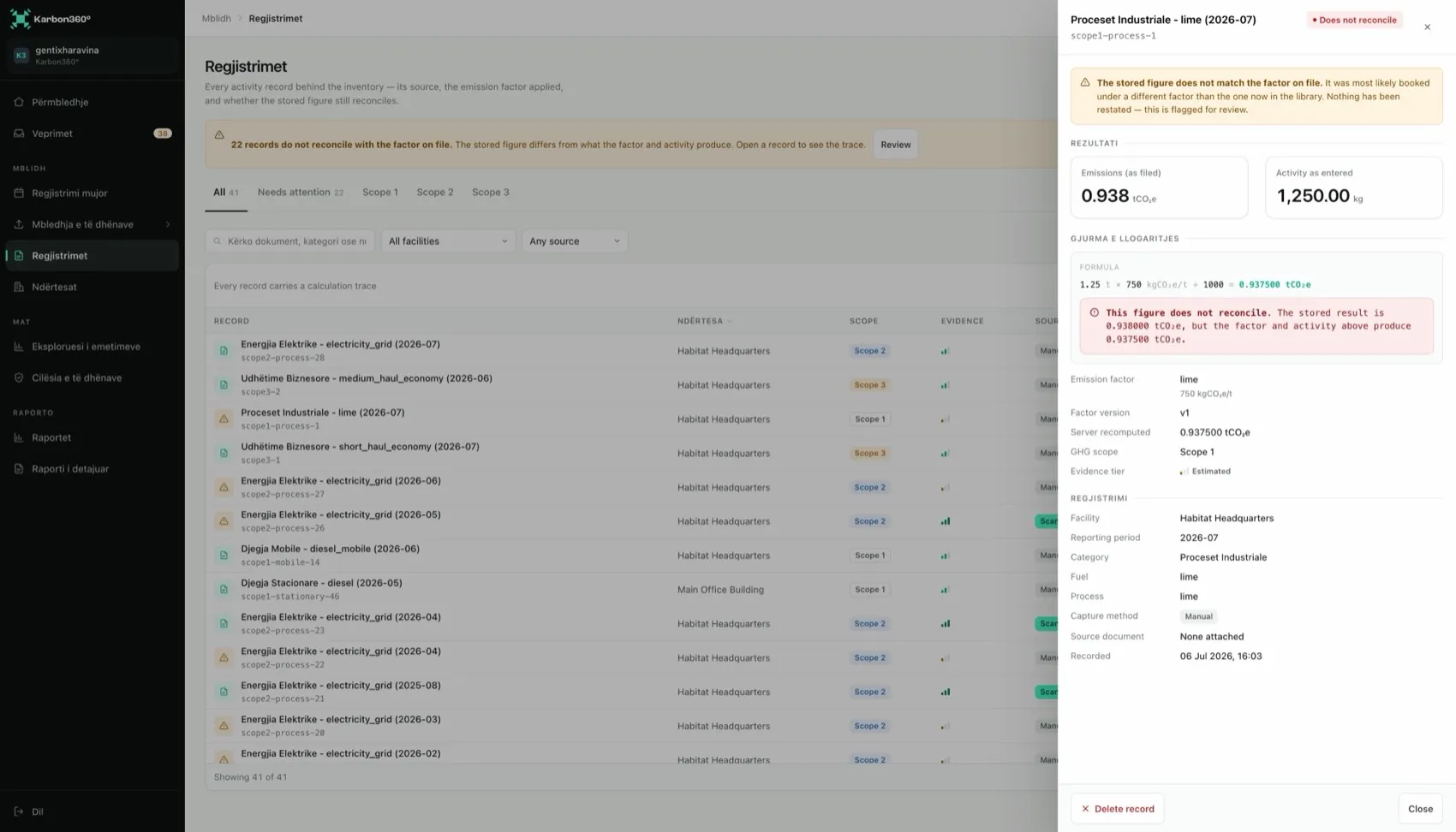
The formula is short: emissions (kg CO₂e) = activity data × emission factor. You bring the activity data from documents you already keep. The factor converts it.
A small error in activity data produces a small error in the result. A wrong factor produces a wrong result on every record that uses it, which is why factors matter more than any single invoice.
Why emission factors differ so much in the Western Balkans
Electricity grids in the region run from hydro-heavy (Albania) to lignite-heavy (Kosovo). The same kWh therefore carries very different emissions depending on the country it was bought in, and an EU-average factor misstates Scope 2 by multiples. Scope 2 is usually the largest line in a Balkan inventory, so this is the single most visible place where a generic tool goes wrong.
Karbon360 applies the factor for the facility's country and shows you which one it applied. That is why the country field on a facility matters: it selects the grid factor for your largest number.
Where emission factors come from
Published factors come from a handful of families of sources: the IPCC guidelines for national greenhouse gas inventories, national statistics and grid operators, and government conversion-factor tables such as the UK's DESNZ/DEFRA set and the US EPA's tables. Each has a base year, a geography and a method, and none of them is correct for every country.
A factor is only as defensible as its source and its year. That is what a verifier is really checking when they ask for it.
How Karbon360 handles emission factors
- A curated regional library. The library is loaded for your market before you go live.
- Sourced and versioned. Every factor names its source and carries a version. Old versions are retained, so a later update never silently changes an earlier record.
- Shown on every record. Open any record to see the factor, its value, its version and its source in the calculation trace.
- Location-based for grid electricity. See how to calculate Scope 2 emissions.
- Not editable by users. If you think a factor is wrong, send support the source and the question is answered with evidence.
The factor values live in the product, on each record, rather than in a public table.
What a verifier asks about emission factors
"Which factor did you use for electricity?" Open any electricity record: the factor, value, version and source are on the trace. "Why is last year different?" Compare periods in the explorer; factor versions are retained, so a change in the result can be explained as a change in activity or a change in factor, never both at once.
Keep reading
- The calculation trace — what is stored behind every figure
- Supported emission sources — every fuel, process and category
- How to calculate Scope 2 emissions — location-based vs market-based