
CBAM authorised declarant: who applies, how, and where a non-EU supplier fits
Since 1 January 2026, CBAM goods above the 50-tonne annual threshold may be imported only by an authorised CBAM declarant, or by an importer whose application lodged by 31 March 2026 is still being decided. The status is granted by the national competent authority of the EU Member State where the importer is established, through the CBAM Registry. A producer outside the EU cannot hold it, but it decides how much its declarant pays.
Published 4 November 2026 · Reflects Regulation (EU) 2025/2083
The authorised CBAM declarant is the party that carries the CBAM obligation inside the EU: it lodges the customs declaration, files the annual CBAM declaration and buys and surrenders the certificates. This guide covers who needs the status, how the application works, what the competent authority checks, and the part a producer in the Western Balkans plays when its steel, aluminium, cement or fertiliser crosses the EU border.
Who must be an authorised CBAM declarant
Regulation (EU) 2023/956 uses the term authorised CBAM declarant for the person lodging the customs declaration for CBAM goods. That is usually the importer established in an EU Member State, or an indirect customs representative acting in its own name on the importer's behalf. In that second case the representative takes on the CBAM reporting and financial obligations.
An importer that is not established in the EU cannot apply for itself. It must appoint an indirect customs representative established in a Member State, and that representative must hold the status.
The Commission's guidance is explicit that every tonne of imported good is the responsibility of exactly one authorised CBAM declarant, so that it is neither reported twice nor left out.
The 50-tonne threshold
The 2025 simplification, Regulation (EU) 2025/2083, replaced the old low-value exemption with a single mass-based threshold. An importer whose cumulative net mass of CBAM goods stays at or below 50 tonnes per calendar year is exempt from CBAM obligations and does not need the status. Hydrogen and electricity are outside the threshold and follow their own rules.
The threshold is counted per importer across all CBAM goods, not per supplier and not per product. An importer that expects to cross it must hold the status before importing beyond it. National competent authorities advise applying in case of doubt: an application can be withdrawn at any time before the assessment is complete.
For a supplier the threshold is outside your control. It depends on everything your customer imports from every supplier in a year, so one customer may be exempt this year and inside the system next year.
How the application works
Applications are lodged in the Authorisation Management Module (AMM) of the CBAM Registry, run by the European Commission. Each user signs in with an EU Login account protected by two-factor authentication. The applicant needs an EORI number and applies in the Member State where it is established; the national competent authority (NCA) of that Member State processes the application.
The procedure is set by Articles 5 and 17 of Regulation (EU) 2023/956 and by Implementing Regulation (EU) 2025/486 on the status of authorised CBAM declarant, amended by Implementing Regulation (EU) 2025/2549. National authorities describe a decision period of up to 120 calendar days after a complete application, which can be extended when the authority asks for more information.
A transitional rule protected importers already in the queue: under Article 17(7a) of the CBAM Regulation, inserted in 2025, an importer that applied by 31 March 2026 could provisionally continue importing until the decision took effect. Importers that missed that date cannot import CBAM goods above the threshold until they obtain the status.
What the competent authority checks
The NCA grants the status when the applicant meets the criteria of Article 17 of the CBAM Regulation. National guidance summarises them as:
- no serious infringement or repeated infringements of customs, taxation, market abuse or CBAM rules;
- financial and operational capacity to meet the CBAM obligations;
- establishment in the Member State where the application is made, with an EORI number;
- a guarantee, under Article 17(5), where the applicant was not established during the two financial years before the year of application.
Once authorised, the declarant receives a CBAM account number, which goes on its customs declarations, and must notify the NCA through the CBAM Registry of relevant changes.
What the declarant must do once authorised
- Track imports by CN code, mass and country of origin, and the installation that produced each consignment.
- Determine embedded emissions from the operator’s verified actual values, or from the Commission's default values, which for most goods carry a mark-up of 10% in 2026, 20% in 2027 and 30% from 2028.
- Buy CBAM certificates on the common central platform from February 2027, covering 2026 imports.
- File the annual CBAM declaration in the CBAM Registry by 30 September for the previous year’s imports, the first one by 30 September 2027, and surrender the certificates it covers.
The declaration may be reviewed by the Commission and the NCA, which can impose penalties under Article 26 of the CBAM Regulation.
Where a non-EU supplier fits
A producer in Kosovo, Albania, North Macedonia, Bosnia and Herzegovina or Montenegro is not the declarant and cannot become one. Its role in the regulation is the operator of an installation.
The Commission's guidance notes that operators outside the EU are not obliged to carry out any activities under CBAM, and that a declarant can always fall back on default values. But the conditions for using actual values are legal ones. Embedded emissions must be monitored and calculated under Implementing Regulation (EU) 2025/2547, reported in the operator’s emissions report template that Article 10 of that act makes mandatory, and verified by an accredited verifier under Article 8 of Regulation (EU) 2023/956. Monitoring records and supporting documents must be kept for at least six years.
If an operator does not do this, its declarant cannot use its actual figures, whatever they are. The declarant then declares the marked-up default and pays for the difference.
Registering your installation in the CBAM Registry
The CBAM Registry has a separate portal for operators of installations outside the EU, the O3CI module (operators of third-country installations). Registration is voluntary and recommended by the Commission. An operator signs in with EU Login and two-factor authentication, then submits an access request with an onboarding form and supporting documents.
A registered operator uploads the emissions data of each installation once. After verification it can share the data with every declarant that imports its goods, and the declarant sees a summary rather than the confidential detail. In 2027 the Registry is to be extended so that operators can share data with other operators that use their goods as precursors.
An operator that does not register sends its emissions report, prepared in the same Commission template, and a PDF of the verification report to each declarant separately. The declarant then uploads them manually and receives the full report data.
Accredited verifiers issue their verification reports inside the CBAM Registry. That is what lets a declarant trust that the report it uses was really issued.
Who does what under CBAM
The obligations are split by law. Knowing which one is yours keeps the conversation with an importer short.
Roles in the definitive period
Reg. (EU) 2023/956| Role | Who | What the law asks |
|---|---|---|
| Authorised CBAM declarant | EU importer, or an indirect customs representative | Holds the status, files the annual declaration by 30 September, buys and surrenders certificates. |
| Operator of an installation | The producer, inside or outside the EU | Where actual values are used: monitoring plan, calculation under IR (EU) 2025/2547, operator’s emissions report, records kept six years. |
| Accredited verifier | Independent body accredited by a national accreditation body | Assesses the monitoring plan and the report, issues the verification report in the CBAM Registry. |
| National competent authority | Authority of the declarant’s Member State | Grants and revokes the status, reviews declarations, imposes penalties. |
| European Commission | DG Taxation and Customs Union | Runs the CBAM Registry, publishes certificate prices, reviews declarations with the NCAs. |
The application in four steps
EU Login
Open the AMM
Submit the file
Decision
Give the declarant figures it is allowed to use.
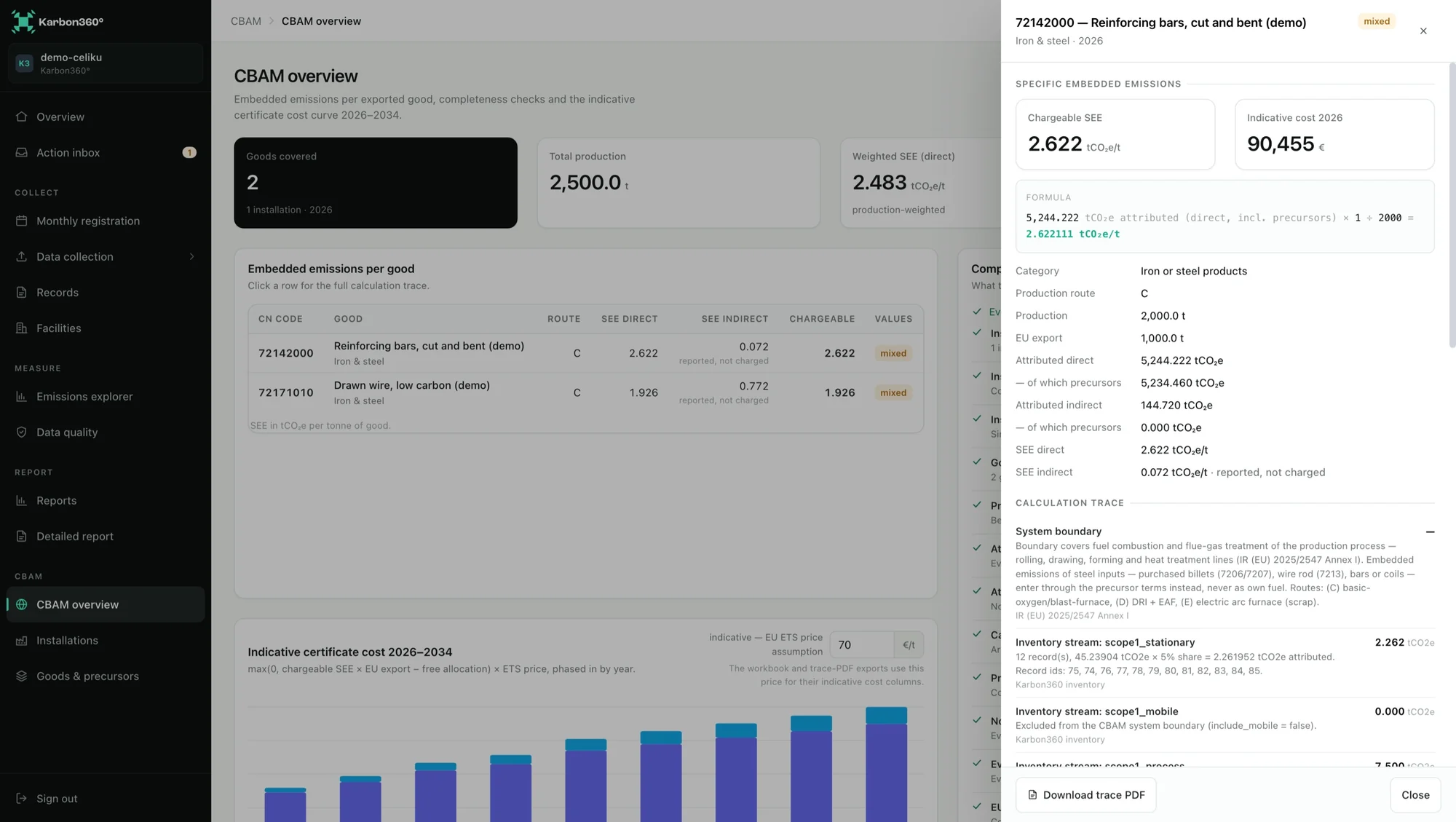
Karbon360 is built for the operator side. It calculates specific embedded emissions per good under IR (EU) 2025/2547, records the production route and precursors, and keeps a trace from every figure to the invoice or meter reading behind it, so the accredited verifier and the declarant can follow the arithmetic.
- Operator’s emissions report workbook in the official 2026 shape
- Trace PDF for the verifier
- Commission default values built in for what you cannot yet measure
Frequently asked questions
Who needs to be an authorised CBAM declarant?
Any importer established in the EU, or indirect customs representative, that imports more than 50 tonnes of CBAM goods in a calendar year. Importers of hydrogen and electricity follow separate rules. An importer established outside the EU must appoint an indirect customs representative in a Member State.
How do I apply for authorised CBAM declarant status?
Through the Authorisation Management Module of the CBAM Registry, signed in with EU Login and two-factor authentication, using the company’s EORI number. The national competent authority of the Member State where you are established decides on the application.
Can a company outside the EU be an authorised CBAM declarant?
No. The status requires establishment in an EU Member State. A producer outside the EU acts as the operator of an installation: it supplies verified embedded emissions data that its declarant can use instead of default values.
What happened to importers who missed the 31 March 2026 deadline?
Importers that applied by 31 March 2026 could keep importing while their application was assessed. Those that did not cannot import CBAM goods above the 50-tonne threshold until they hold the status.
Does a non-EU operator have to register in the CBAM Registry?
No, registration in the O3CI portal is voluntary. The Commission recommends it, because a registered operator uploads its data once, shares it with every declarant after verification and keeps confidential detail out of view.
- European Commission — CBAM Registry and reporting
- European Commission — CBAM legislation and guidance
- Regulation (EU) 2023/956 establishing the CBAM (EUR-Lex)
- Regulation (EU) 2025/2083 simplifying and strengthening CBAM (EUR-Lex)
- Implementing Regulation (EU) 2025/486 on the status of authorised CBAM declarant (EUR-Lex)
- EPA Ireland (national competent authority) — applying for and managing your authorisation
Be the installation whose data a declarant can file.
Embedded emissions calculated under IR (EU) 2025/2547, a trace behind every figure and a report in the shape the regulation sets.