
CBAM default values by country. What your EU buyer declares when you send no data.
The Commission publishes a default value for every CBAM good and every listed country of production. An importer who has no actual data from your plant declares that number, plus a mark-up that rises every year. These pages show the values that apply to goods made in Bosnia and Herzegovina, North Macedonia, Albania, Montenegro and Kosovo.
Last updated: 4 November 2026 · Values checked on EUR-Lex against the corrected Annex I
Default values are set so that embedded emissions are not underestimated — which is why they are rarely the cheapest number your buyer can declare.
Recital 3 of Implementing Regulation (EU) 2025/2621 calls for “a conservative approach”.
What CBAM default values are and when they apply.
What CBAM default values are
A CBAM default value is the specific embedded emissions figure, in tonnes of CO₂e per tonne of good, that the European Commission publishes for a CBAM good from a given country of production. It stands in for the actual emissions of the installation that made the good.
The values sit in Annex I of Implementing Regulation (EU) 2025/2621, which applies from 1 January 2026. Annex I has one table per listed country and a final table called “Other countries and territories”. Each row gives a CN or TARIC code, a description, and three values: direct emissions, indirect emissions and total emissions. A last column shows the production route that decides the CBAM benchmark, for example (C) carbon steel from a blast furnace route or (K) primary aluminium.
Three more annexes complete the set: Annex II gives default factors for indirect emissions, Annex III gives default values for electricity imported as a good, and Annex IV gives the values for a precursor whose country of production cannot be identified.
How the Commission sets them
The method comes from Annex IV of Regulation (EU) 2023/956 and is explained in the recitals of the implementing regulation:
- Values are based on the most up-to-date and reliable information for each exporting country.
- Where neither data from the Joint Research Centre nor data collected in the transitional period is reliable enough, the value is the average of the ten exporting countries with the highest emission intensities for that type of good.
- A mark-up is then added to cover installations that emit more than their country’s average. It is based on how far EU installations deviate from the EU average.
The regulation says the default values and mark-ups will be revised in 2027 at the latest.
When an importer may use them
Since the 2025 simplification (Regulation (EU) 2025/2083), Article 7(2) of the CBAM Regulation lets embedded emissions in goods other than electricity be determined either from actual emissions or by reference to default values. The authorised CBAM declarant may therefore declare default values for any good. Actual emissions must be verified by an accredited verifier before they can be declared.
Which table applies is set out at the top of Annex I:
- If the country of production is listed and the good has a value, that value applies.
- If the country is not listed, or is listed but the field shows “–”, the value from “Other countries and territories” applies.
- For a precursor whose country of production cannot be identified, Annex IV applies: the value of the third country with the highest emission intensity for that precursor.
An operator can also mix the two: actual emissions for its own processes and default values for a purchased precursor, under Article 15 of Implementing Regulation (EU) 2025/2547.
The correction in Implementing Regulation (EU) 2026/1740
On 20 July 2026 the Commission adopted Implementing Regulation (EU) 2026/1740, published in the Official Journal on 31 July 2026. It replaces Annexes I and IV of IR (EU) 2025/2621 in full and applies retroactively from 1 January 2026. The changes that matter in the Western Balkans:
- The printed mark-up columns are gone. The final marked-up value is now calculated in the CBAM Registry from the “total emissions” column. The direct and indirect columns are given for information only.
- Albania gained a value for ferro-chromium (CN 7202 41), which had been omitted and had defaulted to the “Other countries and territories” table.
- Clinker and cement are split by TARIC code into white and grey (2523 10 00 10 / 90 and 2523 90 00 10 / 90), and calcined clay became TARIC 2507 00 80 80.
- Units are stated on every column, and missing or wrong production route letters were added or fixed.
Every table on these pages is taken from the corrected Annex I.
How the mark-up phases in.
The mark-up is applied to the total-emissions default. The longer an importer relies on defaults, the more each tonne costs.
+10% on the default
Cement, iron and steel, aluminium, hydrogen
+20% on the default
Same sectors
+30% on the default
Until the values are revised
+1%, flat
From 2026 onwards
Default values for the same goods, five countries.
Base values in tCO₂e per tonne of good, before the mark-up. Where a country has no value of its own, the “Other countries and territories” value applies, and it is usually the highest in the row.
CBAM default values, total emissions (tCO₂e/t)
Annex I · corrected| Good (CN / TARIC) | Bosnia and Herzegovina | North Macedonia | Albania | Montenegro | Kosovo |
|---|---|---|---|---|---|
Reinforcing bar 7214 20 00 | 2.340 | 1.530 | 3.996 (other countries table) | 3.996 (other countries table) | 3.996 (other countries table) |
Wire rod 7213 | 2.340 | 1.530 | 3.996 (other countries table) | 3.996 (other countries table) | 3.996 (other countries table) |
Steel structures 7308 | 2.850 | 2.690 | 5.064 (other countries table) | 5.064 (other countries table) | 5.064 (other countries table) |
Unwrought aluminium 7601 | 1.700 | 2.203 (other countries table) | 2.203 (other countries table) | 1.700 | 2.203 (other countries table) |
Aluminium profiles 7604 10 90 | 3.059 | 3.251 (other countries table) | 3.251 (other countries table) | 2.290 | 3.251 (other countries table) |
Aluminium doors and windows 7610 10 00 | 3.721 | 3.212 (other countries table) | 3.212 (other countries table) | 2.290 | 3.212 (other countries table) |
Ferro-nickel 7202 60 00 | 4.014 (other countries table) | 3.480 | 4.014 (other countries table) | 3.480 | 4.014 (other countries table) |
Ferro-chromium, over 4% C 7202 41 | 2.350 (other countries table) | 2.350 | 2.350 | 2.350 | 2.350 (other countries table) |
Grey clinker 2523 10 00 90 | 0.920 | 0.910 | 0.870 | 1.410 (other countries table) | 1.410 (other countries table) |
Grey Portland cement 2523 29 00 | 0.980 | 0.960 | 0.930 | 1.440 (other countries table) | 1.440 (other countries table) |
Ammonium nitrate 3102 30 90 | 2.670 | 2.670 | 2.620 | 2.750 (other countries table) | 2.750 (other countries table) |
Open the full table for your country.
Each page lists the default values for the goods that country actually exports, with the 2026, 2027 and 2028 mark-ups worked out.
Bosnia and Herzegovina
North Macedonia
Albania
Montenegro
Kosovo
Default values versus actual data
Why actual data usually beats the default.
The default is marked up, your data is not
Actual emissions go into the declaration as calculated and verified. A default goes in with 10% added in 2026, 20% in 2027 and 30% from 2028. Even for a plant whose actual emissions only equal the base default, the marked-up default from 2028 is 30% higher than what it declares.
Unlisted countries get the high table
Kosovo is not listed at all, and Albania, Montenegro and North Macedonia have no values for some sectors. Goods from those countries take the “Other countries and territories” value. For reinforcing bar that is 3.996 tCO₂e/t against 2.340 for Bosnia and Herzegovina and 1.530 for North Macedonia.
The default assumes a route you may not use
Most steel defaults outside North Macedonia carry route (C), carbon steel from a blast furnace and basic oxygen furnace. A plant that melts scrap in an electric arc furnace, or that only rolls and finishes bought-in billets, has a different emissions profile. A default cannot see that difference. Actual data can.
Hydro-heavy grids and indirect emissions
For cement and fertilisers, indirect emissions from electricity are part of the charge. The default indirect value assumes a typical electricity consumption per tonne. With actual data, indirect emissions come from your own metered consumption multiplied by the country’s electricity emission factor, so an efficient plant on a hydro-heavy grid, such as Albania’s, carries little indirect emissions. Iron and steel, aluminium and hydrogen are charged on direct emissions only, which is why their indirect column reads N/A.
The grid factors themselves are explained on electricity emission factors by country.
Put your actual SEE next to the default.
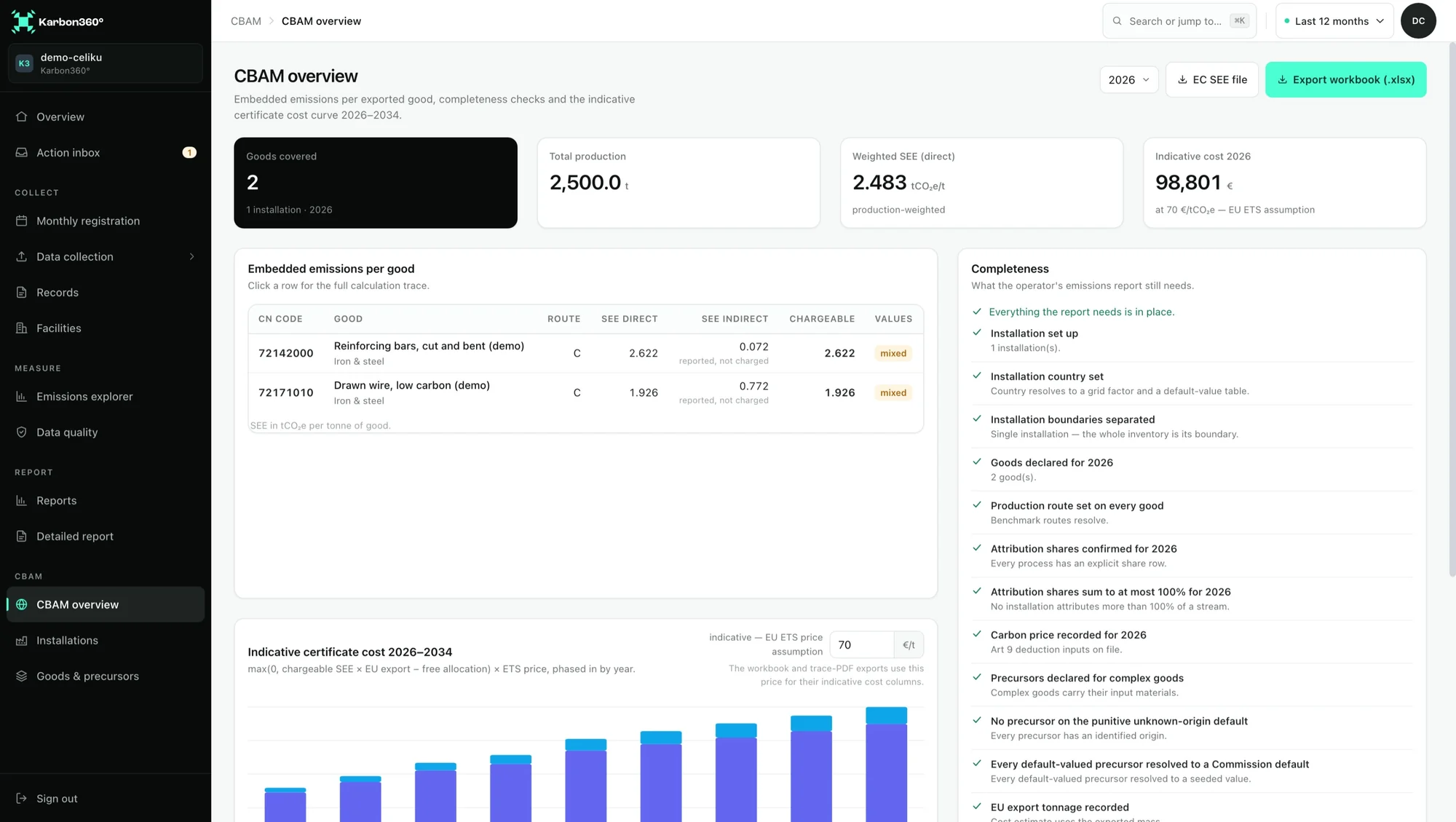
Karbon360 calculates the specific embedded emissions of each good from your installation’s own records, under Implementing Regulation (EU) 2025/2547, and shows the Commission default for the same CN code and country beside it. Where you still lack data for a precursor, the default fills the gap and is labelled as a default in the trace.
- Commission default values built in, per CN code and country
- Mark-up applied by year: 2026, 2027, 2028 onwards
- Trace PDF for your buyer’s verifier
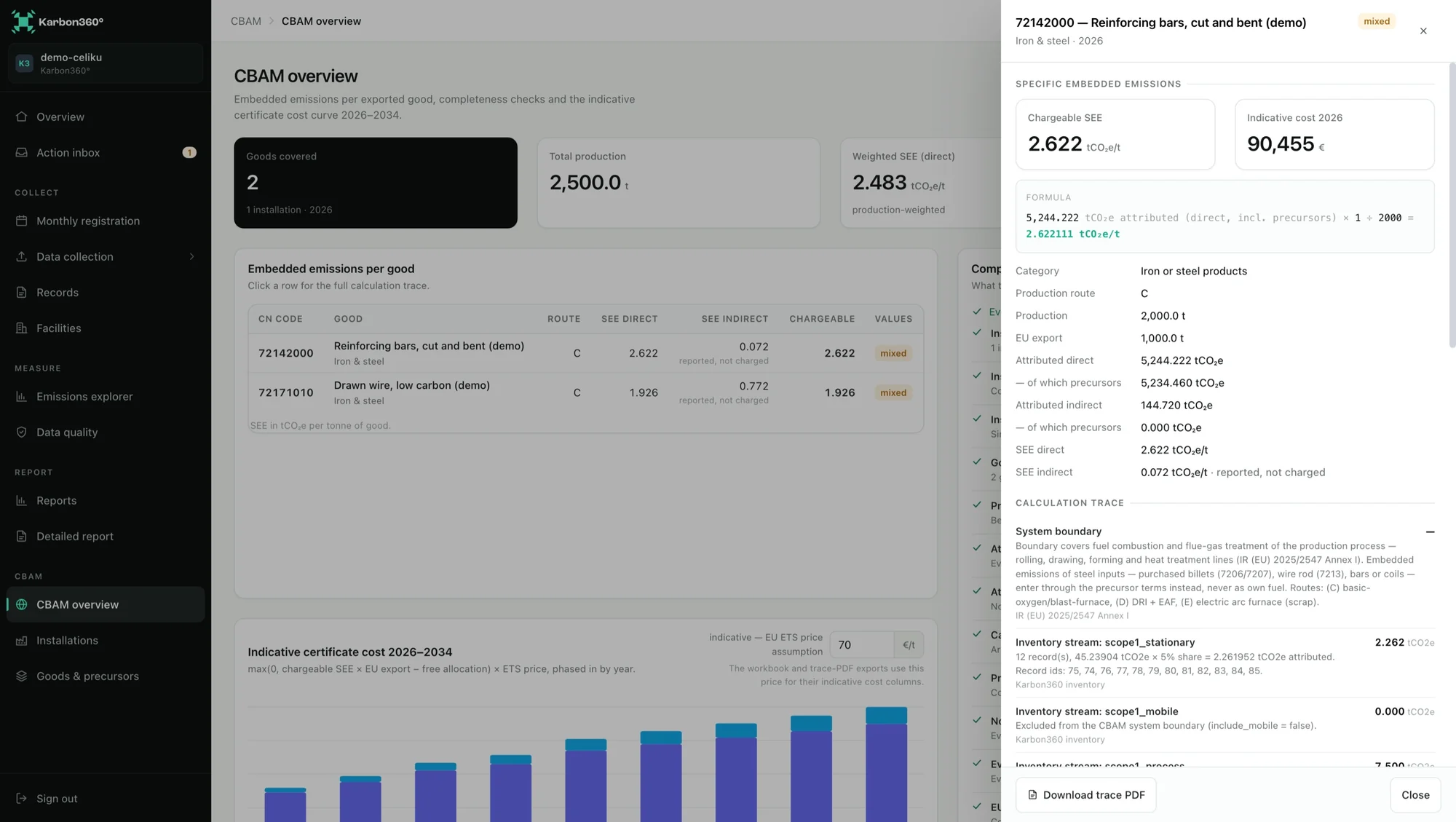
= 2.622111 tCO₂e/t
Frequently asked questions
What are CBAM default values?
They are the specific embedded emissions per tonne of good that the European Commission publishes per CN code and country of production, in Annex I of Implementing Regulation (EU) 2025/2621. An importer uses them when it does not declare actual emissions from the installation that made the goods.
How does the CBAM default value mark-up work?
The total-emissions default is increased by 10% in 2026, 20% in 2027 and 30% from 2028 onwards for cement, iron and steel, aluminium and hydrogen. Fertilisers carry 1% from 2026 onwards. Since the August 2026 correction the CBAM Registry calculates the marked-up value; the annex no longer prints it.
Is there an official CBAM default values Excel?
The legal source is the regulation itself on EUR-Lex: Annex I of IR (EU) 2025/2621 as replaced by IR (EU) 2026/1740. Any spreadsheet, including ours, is a copy of those tables. Check the version before you rely on it, because the August 2026 correction changed several rows.
My country is not in the list. Which value applies?
The table “Other countries and territories”. The same applies when your country is listed but the field for your good shows “–”. Kosovo is the clearest case in the region: it has no table in Annex I, so all Kosovo-origin goods use the other countries values.
Can my buyer just use the default instead of asking me for data?
Yes. Since Regulation (EU) 2025/2083, the declarant may choose default values. Whether that is wise depends on the gap: the declarant pays certificates on whichever figure it declares, and the default is marked up every year.
Do default values include electricity?
For cement and fertilisers, the total includes indirect emissions from electricity. For iron and steel, aluminium and hydrogen only direct emissions count, so the indirect column shows N/A. Electricity imported as a good has its own default values in Annex III.
- Implementing Regulation (EU) 2025/2621 — CBAM default values (EUR-Lex)
- Implementing Regulation (EU) 2026/1740 — correction of Annexes I and IV (EUR-Lex)
- Regulation (EU) 2023/956 establishing the CBAM (EUR-Lex)
- Regulation (EU) 2025/2083 simplifying the CBAM (EUR-Lex)
- Implementing Regulation (EU) 2025/2547 — calculation of embedded emissions (EUR-Lex)
- European Commission — Carbon Border Adjustment Mechanism
Find out how far your data is below the default.
Your installation’s records, the Commission default for each CN code and the mark-up for each year, side by side, with the trace your buyer’s verifier will follow.