
CBAM indirect emissions: counted for cement and fertilisers, not for steel and aluminium.
In CBAM, indirect emissions are the emissions from producing the electricity your plant consumes. In the definitive period they are part of the embedded emissions of cement and fertiliser goods, and of sintered ore. For iron and steel, aluminium and hydrogen, only direct emissions count. Which side your CN code falls on decides whether your grid shows up in your buyer’s certificate bill.
Published 4 November 2026 · Reflects the Commission guidance documents of 14 August 2026
The same kWh is part of the price of a tonne of cement and only a reported figure on a tonne of steel.
Direct vs indirect emissions in CBAM.
What direct and indirect emissions mean in CBAM
The CBAM Regulation and the Commission’s definitive-period guidance use two terms that sound like Scope 1 and Scope 2 but are not the same thing:
- Direct emissions are emissions from the production processes of goods, including emissions from producing the heating and cooling consumed in those processes, wherever that heat or cooling was produced.
- Indirect emissions are emissions from producing the electricity consumed in the production processes of goods, wherever that electricity was produced.
So steam bought from a neighbouring plant, which a GHG inventory reports under Scope 2, is a direct emission in CBAM. Only electricity is indirect. If your installation produces its own electricity, the fuel burned for it is a direct emission of the installation, but electricity production is treated as its own production process.
Which CBAM goods carry indirect emissions
Article 7 of Regulation (EU) 2023/956 and Article 3(2) of Implementing Regulation (EU) 2025/2547 (the Methodology Act) set the rule: indirect emissions are included for goods listed in Annex I to the CBAM Regulation and not listed in Annex II. Annex II is the list of goods for which only direct emissions are taken into account.
| Sector | Indirect emissions in embedded emissions? |
|---|---|
| Cement | Yes, direct and indirect |
| Fertilisers | Yes, direct and indirect |
| Iron and steel | No, direct only. Exception: sintered ore (CN 2601 12 00), which includes indirect |
| Aluminium | No, direct only |
| Hydrogen | No, direct only |
| Electricity imported as a good | Direct emissions only |
Indirect emissions inside precursors
Embedded emissions of a complex good include the embedded emissions of its precursors, and the indirect rule is applied to each precursor on its own terms:
- If the complex good is in Annex II but uses a precursor that is not, the precursor’s indirect emissions are still included. Sintered ore is the common case: its indirect emissions travel into pig iron, crude steel and finished steel products even though those goods are direct-only.
- If the complex good is not in Annex II but uses a precursor that is, the precursor’s indirect emissions are left out. Ammonia counts indirect emissions, but the indirect emissions of hydrogen used to make it are not counted.
Precursors produced in the EU, or in the countries exempted in point 1 of Annex III to the CBAM Regulation, count as zero embedded emissions, direct and indirect.
Why steel and aluminium plants still meter electricity
A steel or aluminium producer outside the EU pays nothing on its electricity under today’s rules. There are still three reasons to keep the indirect number:
- The scope is under review. Article 30 of the CBAM Regulation requires the Commission to assess extending CBAM to the indirect emissions of the goods listed in Annex II. No such extension has been adopted as of November 2026, but a plant that already has metered, attributed electricity data is not starting from zero if it is.
- Your buyer’s own reporting uses the total. An EU customer that reports Scope 3 or asks for a product carbon footprint needs your electricity, whether or not CBAM prices it.
- Electricity is in the energy balance. The Commission’s iron and steel guidance notes that electricity may still be consumed and recorded for operational and energy-balance purposes even where it is not part of embedded emissions.
Why coal-heavy Balkan grids make this the sharpest CBAM question in the region.
For electricity taken from the grid, the default is the Commission’s emission factor for the grid of the country of production, published in Annex II to Implementing Regulation (EU) 2025/2621 and based on International Energy Agency data. A plant may use the actual factor of a specific power plant only if it is directly connected to it or holds a power purchase agreement, and the power plant’s emissions are monitored and verified under the same rules. Where electricity comes from several sources, the factor is a weighted average.
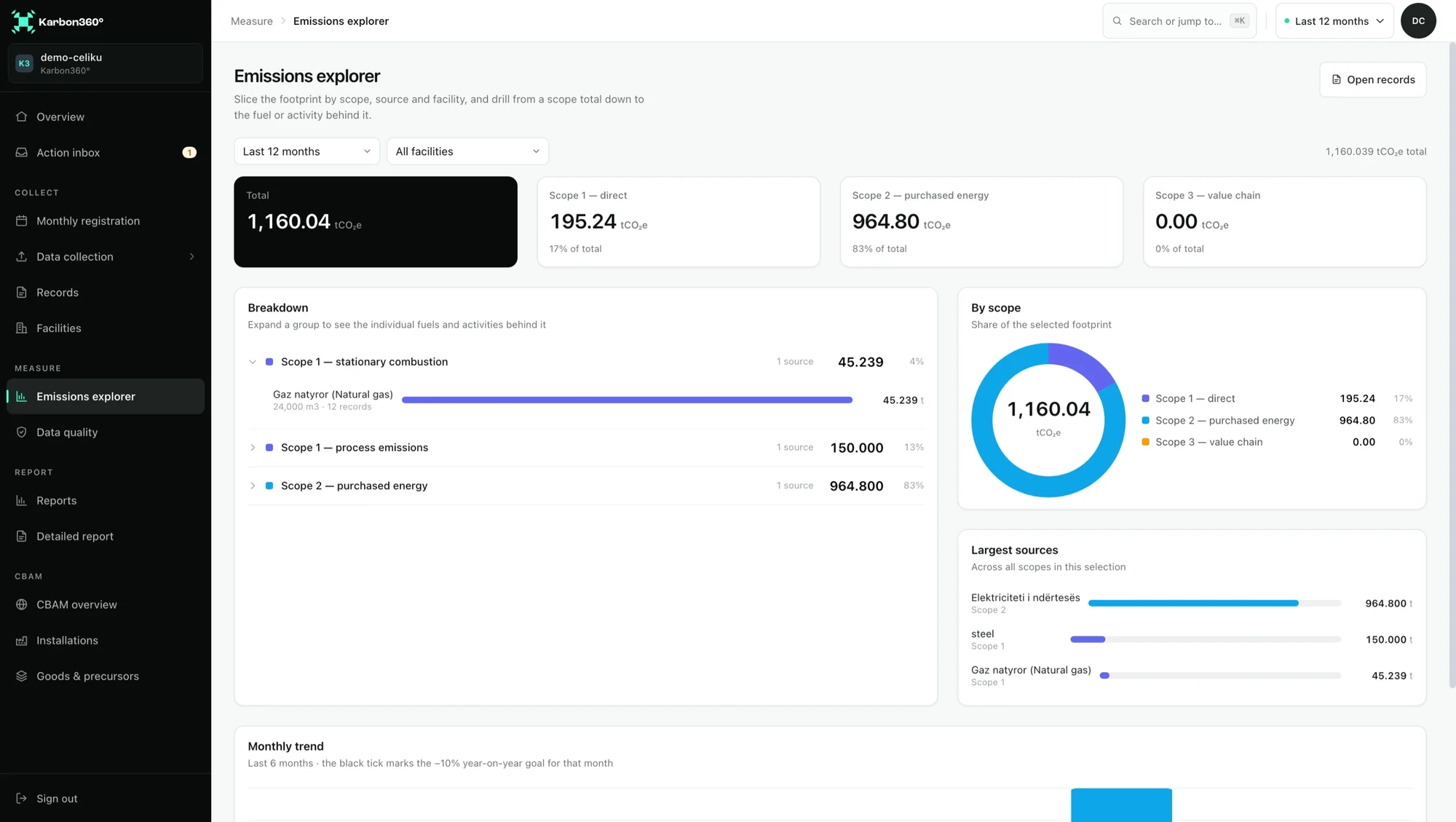
Western Balkan grids range from hydro-heavy to lignite-heavy, and the same kWh carries very different emissions depending on where it was bought. For a cement or fertiliser plant that difference goes straight into the certificate bill. For a steel plant it goes into every Scope 2 figure and product footprint its buyers ask for. In the demonstration steel inventory on the right, purchased electricity is 83% of the total.
- Default grid factor: country of production, Annex II of the Default Values Act
- Actual factor: direct line or power purchase agreement, with verified data
- Guarantees of origin: not accepted
What the Commission assumes for electricity, by country.
The Commission’s default values split each good into a direct and an indirect column. For cement and fertilisers the indirect column is filled in; for iron and steel it reads N/A. Values in tCO₂e per tonne of good, before the default-value mark-up.
Direct · indirect · total, selected goods
IR (EU) 2026/1740| Good (CN) | Country table | Direct | Indirect | Total |
|---|---|---|---|---|
| Grey Portland cement (2523 29 00) | Albania | 0.900 | 0.030 | 0.930 |
| Grey Portland cement (2523 29 00) | Bosnia and Herzegovina | 0.880 | 0.100 | 0.980 |
| Grey Portland cement (2523 29 00) | North Macedonia | 0.870 | 0.090 | 0.960 |
| Grey Portland cement (2523 29 00) | Other countries and territories | 1.360 | 0.080 | 1.440 |
| Ammonium nitrate (3102 30 90) | Bosnia and Herzegovina | 2.520 | 0.150 | 2.670 |
| Reinforcing bars (7214 20 00) | Bosnia and Herzegovina | 2.340 | N/A | 2.340 |
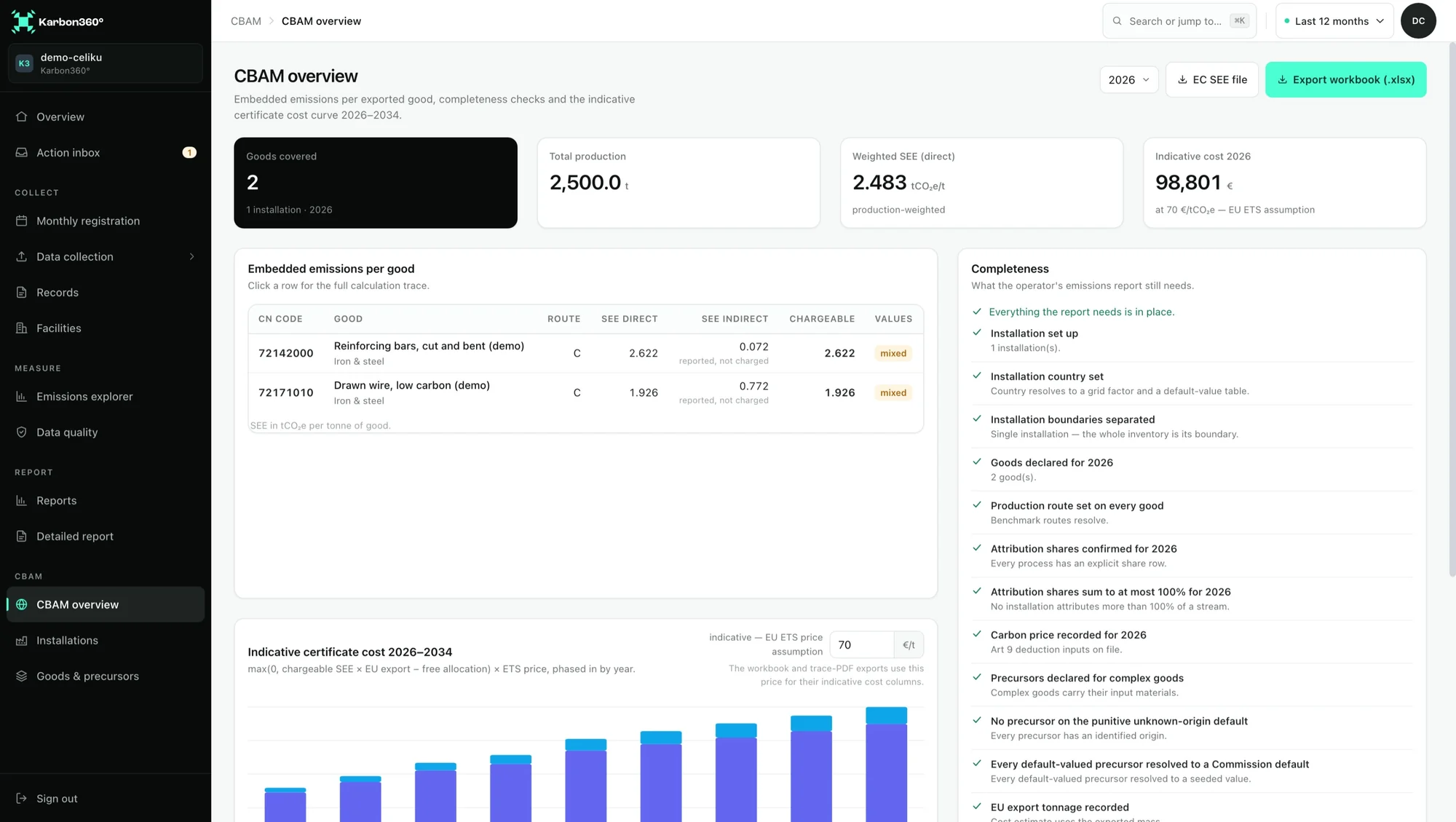
SEE indirect: reported, not charged.
Every good in the CBAM module shows three numbers side by side: specific embedded emissions direct, specific embedded emissions indirect, and the chargeable value your importer’s declarant files. For an iron and steel good, the chargeable column equals the direct value and the indirect value carries the label reported, not charged, so nobody mistakes it for part of the bill and nobody loses it either.
Open the good and the calculation trace shows the attributed indirect emissions, the share that came in through precursors, and the grid factor the installation’s country resolved to.
- Attributed indirect emissions shown per good, with the precursor share as its own line
- Grid factor resolved from the installation country
- Operator’s emissions report workbook in the official 2026 shape
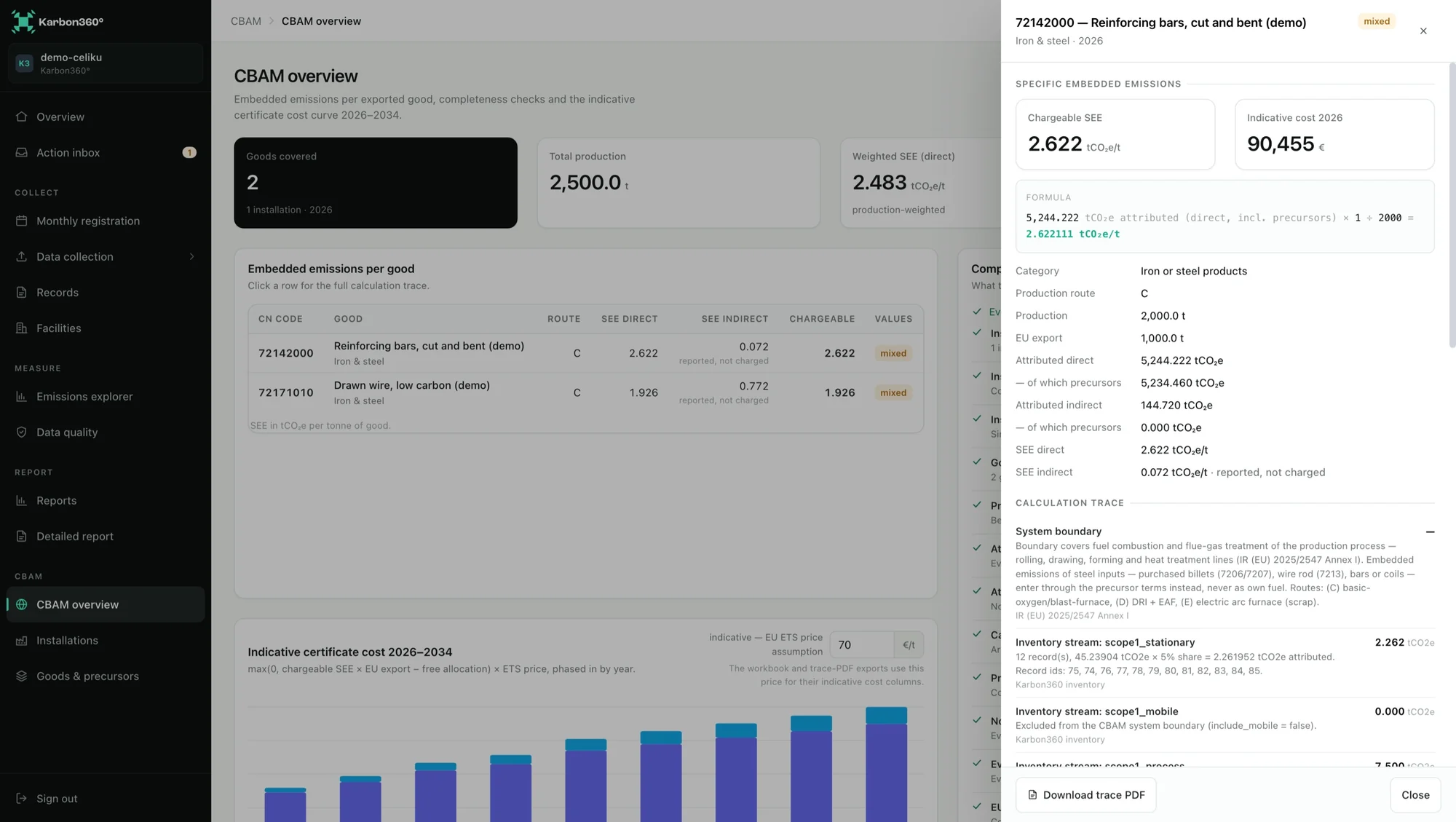
SEE indirect 0.072 · reported, not charged
Chargeable 2.622 tCO₂e/t
Working out the indirect part for one good
Check Annex II
Meter the electricity
Choose the factor
Attribute and divide
Frequently asked questions
What are indirect emissions in CBAM?
Emissions from producing the electricity consumed in the production processes of a good, wherever that electricity was produced. Heat and cooling, even when bought in, are direct emissions under CBAM.
Are indirect emissions included for steel under CBAM?
No. Iron and steel goods are listed in Annex II to Regulation (EU) 2023/956, so only direct emissions are taken into account in the definitive period. The exception is sintered ore (CN 2601 12 00), whose indirect emissions are included and carried into the steel goods made from it.
Which CBAM goods include indirect emissions?
Cement and fertiliser goods, and sintered ore. They are listed in Annex I to the CBAM Regulation but not in Annex II. Aluminium, hydrogen and most iron and steel goods are direct-only, and electricity imported as a good is declared on direct emissions.
Which electricity emission factor does CBAM use?
For grid electricity, the default factor for the country of production in Annex II to Implementing Regulation (EU) 2025/2621. An actual factor from a specific power plant may be used only with a direct connection or a power purchase agreement, and with that plant’s emissions monitored and verified. Guarantees of origin and green certificates are not accepted.
Did the transitional period treat indirect emissions differently?
Yes. From October 2023 to December 2025 indirect emissions had to be reported for every CBAM good. Since 1 January 2026 they count only for goods outside Annex II.
Should a steel exporter still calculate indirect emissions?
It is worth keeping. Article 30 of the CBAM Regulation asks the Commission to assess extending the scope to indirect emissions of Annex II goods, and EU buyers ask for the electricity part of your footprint for their own reporting. Karbon360 keeps it visible on every good and marks it as reported, not charged.
- European Commission — CBAM legislation and guidance
- Commission Guidance No. 3 — CBAM methods for the calculation of emissions embedded in goods (14 August 2026)
- Commission Guidance No. 5d — Sector-specific guidance on iron and steel
- Regulation (EU) 2023/956 establishing the CBAM (EUR-Lex)
- Implementing Regulation (EU) 2025/2547, the Methodology Act (EUR-Lex)
- Implementing Regulation (EU) 2025/2621 on default values (EUR-Lex)
Keep the indirect number, even where nobody pays for it yet.
Karbon360 calculates direct and indirect embedded emissions per good from your metered electricity and the factor for your installation’s country, and shows which part is charged.