
CBAM calculator. What your EU buyer pays on your goods, year by year.
A CBAM cost calculator for exporters: enter the tonnes you ship to the EU and the embedded emissions per tonne, and see the indicative certificate cost from 2026 to 2034 as free allocation is phased out.
Last updated: November 2026 · Certificate prices as published by the European Commission
Estimate the CBAM cost on your exports
Your EU importer pays this in certificates. It is calculated from your embedded emissions, so your data decides the number.
2.000 tCO₂e/t chargeable after the 97.5% free-allocation adjustment
Indicative only. The real obligation uses the benchmark and default values the Commission publishes for each CN code, and your verified installation data. Karbon360 calculates it per good with the full trace.
Calculate it from your own dataHow a CBAM cost is calculated.
For each good and year, the number of certificates comes from three things: how much was imported, how much carbon is embedded in each tonne, and how much of that an EU producer would still receive free.
Embedded emissions, minus free allocation, times the price
The CBAM certificates an importer surrenders for a good are its imported quantity multiplied by its specific embedded emissions, reduced by the specific embedded free allocation, and, where relevant, reduced by the carbon price already effectively paid in the country of origin. A negative result counts as zero.
certificates = tonnes × (SEE − benchmark × CBAM factor)
               − carbon price already paid (in certificate equivalents)
cost         = certificates × certificate price
The calculator above runs exactly that, for every year from 2026 to 2034. The official adjustment in Implementing Regulation (EU) 2025/2620 also applies the EU ETS cross-sectoral correction factor; the calculator leaves it out, which makes the result slightly conservative.
What each input means
- Tonnes exported to the EU per year. The net mass your importers bring in, per good. The 50-tonne exemption is judged on each importer’s total imports, not your production.
- Specific embedded emissions (SEE). tCO₂e per tonne of good, including its precursors. For iron and steel, aluminium and hydrogen the chargeable part is direct emissions only; for cement and fertilisers, direct and indirect.
- Benchmark. The CBAM benchmark for the CN code and production route, set in the annex to Implementing Regulation (EU) 2025/2620. Leave it at 0 for an upper bound if you do not know it.
- Certificate price. In 2026 the Commission publishes one price per quarter, the volume-weighted average of EU ETS auction prices; from 2027 it publishes a weekly price.
- Carbon price already paid at home. Only a carbon price effectively paid in the country of origin counts, net of any rebate or free allowance. The Commission planned an implementing act in 2026 on how the deduction is evidenced and converted.
- Import year. Selects the CBAM factor for that year.
When default values apply
If your importer has no verified actual data from your installation, they declare the Commission’s default value for the good and the country of origin, set in Annex I to Implementing Regulation (EU) 2025/2621. Defaults are country- and year-specific, and from 2026 they carry a mark-up: 10% in 2026, 20% in 2027 and 30% from 2028, with 1% for fertilisers. Where a country or good is not listed, the table for other countries and territories applies.
Example from the published annex: aluminium structures from Bosnia and Herzegovina (CN 7610) have a base default of 3.721 tCO₂e per tonne, declared as 4.093 in 2026, 4.465 in 2027 and 4.837 from 2028. At the Q1 2026 price of €75.36, 4.093 tCO₂e per tonne works out at €308.45 per tonne of goods before the free-allocation adjustment.
The CBAM factor, year by year.
The CBAM factor is the share of free allocation EU producers in CBAM sectors still receive. As it falls, the part of your embedded emissions your importer pays for rises.
CBAM factor under Article 10a(1a) of Directive 2003/87/EC
Law in force| Year | CBAM factor | Share of the benchmark that is no longer free |
|---|---|---|
| 2026 | 97.5% | 2.5% |
| 2027 | 95% | 5% |
| 2028 | 90% | 10% |
| 2029 | 77.5% | 22.5% |
| 2030 | 51.5% | 48.5% |
| 2031 | 39% | 61% |
| 2032 | 26.5% | 73.5% |
| 2033 | 14% | 86% |
| 2034 | 0% | 100% |
The calculator gives you a range. Karbon360 gives you the number.
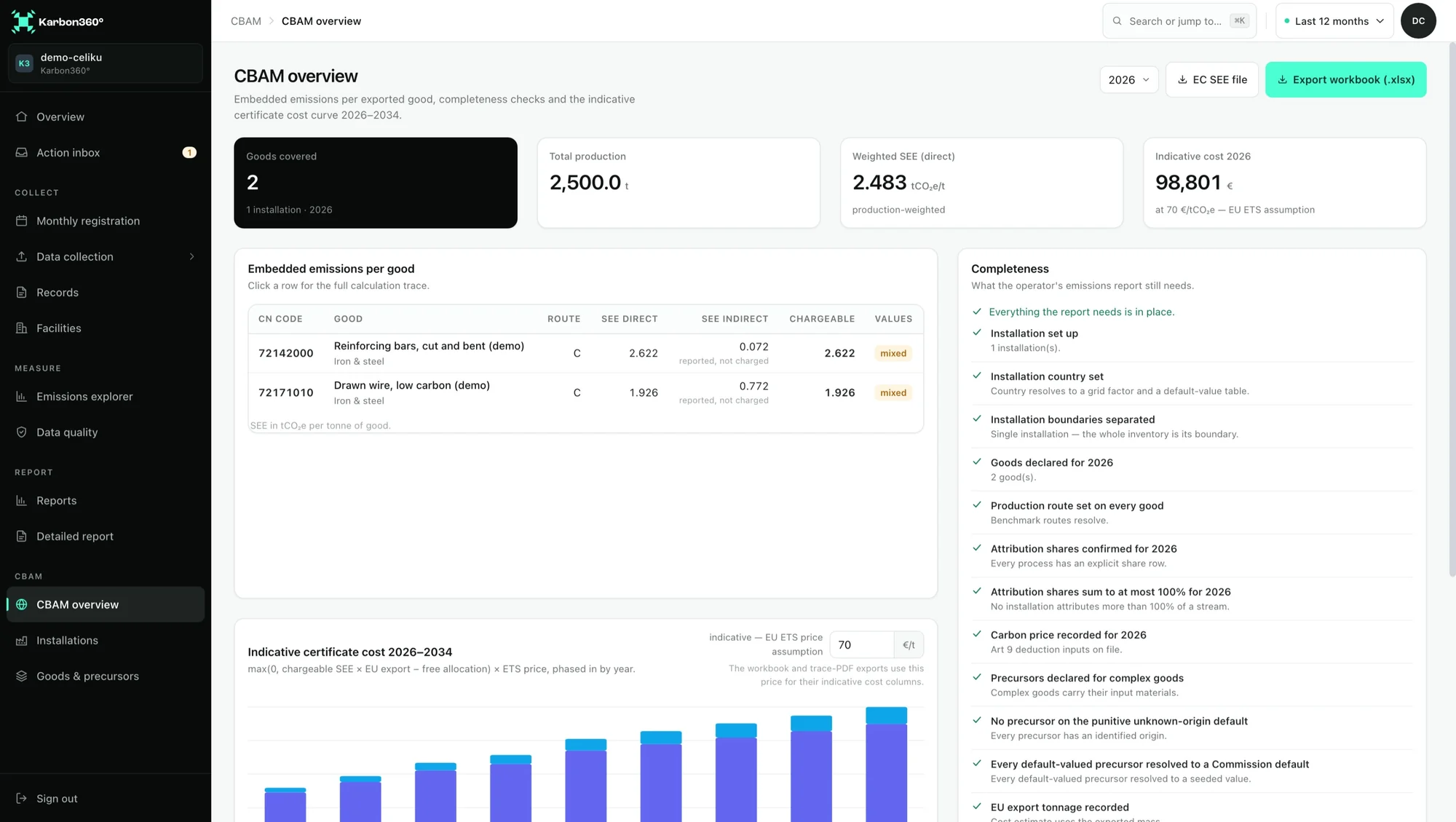
The calculator needs you to know your embedded emissions. Karbon360 calculates them: installation, production processes, goods and precursors per CN code, the benchmark for each good and route, Commission default values where you lack data, and the indicative cost curve to 2034 — with the trace behind every figure.
- Specific embedded emissions per good, per Implementing Regulation (EU) 2025/2547
- Benchmarks and defaults per CN code, versioned
- Cost curve your sales team can show the buyer
CBAM cost calculator questions.
Who pays the CBAM cost — me or my buyer?
Your EU buyer, the authorised CBAM declarant, buys and surrenders the certificates. But the number is calculated from your embedded emissions, so it shows up in how your goods compare with another supplier’s.
Why is the 2026 cost so low?
Because the CBAM factor is 97.5% in 2026: most of the benchmark is still deducted as free allocation. The deduction shrinks every year and reaches zero in 2034 under the law in force, so the same goods cost more each year.
Where do I find the benchmark for my CN code?
In the annex to Implementing Regulation (EU) 2025/2620, by CN code and production route. Different columns apply depending on whether actual emissions or default values are declared. If you leave it at 0, the calculator shows an upper bound.
Which certificate price should I use?
For 2026 imports, the quarterly price the Commission published for the quarter of import: €75.36 for Q1, €75.28 for Q2 and €82.32 for Q3. From 2027 prices are published weekly.
Can carbon tax paid in my country reduce the cost?
Yes, if it is a carbon price effectively paid in the country of origin on those emissions, with evidence. Rebates and free allowances reduce what counts. Enter it in € per tCO₂e and the calculator subtracts it from the certificate price.
Is the calculator result what my buyer will actually pay?
No. It is indicative. The real obligation uses the verified data from your installation or the Commission’s defaults for each CN code, the official benchmark and correction factor, and the price for the period of import.
- European Commission — Price of CBAM certificates
- European Commission — CBAM Questions and Answers (definitive period)
- Implementing Regulation (EU) 2025/2620 — free allocation adjustment and benchmarks (EUR-Lex)
- Implementing Regulation (EU) 2025/2621 — default values (EUR-Lex)
- Directive (EU) 2023/959 amending the EU ETS Directive (EUR-Lex)
- Commission proposal COM(2026) 616 revising the EU ETS (EUR-Lex)
Replace the estimate with your own number.
Your installation’s data, the benchmark for each good and the Commission’s defaults where you still need them — calculated per CN code, with the trace attached.