
Electricity emission factors by country, for the Western Balkans, with sources.
A grid emission factor turns the kilowatt-hours on your electricity bill into kilograms of CO₂e. Across the Western Balkans it ranges from near zero to more than one kilogram per kWh, so the country you pick decides your largest number. Each factor below is specific to one country and names its source.
Last updated: 4 November 2026 · Ember data downloaded 4 November 2026
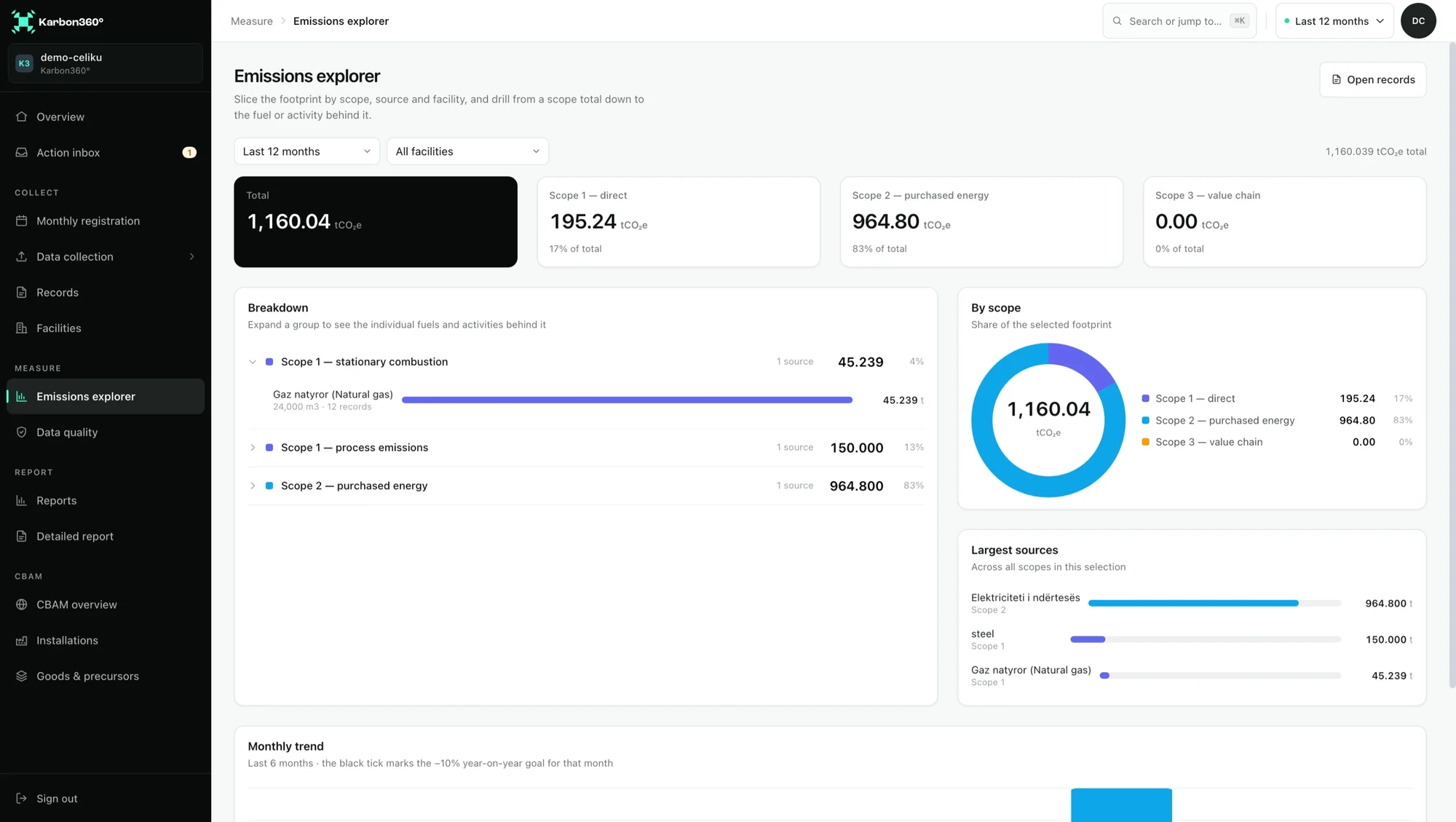
What a grid emission factor is.
What is the emission factor for grid electricity?
A grid emission factor is the average greenhouse gas emitted per unit of electricity, usually stated in kgCO₂e per kWh or tCO₂e per MWh. The calculation is the same for every site: emissions = electricity consumed (kWh) × grid emission factor.
The factor depends on what the grid burns. A grid running on lignite carries a high factor, a grid running on hydropower a low one. That is why a single regional or EU figure misstates the result for any one country.
Location-based and market-based Scope 2
The GHG Protocol Scope 2 Guidance, which sits under the GHG Protocol Corporate Accounting and Reporting Standard, defines two ways to report purchased electricity:
- Location-based: the average emission factor of the grid where the electricity is consumed. This is what the factors on this page are for.
- Market-based: factors from the contracts a company holds, such as supplier-specific rates or energy attribute certificates.
Karbon360 calculates Scope 2 with the location-based method, using the national grid factor of the facility’s country.
Why the right country factor matters
In a Western Balkan factory, Scope 2 is often the largest line in the inventory. Using the EU-27 average of 0.212 kgCO₂e/kWh for a plant in Bosnia and Herzegovina would cut its Scope 2 to about a third of the Ember country figure of 0.602. Using it for a plant in Albania would multiply Scope 2 by about eight. Neither number would survive a buyer’s or a bank’s review.
More on this in why an EU-average grid emission factor misleads Balkan exporters.
Grid emission factors, Western Balkans.
Each value belongs to one country and one source. Kosovo’s factor comes from a different source and year from the Ember series, so read it on its own terms rather than as a like-for-like comparison.
Location-based grid emission factors (kgCO₂e per kWh)
Cited per row| Country | Factor (kgCO₂e/kWh) | Data year | Source | What the figure measures |
|---|---|---|---|---|
| Albania | 0.025 | 2024 | Ember | Emissions intensity of domestic generation, almost all hydro. Electricity imported in dry years is not in the figure. Ember has not yet published a 2025 value. |
| Bosnia and Herzegovina | 0.602 2025: 0.573 | 2024 | Ember | Emissions intensity of domestic generation. |
| Croatia | 0.171 2025: 0.159 | 2024 | Ember | Emissions intensity of domestic generation. |
| Kosovo | 1.34 | 2016 | World Bank / Grütter Consulting | Provisional national grid emission factor for Kosovo. This is the factor Karbon360 applies to Kosovo facilities. |
| Montenegro | 0.422 2025: 0.275 | 2024 | Ember | Emissions intensity of domestic generation. Small grid, so the value moves a lot from year to year. |
| North Macedonia | 0.512 2025: 0.426 | 2024 | Ember | Emissions intensity of domestic generation. |
| EU-27 (for comparison) | 0.212 2025: 0.211 | 2024 | Ember | Emissions intensity of EU generation. |
Grid factors and CBAM indirect emissions.
Which CBAM goods carry indirect emissions
Indirect emissions are the emissions from producing the electricity a CBAM installation consumes. In the definitive period they are part of the charge for cement and fertilisers. For iron and steel, aluminium and hydrogen only direct emissions count, which is why the indirect column of the CBAM default values reads N/A for those goods. The detail by country is on CBAM default values by country.
The CBAM electricity emission factor is a separate number
For indirect emissions CBAM does not use your Scope 2 factor. Annex II of Implementing Regulation (EU) 2025/2621 sets a default emission factor per country, calculated as the simple average of the country’s grid emission factor over the most recent five-year period with reliable data. All five Western Balkan countries, Kosovo included, are listed by name.
The Annex II values are based on International Energy Agency data that the regulation says may be redistributed for non-commercial purposes only, so we do not reprint them here. Read them in the regulation on EUR-Lex.
When an installation can use its own electricity factor
Under Implementing Regulation (EU) 2025/2547, an installation can use the emission factor of a specific power producer instead of the default only where there is a direct technical link to that producer or a power purchase agreement with it, as point 6 of Annex IV to the CBAM Regulation allows. In that case the emissions of that electricity production are monitored to set the factor.
Either way, the consumption figure comes from your own meters and invoices, and that is the half of the calculation you control.
The factor, its source and its version on every record.
The country of each facility selects its grid factor. Open any electricity record and the trace shows the factor that was applied, its value, its version and its source. Factors are not editable by users, so they stay sourced and defensible, and an update never silently changes an earlier record.
- GHG Protocol Corporate Standard inventory, Scope 2 location-based
- Country-specific factor per facility, cited on the record
- Kosovo facilities on 1.34 kgCO₂e/kWh
Frequently asked questions
What is the emission factor for grid electricity?
It is the average CO₂e emitted per kWh of electricity on a given grid. You multiply your consumption by it to get location-based Scope 2 emissions under the GHG Protocol.
What is the electricity emission factor for Albania?
Ember puts Albanian generation at 0.025 kgCO₂e/kWh for 2024, because almost all of it is hydropower. That figure covers domestic generation only; electricity imported in dry years is not included.
What is the electricity emission factor for Kosovo?
Karbon360 uses 1.34 kgCO₂e/kWh, the provisional national grid factor for Kosovo published by the World Bank with Grütter Consulting in 2016.
Is the CBAM electricity emission factor the same as my Scope 2 factor?
No. For CBAM indirect emissions the default factor is set per country in Annex II of Implementing Regulation (EU) 2025/2621, as a five-year average. Your Scope 2 inventory uses a location-based grid factor with its own source and year.
Why did Montenegro’s factor fall so much in 2025?
Ember’s series shows 0.422 for 2024 and 0.275 for 2025, with power-sector emissions falling from 1.50 to 0.67 MtCO₂e between the two years. On a grid that small, a change at a few plants moves the national average a lot, which is why the data year must always travel with the factor.
Where do these figures come from?
Every country factor on this page except Kosovo’s comes from Ember’s Yearly Electricity Data, published under CC BY 4.0. Kosovo’s comes from the World Bank / Grütter Consulting 2016 study. The source is named on each row.
- Ember — Yearly Electricity Data
- Ember — data methodology (PDF)
- Ember — Creative Commons licence (CC BY 4.0)
- GHG Protocol — Scope 2 Guidance
- GHG Protocol — Corporate Accounting and Reporting Standard
- Implementing Regulation (EU) 2025/2621 — Annex II default indirect emission factors (EUR-Lex)
- Implementing Regulation (EU) 2025/2547 — calculation of embedded emissions (EUR-Lex)
See your Scope 2 with your own country’s factor.
Bring one month of electricity bills. The national factor, its source and its version sit on every record.