
CBAM certificate price: how it is set, and the formula behind the cost
One CBAM certificate covers one tonne of CO₂e embedded in imported goods. Its price follows the EU ETS auction price: four quarterly prices for 2026, then a new price every week from 2027. The cost to an importer is that price multiplied by the certificates it owes, and the number of certificates starts at the exporter’s plant.
Published 4 November 2026 · Prices as published by the European Commission up to 5 October 2026
A CBAM certificate is the unit an authorised CBAM declarant surrenders for each tonne of CO₂e embedded in the goods it imports, after the free allocation adjustment and any carbon price already paid abroad. This guide explains how the European Commission sets the price, which prices apply to 2026 imports, when certificates can be bought and surrendered, and how the cost is calculated, with a worked example that is labelled as an illustration.
How the CBAM certificate price is set
The price is not set by a market for CBAM certificates. Under Article 21 of Regulation (EU) 2023/956 the Commission calculates it as the weighted average of the auction clearing prices of EU ETS allowances over the relevant period. The detailed method and the publication rules are in Implementing Regulation (EU) 2025/2548 on the calculation and publication of CBAM certificate prices.
Tying the price to EU ETS auctions is the point of the mechanism: an importer pays for embedded emissions at the same carbon price an EU producer pays for its own.
CBAM certificate prices for 2026
For 2026 the Commission publishes four quarterly prices. Each is calculated in the first calendar week after the quarter ends and applies to the certificates corresponding to emissions in CBAM goods imported during that quarter.
| Quarter of import | Published | Price per certificate |
|---|---|---|
| Q1 2026 | 7 April 2026 | €75.36 |
| Q2 2026 | 6 July 2026 | €75.28 |
| Q3 2026 | 5 October 2026 | €82.32 |
| Q4 2026 | 4 January 2027 | Not yet published |
So two consignments of the same good imported in March and in August 2026 are priced differently, even though both certificates are bought in 2027.
From 2027: weekly prices
From 2027 onwards the Commission calculates and publishes a weekly price. Goods imported in 2027 and later are therefore priced closer to the EU ETS market at the time certificates are bought. Nobody can tell you that price in advance; any forward number is an assumption about the EU ETS, and should be presented as one.
When certificates are bought and surrendered
- From February 2027 authorised declarants buy certificates on the common central platform under Article 20 of the CBAM Regulation, starting with those for 2026 imports.
- By 30 September 2027 the declarant files its first annual CBAM declaration, covering 2026 imports, and surrenders the certificates it owes.
- From 2027, national competent authorities describe a quarterly holding rule: by the end of each quarter a declarant above the threshold must hold certificates for at least 50% of the emissions embedded in goods imported since the start of the year.
- Re-purchase: after surrender, a declarant may ask for certificates left in its Registry account to be bought back; the request is due by 31 October of the year of surrender.
Only an authorised CBAM declarant buys certificates. An exporter outside the EU never buys or holds them.
The CBAM certificate calculation formula
The Commission's guidance combines Articles 7, 9 and 31 of the CBAM Regulation into one formula for the number of certificates owed for each imported good g:
Certificates(g) = max[0 ; SEE(g) − SEFA(g) − SECPP(g) ÷ RP] × M(g)
- SEE — specific embedded emissions of the good, tCO₂e per tonne, from the operator’s verified report or from the Commission's default value;
- SEFA — specific embedded free allocation, the benchmark scaled by the CBAM factor (see CBAM benchmarks);
- SECPP ÷ RP — any eligible carbon price effectively paid in the country of production, net of rebates, converted into certificates using the reference price, the yearly average of the CBAM certificate prices;
- M — mass imported in the year.
The cost is then the number of certificates multiplied by the applicable price. If the result inside the brackets is negative, the obligation is zero.
Three of the four inputs are set at the plant: the embedded emissions, the production route that selects the benchmark, and any carbon price paid locally. Only the mass and the price are decided at the border.
Worked example (illustrative)
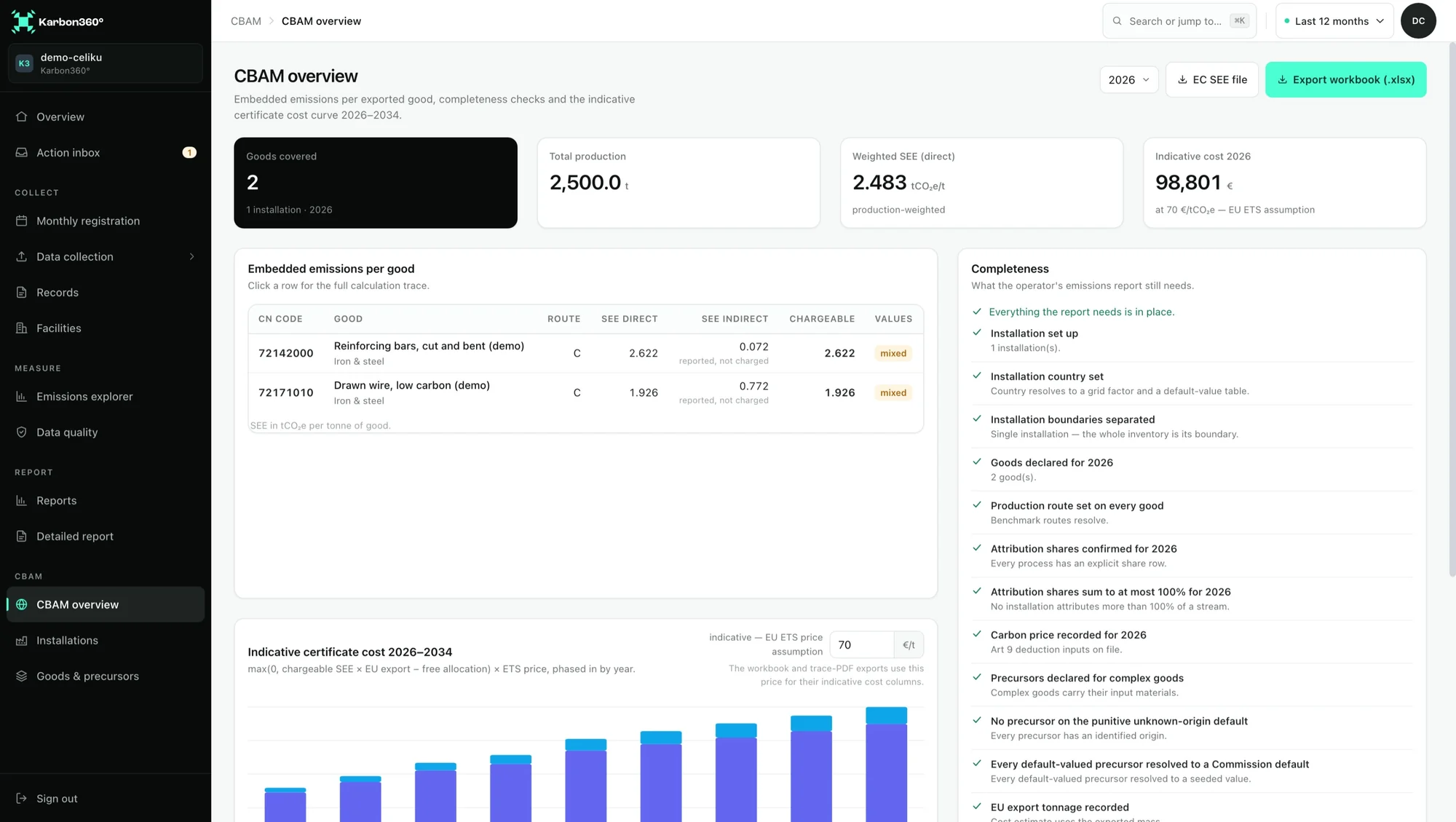
The numbers below are an illustration, not a quote and not a forecast. They use the reinforcing bar from the Karbon360 demo installation shown further down this page.
- Good: reinforcing bars, CN 7214 20 00, production route (C).
- Specific embedded emissions: 2.622 tCO₂e/t, direct only, because iron and steel goods are charged on direct emissions.
- Mass imported into the EU in 2026: 1,000 t.
- Free allocation: for illustration, the whole-chain benchmark for route (C), 1.364 tCO₂e/t, × CBAM factor 97.5% × CSCF 1.0 = 1.330 tCO₂e/t.
- No carbon price paid in the country of production.
(2.622 − 1.330) × 1,000 t = 1,292 certificates
At the Q3 2026 price of €82.32 that is about €106,375; at a €70 assumption, the figure on the demo screen, about €90,455. With a default value instead of actual data the embedded emissions figure would carry the mark-up, and the certificate count would rise with it.
Illustration only. A real declaration uses the SEFA from the operator’s verified emissions report, built per production process with its precursors, and the price of the quarter in which each consignment was imported.
What an exporter can actually change
The certificate price is the same for every importer. What differs between two suppliers of the same product is the number of certificates their goods carry:
- Actual data instead of defaults. Default values are set high and marked up each year. Actual values monitored under Implementing Regulation (EU) 2025/2547 and verified by an accredited verifier replace them.
- The right production route. The route decides the benchmark, and the benchmark decides how much is deducted.
- Precursor data. Precursors on verified supplier data, or from EU origin, cost less than precursors on defaults.
- Carbon price paid at home. Where a mandatory carbon price is paid in the country of production, a certified deduction lowers the count.
The same 1,000 tonnes, year by year
The demo rebar from the worked example, with the same embedded emissions every year. Only the CBAM factor changes. Cost columns hold the price constant to isolate that effect; they are not price forecasts.
CN 7214 20 00 · route (C) · SEE 2.622 tCO₂e/t
Illustrative| Year | CBAM factor | SEFA (tCO₂e/t) | Certificates per 1,000 t | At €70 | At €82.32 |
|---|---|---|---|---|---|
| 2026 | 97.5% | 1.330 | 1,292 | €90,455 | €106,375 |
| 2027 | 95.0% | 1.296 | 1,326 | €92,842 | €109,182 |
| 2028 | 90.0% | 1.228 | 1,395 | €97,616 | €114,796 |
| 2030 | 51.5% | 0.702 | 1,920 | €134,376 | €158,026 |
| 2032 | 26.5% | 0.361 | 2,261 | €158,246 | €186,097 |
| 2034 | 0% | 0.000 | 2,622 | €183,548 | €215,852 |
The cost curve uses your own embedded emissions.
The CBAM overview turns each good’s chargeable embedded emissions and EU export tonnage into an indicative certificate cost for every year from 2026 to 2034, with the free allocation deducted and the ETS price as a visible assumption you can change. The workbook and trace PDF exports carry the same price in their indicative cost columns.
- Indicative certificate cost curve 2026 to 2034
- ETS price assumption shown and editable
- Operator’s emissions report workbook in the official 2026 shape
Frequently asked questions
What is the CBAM certificate price in 2026?
The Commission publishes one price per quarter for 2026: €75.36 for Q1, €75.28 for Q2 and €82.32 for Q3. The Q4 2026 price is due on 4 January 2027. Each price applies to goods imported in that quarter.
How is the CBAM certificate price calculated?
As the weighted average of the auction clearing prices of EU ETS allowances, under Article 21 of Regulation (EU) 2023/956 and Implementing Regulation (EU) 2025/2548. In 2026 the average is quarterly; from 2027 it is weekly.
When can CBAM certificates be bought?
From February 2027, on the common central platform, by authorised CBAM declarants only. The first certificates cover 2026 imports and are surrendered with the first annual declaration by 30 September 2027.
What is the CBAM certificate calculation formula?
Certificates owed = max[0 ; embedded emissions − free allocation adjustment − carbon price paid ÷ reference price] × imported mass, per good. The cost is the number of certificates multiplied by the applicable price.
Does the exporter pay for CBAM certificates?
No. The authorised declarant in the EU buys and surrenders them. The exporter’s embedded emissions data decides how many it needs, which is why verified actual data is a cost argument in every price negotiation.
Lower the count, not the price.
The certificate price is the same for everyone. The number of certificates on your goods is decided by the data you can prove.