
CBAM data from suppliers: what to ask your Balkan supplier, and how to get it verified.
Your CBAM declaration is calculated from emissions that happen in a plant you do not run. If the operator in Bosnia and Herzegovina, Albania, North Macedonia, Montenegro or Kosovo sends verified actual data, you declare their real number. If not, you declare the Commission’s default with a mark-up. This page is the checklist and the request process that gets you the first outcome.
Published 4 November 2026 · Reflects the Commission guidance documents of 14 August 2026
Your CBAM cost is calculated from data you do not hold. It sits in your supplier’s meter readings, fuel invoices and production logs.
What the declarant needs from a non-EU supplier.
Why importers depend on supplier data
The authorised CBAM declarant files the annual declaration and surrenders certificates for the emissions embedded in its imports. Those emissions are monitored by the operator of the installation that made the goods, outside the EU, under the rules of Implementing Regulation (EU) 2025/2547. Only the operator has the fuel, electricity, process and production data.
Where the operator calculates embedded emissions from actual data, it prepares an annual operator’s emissions report and a summary in the Commission’s template, which is mandatory under Article 10 of that regulation, and has it checked by a verifier accredited by a national accreditation body in the EU. Without that, the declarant uses default values from Implementing Regulation (EU) 2025/2621, increased by the mark-up for the year.
Where the CBAM Registry fits
The CBAM Registry has a module for operators of installations outside the EU, called O3CI. Registration is voluntary and recommended by the Commission: a registered operator uploads its installation data once and shares it with each declarant that imports its goods, and the declarant sees the summary it needs rather than the confidential detail. An operator that does not register sends the same report template to each customer directly.
Either way, ask your supplier which route it will use, so your team knows where the data will arrive.
When the supplier cannot deliver in time
Default values remain available for every CBAM good. A good not listed for its country of production takes the value from the table for other countries and territories, and a precursor whose country of production is unknown takes the highest value in Annex IV. Defaults and verified actual data can also be combined: a supplier’s complex good can carry actual data for its own process and defaults for precursors it could not trace.
The Commission’s methods guidance also mentions that declarants could use default values to check the plausibility of the actual data they receive. A supplier figure far below the default for the same good and country deserves a question before it is filed.
The importer’s checklist: what to ask a supplier for.
One request, per installation and per reporting year. The reporting period is the calendar year in which the goods were produced; for goods imported in 2026 it is 2026.
CBAM supplier data request
Per installation · per year| Item | What to ask for | Why the declarant needs it |
|---|---|---|
| Installation | Name, address and country of the plant that made the goods, not the trading company. | Embedded emissions are monitored per installation, and the country selects the default table. |
| Goods | Each good by 8-digit CN code, with the tonnes delivered to you. | Emissions, defaults and benchmarks are all set per CN code. |
| Production route | For steel the route (for example blast furnace, DRI or scrap with an electric arc furnace); for aluminium, primary or secondary. | The route decides which benchmark applies to the free allocation adjustment. |
| Specific embedded emissions | Direct emissions in tCO₂e per tonne; for cement and fertilisers, indirect emissions as well. | This is the figure the certificates are calculated from. |
| Precursors | For complex goods: each precursor, its country of production, its embedded emissions and whether they are actual or default. | Precursor emissions are part of the good’s embedded emissions. |
| Free allocation | The specific embedded free allocation for each good. | It is deducted before certificates are surrendered. |
| Carbon price paid | Any carbon price effectively paid in the country of production, net of rebates, with the independent certification Article 9 requires. | It can reduce the certificates to surrender. |
| Qualifying parameters | The sector parameters in point 2 of Annex IV to IR (EU) 2025/2547, such as clinker content for cement. | The declaration reports them alongside the emissions. |
| Operator’s emissions report | The annual report and its summary in the Commission template, in English. | Mandatory format where actual data is used. |
| Verification report | Issued by a verifier accredited by an EU national accreditation body, covering the reporting year. | Without it the actual data cannot replace defaults. |
A supplier request process that ends in verified data
Most failed requests fail on timing: the verifier is booked too late, or the request reaches the sales office instead of the plant.
Map suppliers and goods
Send one written request
Agree the verifier early
Check, file, keep
What your supplier gets from Karbon360.
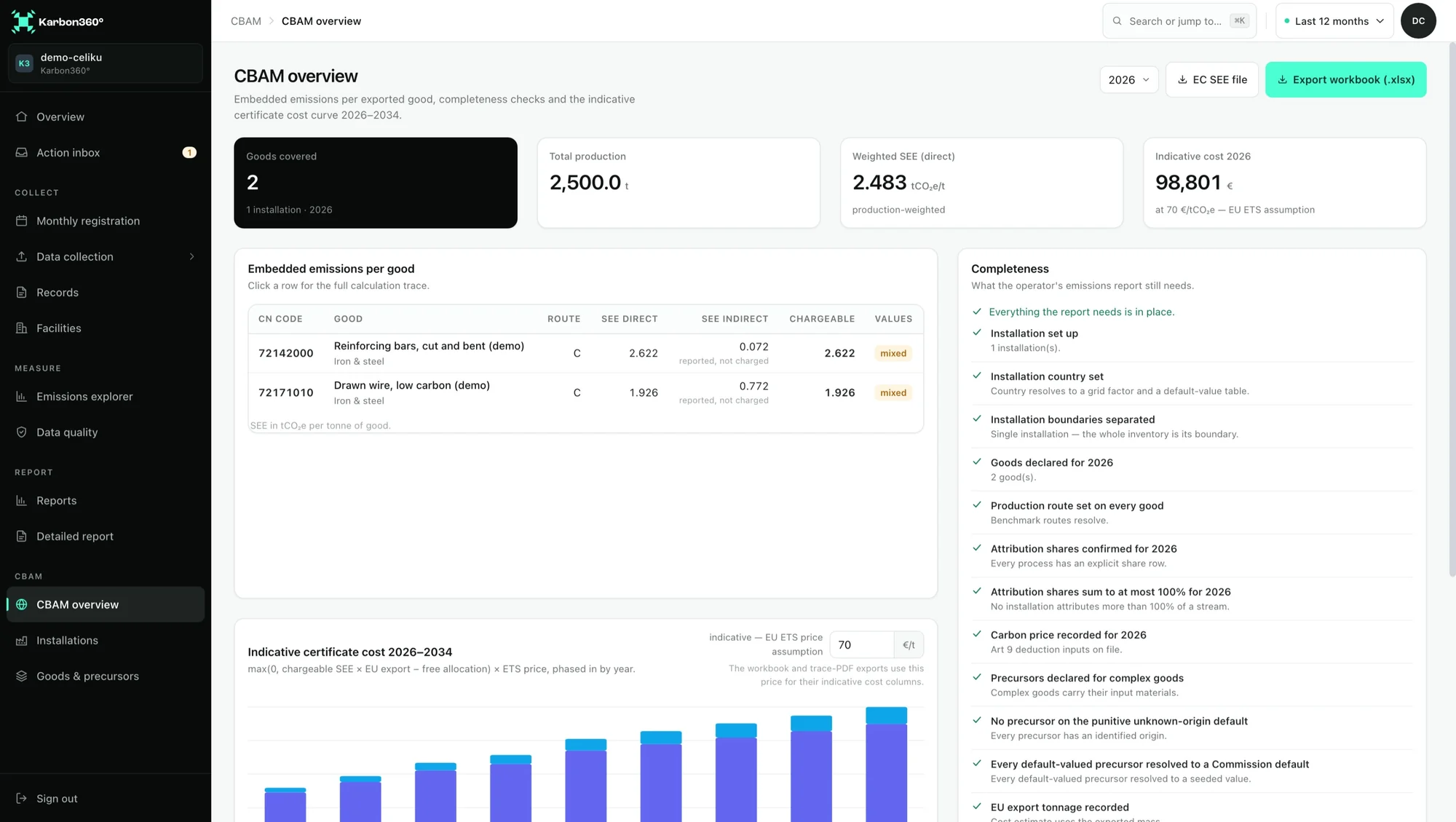
Karbon360 is built for producers in the Western Balkans. The operator records fuel, electricity, process data and production every month from invoices and meters; the CBAM module turns that into specific embedded emissions per CN code, with precursors, production routes and Commission defaults for whatever is not yet measured.
What comes out is what your checklist asks for: the operator’s emissions report workbook in the official 2026 shape and a trace PDF a verifier can follow from each figure back to the record behind it. Karbon360 prepares the data; the accredited verifier verifies it.
- Specific embedded emissions per CN code, direct and indirect shown separately
- Precursors with country of origin and actual-or-default status
- Operator’s emissions report workbook and trace PDF for the verifier
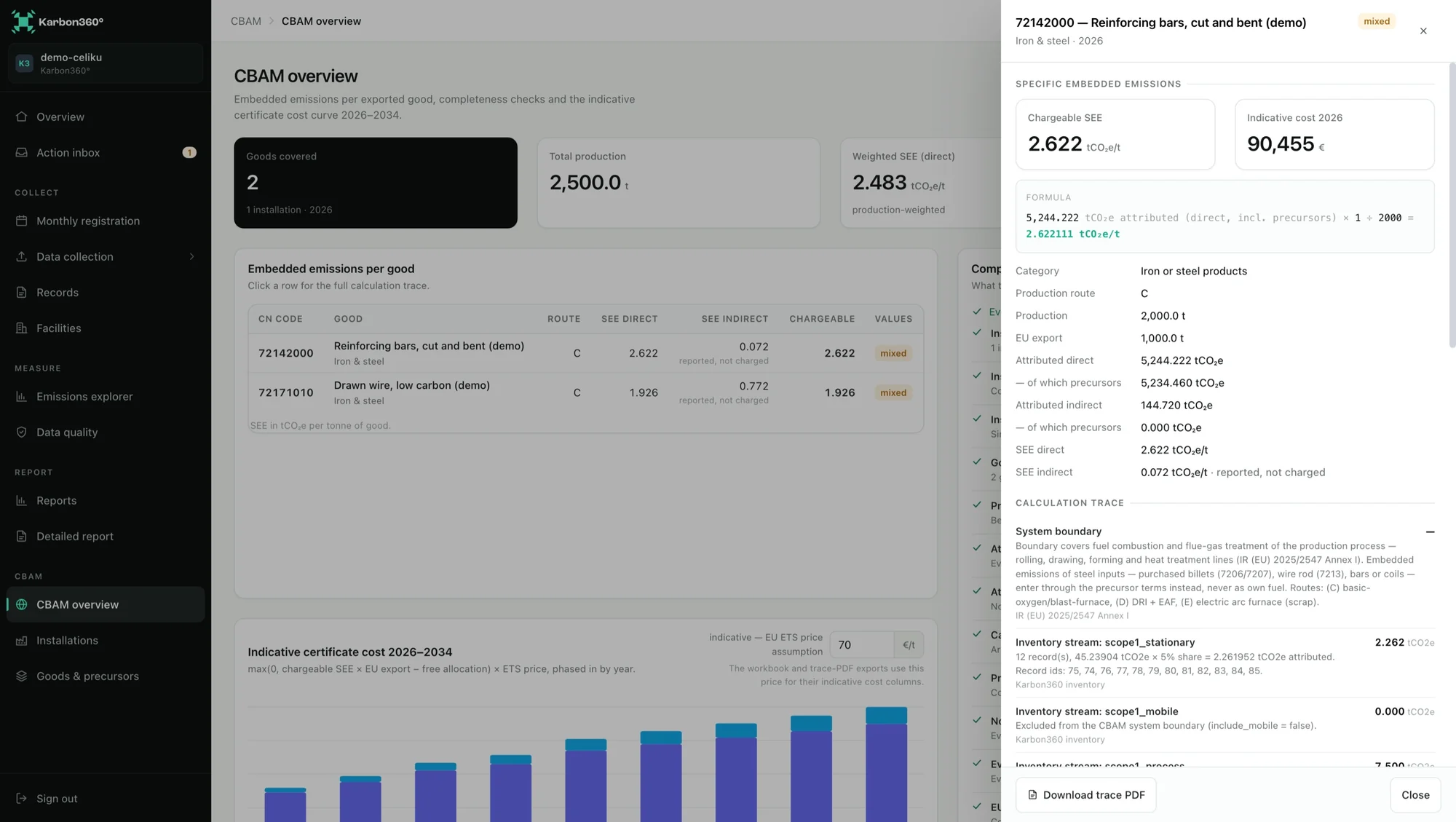
= 2.622111 tCO₂e/t
Invite your Balkan supplier.
Tell us which supplier and which goods through the contact form. We agree with you how to approach them, contact them only after you confirm, and say plainly who asked. Your supplier gets a setup that produces the report on your checklist; you get data you can file.
Frequently asked questions
What CBAM data do I need from a non-EU supplier?
Per installation and year: the goods by CN code and tonnes, production route, specific direct embedded emissions (and indirect for cement and fertilisers), precursors with their origin and emissions, the specific embedded free allocation, any carbon price paid, the sector parameters in Annex IV to IR (EU) 2025/2547, and the operator’s emissions report with its verification report.
Can I use supplier data that has not been verified?
Not instead of default values. Actual data can be used in a CBAM declaration only if an accredited verifier has verified it. Unverified figures are useful to plan with, not to file.
What if my supplier will not provide CBAM data?
You declare the Commission’s default value for the good and the country of production, increased by 10% in 2026, 20% in 2027 and 30% from 2028 (1% for fertilisers). Defaults are designed not to underestimate emissions, so they usually cost more than a supplier’s verified data.
Does my supplier have to register in the CBAM Registry?
No. Registration in the O3CI module is voluntary and recommended. A registered operator shares its data with each declarant through the Registry; one that is not registered sends the report template to each customer.
Is there a template for the supplier request?
The data the supplier returns has a mandatory format: the operator’s emissions report template in Annex IV to IR (EU) 2025/2547. Your request itself can be a short letter with the checklist on this page attached.
Does the 50-tonne threshold apply to my supplier?
No. The 50-tonne annual threshold applies to the importer’s net imports of covered goods. A supplier’s production volume does not change it.
- European Commission — Carbon Border Adjustment Mechanism
- Commission Guidance No. 2 — Quick guide for non-EU operators on CBAM implementation
- European Commission — CBAM Registry and reporting
- Regulation (EU) 2023/956 establishing the CBAM (EUR-Lex)
- Implementing Regulation (EU) 2025/2547, the Methodology Act (EUR-Lex)
Declare your supplier’s number, not the default.
Invite your Western Balkan supplier and they get a setup that produces the operator’s emissions report your declaration needs, with a trace their verifier can follow.