
One answer, many buyers
The PACT Network lists more than 50 conformant solutions that exchange footprints over the same standard. A footprint you publish once can be read by any of them.
PACT, the Partnership for Carbon Transparency, is an initiative hosted by WBCSD: a methodology for product carbon footprints and technical specifications for exchanging them between software systems. Karbon360 passed the PACT conformance tests for Technical Specifications v3.0, so an EU customer’s system can request your product footprints per good instead of sending another spreadsheet.
Last updated: November 2026 · PACT Technical Specifications v3.0 and PACT Methodology v3

Karbon360 passed PACT conformance testing for Technical Specifications v3.0 in November 2026 and is listed on the PACT Network. Your customers’ PACT conformant systems can request product footprints from Karbon360 directly, in the same format.
The Partnership for Carbon Transparency (PACT) is an initiative that works to unlock decarbonization through transparency in value chains. It establishes a standardized methodology for product-level carbon footprints and the technology infrastructure to exchange them, and brings together companies, technology providers, industry initiatives, standard setters and regulators. PACT is hosted by the World Business Council for Sustainable Development (WBCSD), co-convenor of the Greenhouse Gas Protocol.
PACT website · PACT Network · PACT Methodology · PACT Technical Specifications
PACT, the Partnership for Carbon Transparency, is an initiative of the World Business Council for Sustainable Development (WBCSD). It gives companies a common way to calculate a product’s carbon footprint and a common way to send it to the customers who ask for it. Data is exchanged peer-to-peer between companies’ own systems; PACT does not hold it on a central platform.
The PACT Methodology, previously known as the Pathfinder Framework, describes how to calculate and exchange cradle-to-gate product carbon footprints using supplier data. It builds on the GHG Protocol and ISO standards and adds rules meant to make footprints from different companies comparable. Version 3 is the current version.
The Technical Specifications define two things: a data model for a product footprint (the ProductFootprint) and an HTTP API for exchanging it. A buyer’s system authenticates with OAuth 2.0 client credentials, lists or fetches footprints through /3/footprints, and sends events such as a footprint request through /3/events. Footprints are never edited in place: a change creates a new footprint, the old one is marked Deprecated and its id is kept in precedingPfIds.
A solution is PACT conformant when it passes all of the automated tests in the PACT Conformance Tool, run by PACT against the Technical Specifications. Karbon360 passed all 41 tests for v3.0.
Conformance is about protocol: authentication, the data model, filtering, pagination, events and error handling, so that any conformant system can exchange footprints with any other. It is not an audit of how a footprint was calculated and it does not certify the numbers. Each footprint says which methodology produced it, and its values stand or fall on that methodology and on independent verification where it exists.
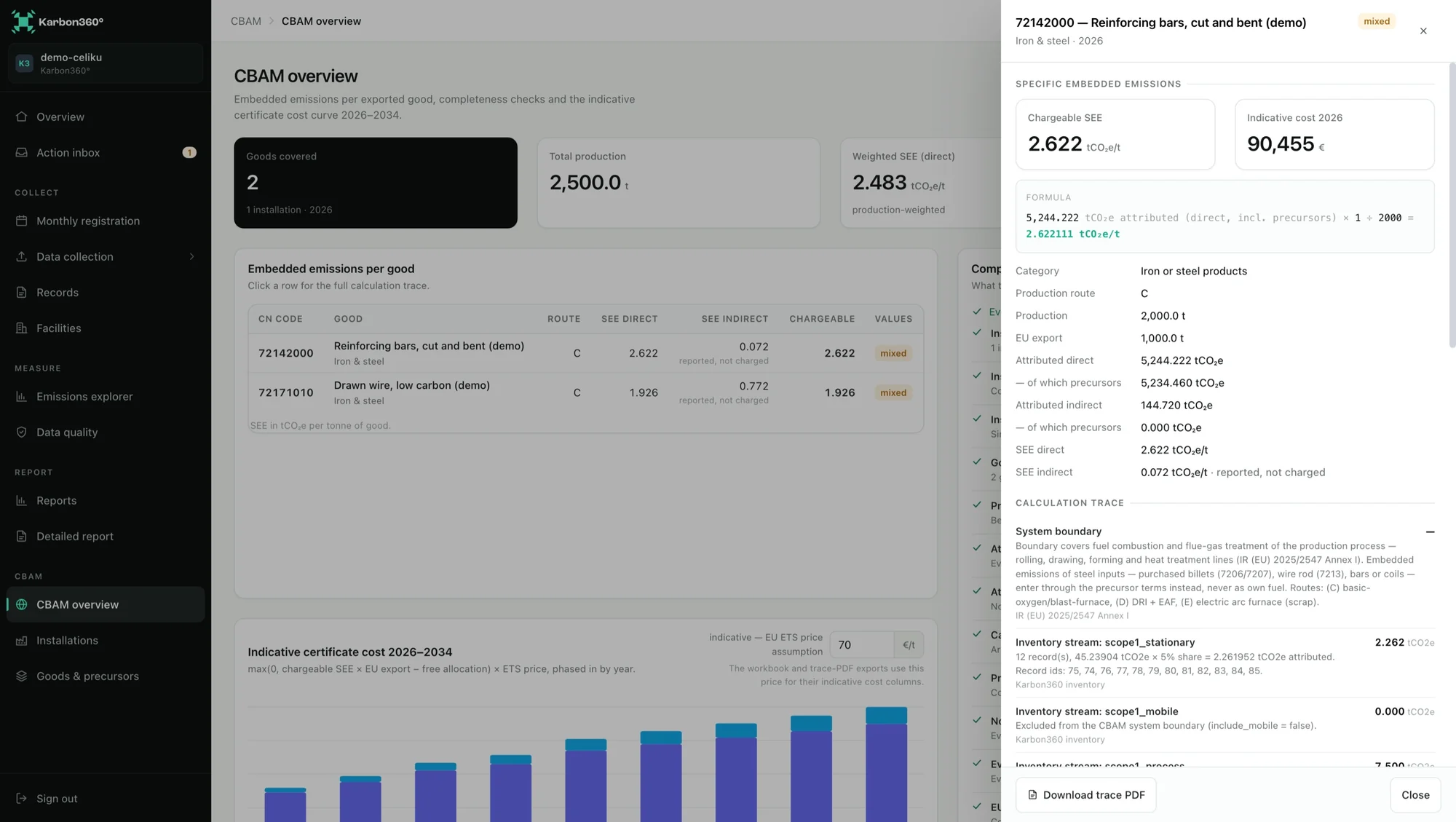
For each CBAM good you export, Karbon360 can publish a product carbon footprint derived from the same calculation behind your CBAM figures: the specific embedded emissions per tonne of the good, expressed per kilogram, with direct and indirect emissions both included.
A PACT footprint is a structured record, not a PDF. These are the parts a buyer’s reviewer looks at first, and what Karbon360 puts in them.
| Part of the footprint | What Karbon360 publishes |
|---|---|
| Product | The good, identified by its CN code — the same classification your importer declares under CBAM. |
| Declared unit | 1 kilogram. CBAM figures are in tCO₂e per tonne, which is numerically the same as kgCO₂e per kilogram. |
| Footprint value | Direct plus indirect specific embedded emissions of the good, including its precursors. Never the chargeable CBAM figure alone. |
| Geography | The country of the installation that made the good. |
| Reference period | The reporting year the calculation covers. |
| Boundary and method | The CBAM production boundary, direct and indirect emissions, calculated under the GHG Protocol Corporate Standard and the EU CBAM method (Implementing Regulation (EU) 2025/2547). |
| Secondary data | Where a Commission default value stands in for a precursor, the footprint says so. |
| Verification | Stated only when that year’s figures have been verified by an independent verifier. |
| Versioning | Append-only. A republished footprint gets a new id; the previous one is deprecated and linked. |
PACT is the Partnership for Carbon Transparency, an initiative of the World Business Council for Sustainable Development. It publishes the PACT Methodology for product carbon footprints and the Technical Specifications for exchanging them.
Yes. The PACT Methodology was previously named the Pathfinder Framework, and the network of conformant solutions was previously the Pathfinder Network. Version 3 is the current methodology.
No. Conformance testing checks that a system implements the Technical Specifications correctly, so it can exchange footprints with other systems. It does not check how a footprint was calculated. Verification of the underlying CBAM data is done by an independent accredited verifier.
The GHG Protocol Corporate Standard and the EU CBAM method under Implementing Regulation (EU) 2025/2547. The footprint covers the CBAM production boundary, direct and indirect emissions. We do not present it as a full PACT Methodology or product-standard study, and the footprint says which method it used.
Yes. Their system can send a request event through the PACT API. Karbon360 answers it with the footprint once it exists, or with a stated rejection, rather than leaving the request unanswered.
PACT product footprints are part of Compliance & Export, together with the CBAM module, and of Enterprise.
Publish a footprint per good from the CBAM data you already maintain, and let your buyer’s system ask for it directly.