
CBAM for ferronickel, ferrochrome and ferromanganese: a CBAM good and a precursor at once.
Ferro-manganese, ferro-chromium and ferro-nickel are CBAM goods in the iron and steel sector. An EU importer declares their embedded emissions when it buys them, and every steelmaker that melts them into crude steel carries those emissions into its own goods as a precursor. Either way, the number starts at the ferro-alloy furnace.
Published 4 November 2026 · Reflects Commission Guidance No. 5d of 14 August 2026 and IR (EU) 2026/1740
Ferro-alloys are bought in small tonnages and melted into large ones. Their embedded emissions follow the alloy into every tonne of steel it ends up in.
Which ferro-alloys CBAM covers.
Ferro-alloys in Annex I to the CBAM Regulation
Ferro-alloys sit in CN heading 7202, inside the iron and steel sector of Annex I to Regulation (EU) 2023/956. Only three families are in scope:
| CN code | Good | Aggregated goods category |
|---|---|---|
| 7202 11 · 7202 19 | Ferro-manganese (more than 2% carbon, and 2% or less) | FeMn |
| 7202 41 · 7202 49 | Ferro-chromium (more than 4% carbon, and 4% or less) | FeCr |
| 7202 60 00 | Ferro-nickel | FeNi |
Other ferro-alloys are outside CBAM: ferro-silicon, ferro-silico-manganese, ferro-silico-chromium, ferro-molybdenum, ferro-tungsten and ferro-silico-tungsten among them. Nickel pig iron with more than 10% nickel is treated as ferro-nickel production; below 10% it falls under pig iron.
What the system boundary of a ferro-alloy plant includes
Point 3.12 of Annex I to the Methodology Act defines the boundary for FeMn, FeCr and FeNi production. Direct emissions cover:
- CO₂ from all fuel inputs, whether used for energy or as reducing agent, such as coke charged to the furnace;
- CO₂ from process inputs such as limestone, and from flue gas cleaning;
- CO₂ from the consumption of electrodes or electrode paste;
- carbon remaining in the alloy, the slag or wastes, handled with a mass balance.
The Commission’s iron and steel guidance lists the steps inside the boundary: raw material handling and pre-treatment (pellets and sinter for FeMn and FeCr; calcination and pre-reduction in a rotary kiln for FeNi), the electric arc furnace itself, decarburisation and secondary metallurgy where needed, casting, crushing and granulation, and emissions control.
Ferro-alloys as precursors in the steel chain
The Methodology Act specifies no precursors for ferro-alloy production itself; the Commission’s guidance adds sintered ore, where it is used. Going downstream, ferro-alloys are a precursor of nearly every steel category:
- Pig iron and DRI, together with hydrogen, sintered ore and other pig iron or DRI;
- Crude steel (CN 7206, 7207, 7218, 7224), from basic oxygen or electric arc furnaces, together with pig iron, DRI and bought-in crude steel;
- Iron or steel products, together with crude steel and other iron or steel products.
A steelmaker that wants to use actual data for the ferro-alloy it melts must take it from a verification report issued by an accredited verifier and covering the year the alloy was produced. Without it, the steelmaker uses the default value for the alloy’s country of production with the mark-up, or the Annex IV value if the country is unknown. Defaults and actual data can be mixed batch by batch, and the split is reported in the operator’s emissions report.
What a ferro-alloy producer must supply
Whether the buyer is an EU importer or a steelmaker using the alloy as a precursor, the request comes down to the same verified figures for each production process and reporting year:
- the installation and the production process, with the CN code of each alloy and the tonnes produced;
- specific direct embedded emissions in tCO₂e per tonne, with indirect emissions marked as not applicable;
- the embedded emissions of sintered ore, if bought in and used;
- the specific embedded free allocation for the alloy, which the declarant deducts before buying certificates;
- any carbon price effectively paid in the country of production, if a deduction is claimed;
- the operator’s emissions report in the Commission template and the verifier’s report for that year.
Ferro-alloy default values for Western Balkan country tables.
What an importer or steelmaker declares when no verified data comes from the plant. Values in tCO₂e per tonne of good, before the mark-up of 10% in 2026, 20% in 2027 and 30% from 2028.
Specific embedded emissions, direct only
IR (EU) 2026/1740| CN code | Good | Albania | North Macedonia | Montenegro | Other countries and territories | Annex IV (origin unknown) |
|---|---|---|---|---|---|---|
| 7202 11 | Ferro-manganese, > 2% C | - | 1.690 | 1.690 | 1.690 | 1.690 |
| 7202 19 | Ferro-manganese, ≤ 2% C | - | - | - | 5.590 | 5.590 |
| 7202 41 | Ferro-chromium, > 4% C | 2.350 | 2.350 | 2.350 | 2.350 | 2.350 |
| 7202 49 | Ferro-chromium, ≤ 4% C | - | - | - | 2.870 | 2.870 |
| 7202 60 00 | Ferro-nickel | - | 3.480 | 3.480 | 4.014 | 6.150 |
A default is not a neutral number for a ferro-nickel plant.
For ferro-nickel the default climbs as the origin gets less certain: 3.480 tCO₂e per tonne in the North Macedonia and Montenegro tables, 4.014 in the table for other countries and territories, 6.150 in Annex IV when the origin is unknown. The mark-up then adds 10%, 20% and from 2028 30% on top.
A steelmaker that cannot identify where its ferro-nickel came from takes the highest value. One that holds a verified report from the alloy plant takes that plant’s real number. For an alloy producer, the verified report is what keeps its product from being priced as the worst case in its customers’ declarations.
- Country of production recorded for every precursor
- Commission default values built in for what is not yet measured
- Completeness check flags any precursor left on the unknown-origin default
From furnace records to a verified ferro-alloy number
Map the goods
Set the boundary
Record monthly
Report and verify
One installation, every good, the precursor chain in view.
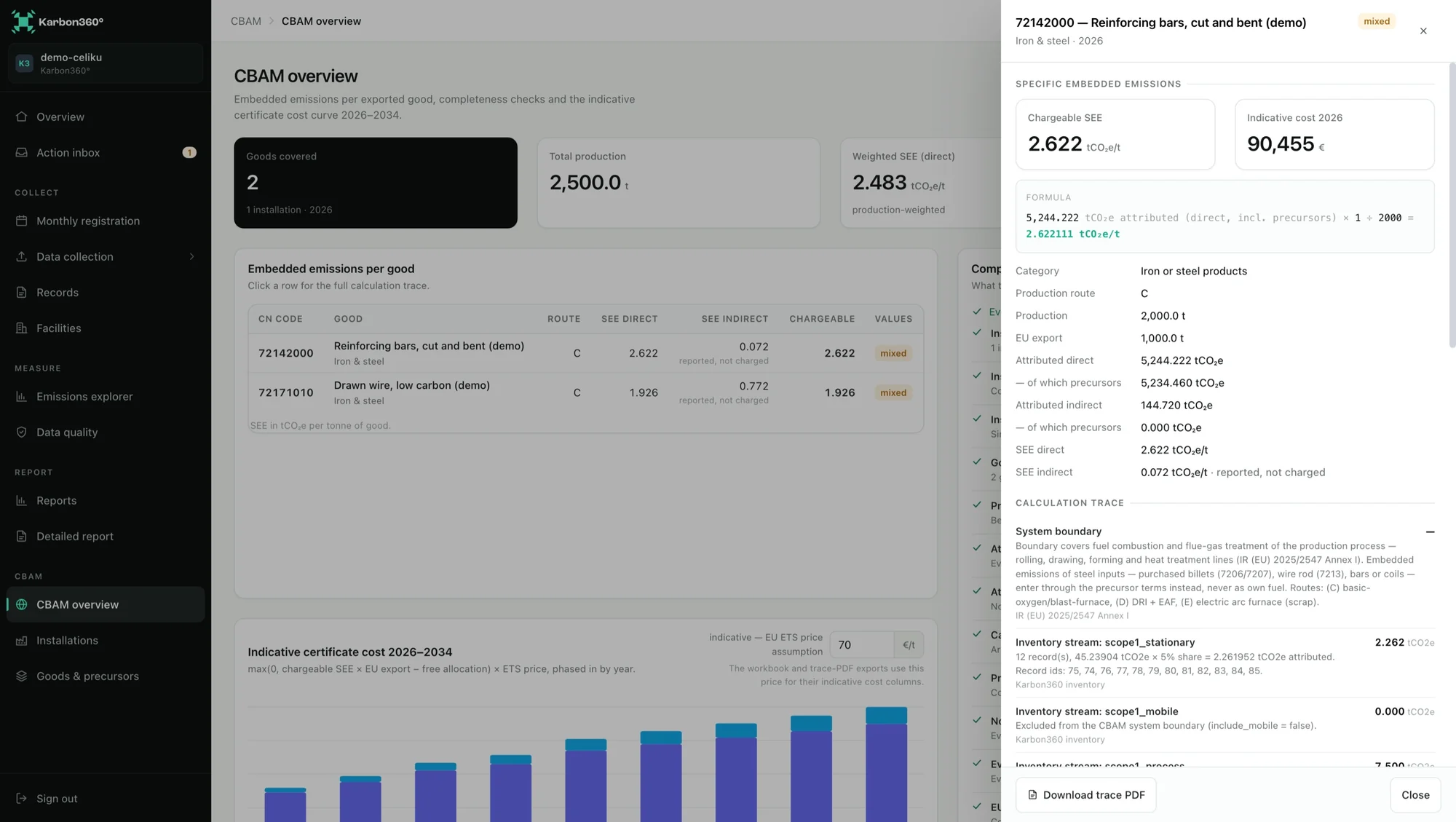
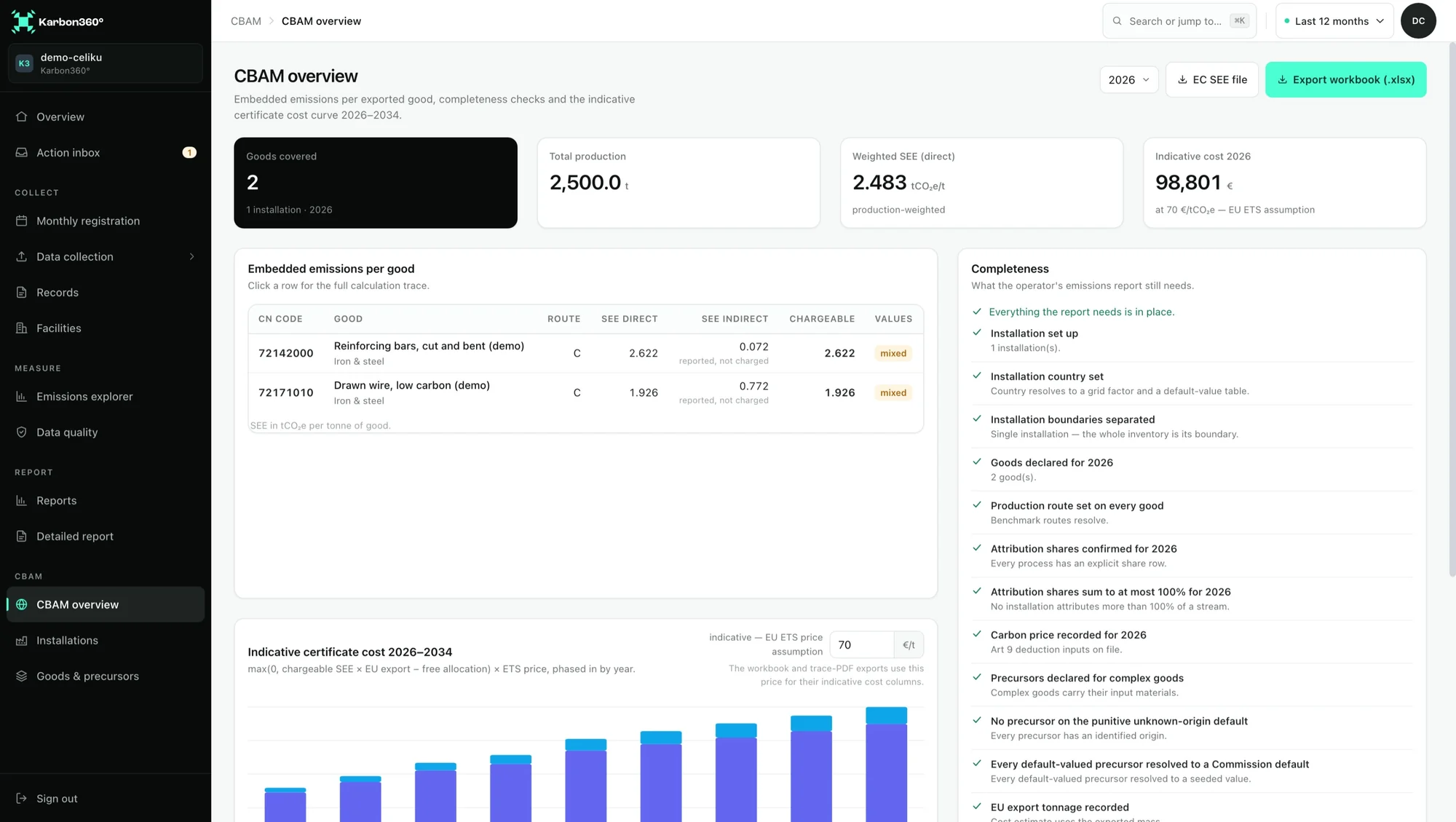
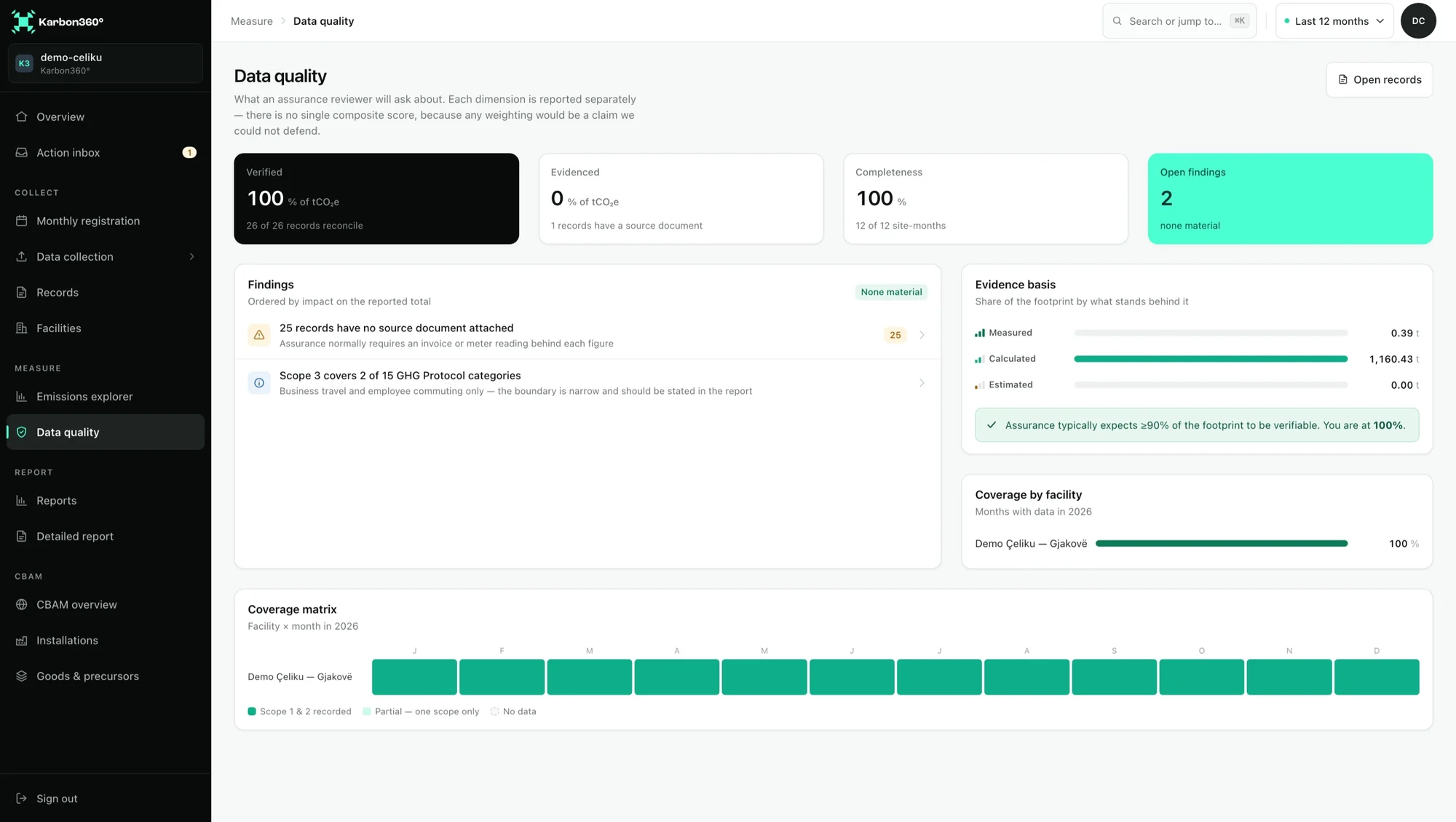
Karbon360’s CBAM module holds the installation, its production processes and each good by CN code, calculates specific embedded emissions per good from the monthly records, and carries precursors with their country of origin and whether each value is actual or a default. The output is the operator’s emissions report workbook in the official 2026 shape and a trace PDF for the verifier.
Ferro-alloy plants are few and each is set up differently, so we start with a call: you describe the furnaces, reductants and product mix, and we show how they map to processes and goods before you subscribe.
- Specific embedded emissions per CN code with the full trace
- Precursors with origin and actual-or-default status
- Operator’s emissions report workbook and trace PDF
Frequently asked questions
Is ferronickel covered by CBAM?
Yes. Ferro-nickel (CN 7202 60 00) is a CBAM good in the iron and steel sector, in the FeNi aggregated goods category. Its embedded emissions are declared when it is imported into the EU and added to the steel goods it is used in.
Are ferro-silicon and ferro-silico-manganese covered?
No. Only ferro-manganese (7202 1), ferro-chromium (7202 4) and ferro-nickel (7202 6) are in scope. Ferro-silicon, ferro-silico-manganese, ferro-silico-chromium, ferro-molybdenum and ferro-tungsten are among the ferro-alloys outside CBAM.
Does electricity count in the CBAM emissions of ferro-alloys?
No. Ferro-alloys are listed in Annex II to the CBAM Regulation, so only direct emissions are taken into account in the definitive period. Electricity had to be reported during the transitional period, and it is still worth recording for buyers’ own footprints.
What is a CBAM precursor?
An input material listed in Annex I to the CBAM Regulation that is consumed in producing another CBAM good. Its embedded emissions are added to the complex good. Ferro-alloys are precursors of pig iron, DRI, crude steel and iron or steel products.
What happens if a steelmaker cannot get data from its ferro-alloy supplier?
It uses the default value for the alloy’s country of production, increased by the mark-up for the year. If it cannot identify the country, it must use the highest default in Annex IV: 6.150 tCO₂e per tonne for ferro-nickel before mark-up.
- Commission Guidance No. 5d — Sector-specific guidance on iron and steel (14 August 2026)
- European Commission — CBAM legislation and guidance (default values file)
- Regulation (EU) 2023/956 establishing the CBAM (EUR-Lex)
- Implementing Regulation (EU) 2025/2547, the Methodology Act (EUR-Lex)
- Implementing Regulation (EU) 2025/2621 on default values (EUR-Lex)
Keep your alloy off the worst-case default.
A verified number per CN code, the precursor chain recorded and an operator’s emissions report your buyers and their steelmakers can use. Tell us about your furnaces and we will show you the setup.