
Product carbon footprint calculation, with the boundary written on it.
A product carbon footprint is the greenhouse gas emissions of one unit of one product. For exporters of steel, aluminium, cement and fertilisers, Karbon360 calculates it from the same installation data as your CBAM figures and states exactly which boundary it covers.
Last updated: November 2026
PCF vs corporate footprint vs LCA vs CBAM.
Buyers, banks and the EU ask for different carbon numbers. They are related, but they answer different questions and are not interchangeable.
Which carbon figure answers which question
Plain comparison| Corporate footprint | Product carbon footprint | Life cycle assessment | CBAM embedded emissions | |
|---|---|---|---|---|
| What it measures | All emissions of a company in a year | Emissions of one unit of one product | Several environmental impacts of a product, climate among them | Emissions embedded in a tonne of a CBAM good |
| Boundary | Scope 1, 2 and selected Scope 3 | Usually cradle-to-gate or cradle-to-grave | Defined by the study | The CBAM production boundary set in Implementing Regulation (EU) 2025/2547 |
| Unit | tCO₂e per year | kgCO₂e per declared unit | Per functional unit | tCO₂e per tonne of good |
| Typical rules | GHG Protocol Corporate Standard | Product-level standards, PACT Methodology | LCA standards | The CBAM Regulation and its implementing acts |
| Who asks | Banks, CSRD-reporting customers | Customers buying your product | Product designers, tenders, EPD programmes | Your EU importer, for its CBAM declaration |
Cradle-to-gate, LCA and CBAM — what actually differs.
What cradle-to-gate emissions are
Cradle-to-gate emissions are the emissions from extracting and processing raw materials up to the moment the finished product leaves your factory gate. Use by the customer and end of life are outside it. That makes it the natural boundary for a supplier’s footprint: everything you and your upstream suppliers did to make the product, and nothing that happens after you sell it. The PACT Methodology is written for cradle-to-gate product footprints.
PCF vs LCA
A life cycle assessment is the wider study. It can cover the full life cycle and many impact categories — water, land use, acidification — as well as climate. A product carbon footprint takes one result from that family: greenhouse gas emissions only, per declared unit of product. Every PCF is a partial life-cycle view; not every LCA produces a PCF a buyer can use, and not every PCF needs a full LCA behind it.
CBAM vs PCF
CBAM specific embedded emissions are a regulated product-level number with a fixed boundary: the emissions of the production processes inside the installation, the electricity they consume, and the embedded emissions of the precursors listed for that good. Several things a general PCF would include sit outside that boundary:
- Emissions from producing the fuels and materials that are not CBAM precursors.
- Transport of raw materials and precursors to your plant.
- Mobile machinery on site — trucks, forklifts — which CBAM excludes.
- Greenhouse gases CBAM does not list for the sector: it covers CO₂, and also N₂O for some fertilisers and perfluorocarbons for aluminium.
And the rules differ: CBAM does not accept emission factors from LCA databases, and for iron and steel, aluminium and hydrogen the chargeable figure is direct emissions only.
From the CBAM figure to a product footprint, in one honest step.
Karbon360 calculates specific embedded emissions per good under Implementing Regulation (EU) 2025/2547: attributed process and combustion emissions, electricity, and precursors, divided by the tonnes produced. The product footprint is that figure with direct and indirect emissions both included, expressed per kilogram — tCO₂e per tonne is numerically the same as kgCO₂e per kilogram.
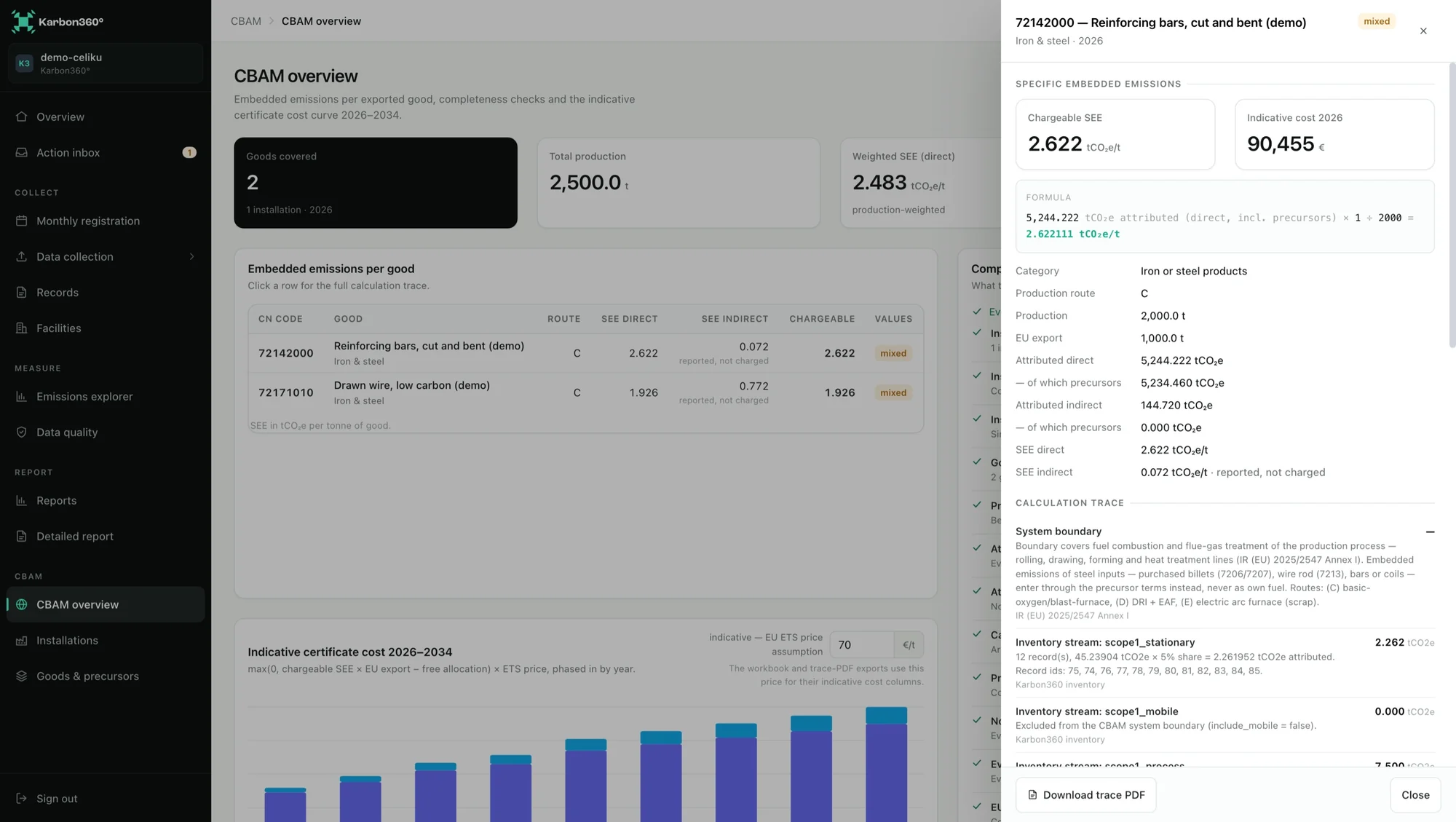
On the demo steel installation, rebar (CN 72142000) carries a chargeable CBAM figure of 2.622 tCO₂e/t, because steel is charged on direct emissions only. Its product footprint is 2.690721 kgCO₂e/kg: the difference is the indirect emissions from electricity.
- Same installation data as your CBAM figures, no second calculation
- Boundary stated on the footprint: CBAM production boundary, direct and indirect
- Defaults flagged wherever they stand in for supplier data
= 2.622111 tCO₂e/t
The company footprint is a different number — and you will need both.
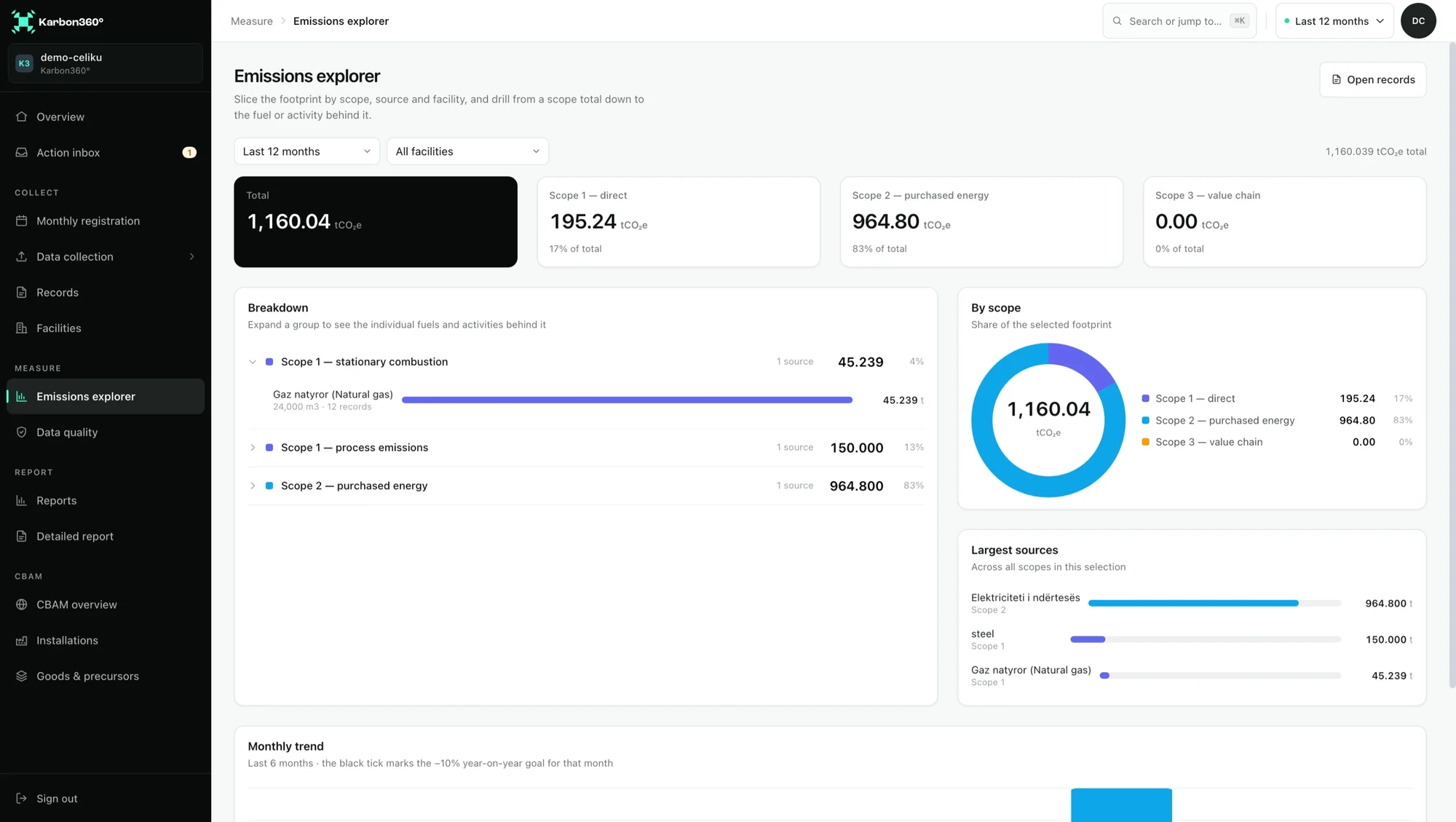
A bank or a CSRD-reporting customer asks for the corporate footprint: every facility, every fuel, Scope 1, 2 and 3 for the year. The same records feed it. The emissions explorer shows that view, from the scope total down to the litre of fuel behind it.
- Scope 1, 2 and 3 under the GHG Protocol Corporate Standard
- Largest sources ranked across facilities
- Every figure links to its records
How a product carbon footprint is calculated.
Fix the unit
Draw the boundary
Allocate
Add the inputs
Product carbon footprint questions.
What is a product carbon footprint?
The greenhouse gas emissions attributable to one declared unit of a product, in kgCO₂e — for example per kilogram of rebar. It is product-level, unlike a corporate footprint, which covers a whole company for a year.
What is the difference between a PCF and an LCA?
An LCA can cover many environmental impacts across the whole life cycle. A PCF covers greenhouse gas emissions only, per unit of product, and suppliers usually report it cradle-to-gate.
Is my CBAM figure the same as my product carbon footprint?
No. The CBAM figure follows the CBAM boundary and, for steel and aluminium, the chargeable part is direct emissions only. A product footprint usually includes indirect emissions and may draw a wider boundary. Karbon360 publishes a footprint that includes direct and indirect emissions within the CBAM boundary, and says so on the footprint.
Is Karbon360 a full PCF calculation tool for any product?
No. It derives product footprints for CBAM goods from installation-level CBAM data. Its methodology is the GHG Protocol Corporate Standard and the EU CBAM method. It does not claim conformance with any product-level footprint standard, and it does not run life cycle assessments.
What does cradle-to-gate leave out?
Everything after the product leaves your gate: distribution to the customer, use and end of life. Those belong to the customer’s own footprint or to a cradle-to-grave study.
How do customers receive the footprint?
Over the PACT API: Karbon360 passed the WBCSD PACT conformance tests for Technical Specifications v3.0, so a buyer’s system can request and receive your footprints per good.
- PACT Methodology — cradle-to-gate product carbon footprints (WBCSD)
- GHG Protocol — Corporate Accounting and Reporting Standard
- PACT Technical Specifications for PCF Data Exchange v3
- European Commission — CBAM Questions and Answers (definitive period)
- Implementing Regulation (EU) 2025/2547 — CBAM calculation methods (EUR-Lex)
- Regulation (EU) 2023/956 establishing the CBAM (EUR-Lex)
One set of records, every number a buyer asks for.
The corporate footprint, the CBAM figure per good and the product footprint your customer’s system can request — from the same invoices, with the boundary stated on each.