
CBAM communication template: what the Excel file holds, and what changes in 2026
The CBAM communication template for installations is the Commission’s Excel workbook for passing embedded emissions from a plant outside the EU to the EU importer. It carried the transitional period. In the definitive period the law goes further: actual values reach a declaration only through the operator’s emissions report set by Implementing Regulation (EU) 2025/2547, checked by an accredited verifier.
Published 4 November 2026 · Reflects Commission guidance of 14 August 2026
Most Western Balkan exporters meet CBAM as a file: an Excel workbook, a supplier questionnaire or a data collection template sent by an EU customer. Behind them sits one Commission template and, from 2026, one legally required report. This guide explains what the communication template for installations contains, who fills it in, what the definitive period changes, and the mistakes that send an importer back to default values.
What the CBAM communication template for installations is
The template is an Excel workbook developed on behalf of the European Commission by its consultants, Umweltbundesamt GmbH Austria. Its stated purpose is to facilitate communication between operators of installations in third countries and the declarants who report their goods. It was written for the transitional period under Implementing Regulation (EU) 2023/1773, when importers filed quarterly reports and paid nothing.
The operator enters installation-level data once; the template's own formulas attribute emissions to production processes, compute specific embedded emissions per good and fill the summary sheets that the importer needs. The Commission published sector examples alongside it for cement, aluminium, fertilisers, hydrogen and steel. The version in circulation at the end of the transitional period is 2.1.1, dated 13 December 2024; the version number is on the first sheet.
Who fills it in
The operator of the installation: the company that runs the plant where the goods are made. Only the operator has the meter readings, fuel invoices, production logs and process data the workbook asks for. The importer receives the result; it cannot produce it.
A trader or a sales company does not fill it in either. Where goods pass through intermediaries, the Commission's guidance expects the request to be forwarded to the operator of the installation that produced them.
What changes in the definitive period
From 1 January 2026 the legal basis is Implementing Regulation (EU) 2025/2547 on the methods for calculating embedded emissions. Three things follow:
- A mandatory report. Where embedded emissions are based on actual data, the operator prepares an annual operator’s emissions report and a summary of it, using the template set out in points 1.1 and 1.2 of Annex IV to IR (EU) 2025/2547. Article 10 makes the template mandatory. For electricity on actual values a declarant-specific addendum is added.
- Verification. Actual values can be used only if verified by an accredited verifier under Article 8 of Regulation (EU) 2023/956, with a positive verification report. National authorities have warned declarants that simply completing the transitional communication template is not enough in the definitive period.
- A calendar year. The reporting period is the calendar year of production, and the report is compiled after the year closes.
The Commission's definitive-period guidance documents of 14 August 2026 state that the series is accompanied by an electronic template for operators to communicate information to declarants and the CBAM Registry, and that the Commission's Excel template also generates the summary report automatically.
A transitional-period workbook filled in for 2026 data is a useful working file. It is not, on its own, something a declarant can use to replace default values.
Supplier questionnaires and data collection templates
Many EU importers send their own CBAM supplier questionnaire or data collection template before, or instead of, the Commission file. Formats vary. The substance does not, because it comes from the same law: installation identity, goods by CN code, production routes, attributed emissions, precursors, electricity and its emission factor, and the reporting period.
Answer them from one dataset. If the installation-level record is complete, every questionnaire is an export of it; if it is not, each one becomes a separate estimate that a verifier will later have to reconcile. The document that settles the matter for the declaration is the verified operator’s emissions report.
Common mistakes
- Company totals instead of installation data. Emissions are monitored per installation and attributed per production process. Two plants at one address are still two installations.
- Production processes drawn wrongly. The transitional template asked for separate processes where separate routes made the same goods category. Under IR (EU) 2025/2547 a process covers goods with the same functional unit and, where relevant, all production routes used in the installation. Carry the 2026 structure forward, not last year’s.
- An electricity factor with no source. The workbook asks for the emission factor of consumed electricity and the method by which it was determined. An EU-average factor entered without a source is exactly the kind of figure a verifier will question.
- Precursors without origin. Every purchased precursor needs its country, its mass and whether its embedded emissions are measured or default. A precursor of unknown origin falls back to the Commission’s default for unknown origin, which is set high.
- Annual guesses instead of records. Monthly meter readings and invoices are what a verifier samples. Figures typed in once a year rarely survive the visit.
- Treating the file as final. Until a verifier has issued a positive report, the numbers are the operator’s draft, however carefully the workbook was filled.
How to prepare 2026 data now
The first operator’s emissions reports cover calendar year 2026. A monitoring plan, monthly records and a verifier booked early are the difference between a report in the first months of 2027 and a declarant forced onto defaults. The Commission's guidance advises contracting a verifier early in the reporting period, because much of the verification work, starting with the monitoring plan, can be done during the year.
The steps below follow the order the regulation implies.
The communication template, sheet by sheet
The data sheets of the Commission’s communication template for installations (version 2.1.1). Guidance, code-list and parameter sheets are left out.
CBAM communication template for installations
Excel · v2.1.1| Sheet | What it holds |
|---|---|
| A_InstData | Reporting period, installation name, address, country and coordinates, authorised representative, verifier details, goods categories with their routes, production processes and purchased precursors. |
| B_EmInst | The installation’s emissions at source-stream and emission-source level: fuels and materials, calculation-based and measurement-based approaches, PFC emissions. |
| C_Emissions&Energy | Installation-level greenhouse gas emissions and energy consumption, including the fuel and heat balance. |
| D_Processes | For each production process: production levels and routes, output put on the market or consumed internally, directly attributable emissions, measurable heat, waste gases and electricity with its emission factor. |
| E_PurchPrec | Purchased precursors: quantity, country of origin, specific direct and indirect embedded emissions, and whether each value is measured or a default. |
| Summary_Processes, Summary_Products, Summary_Communication | Calculated results per process and per good, and the summary the importer needs for its report. |
From plant records to a report a declarant can use
Map the installation
Record monthly
Calculate and report
Verify and share
Your records, in the shape the regulation sets.
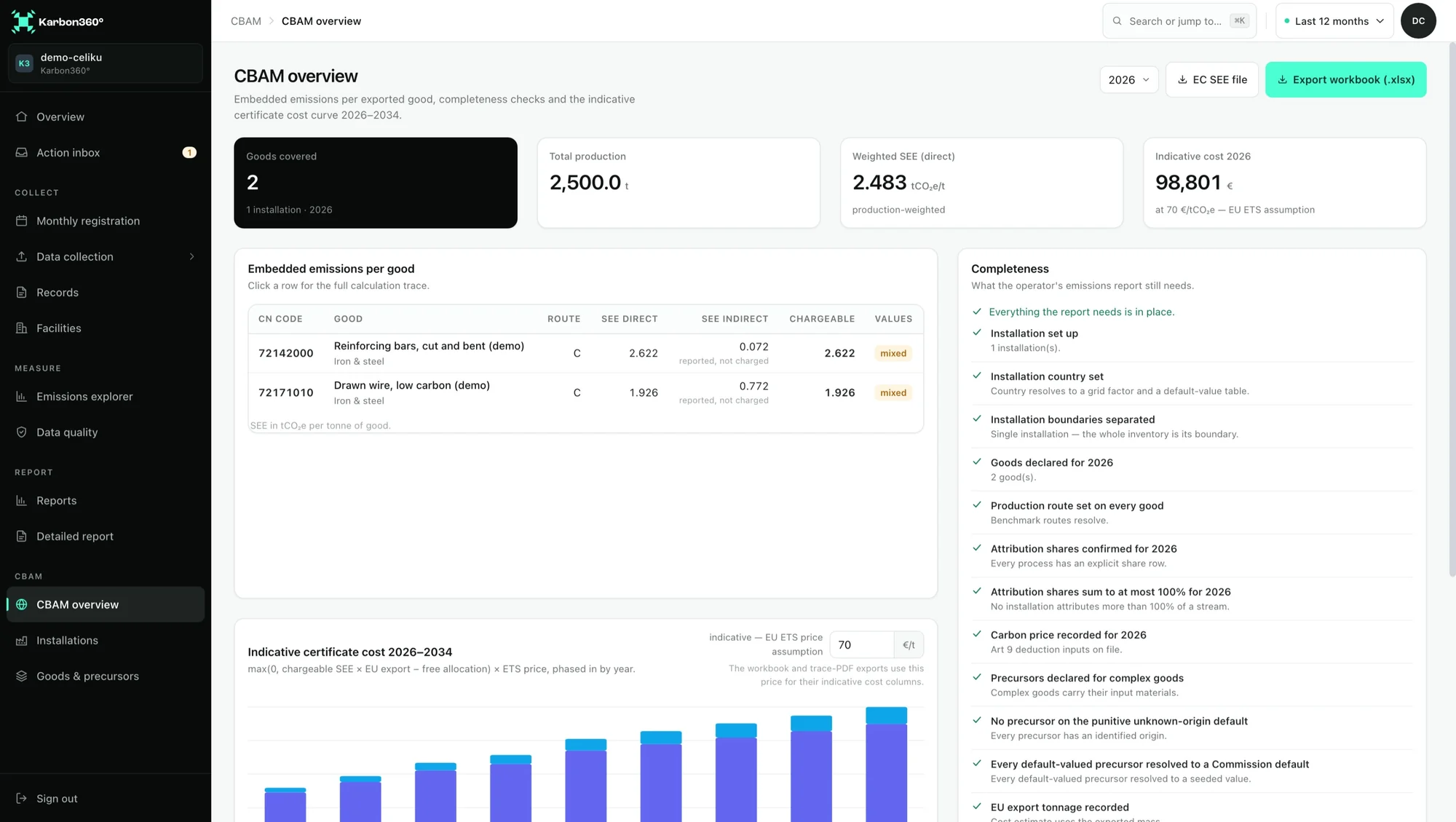
Karbon360 keeps the installation, its goods, routes and precursors next to the monthly energy and production records, and calculates specific embedded emissions per good under IR (EU) 2025/2547. A completeness check lists what the operator’s emissions report still needs. When it is green, the report exports as a workbook in the official 2026 shape, with a trace PDF per good for the verifier.
- Operator’s emissions report workbook in the official 2026 shape
- Completeness check against what the report needs
- Trace PDF for the verifier
Frequently asked questions
What is the CBAM communication template for installations?
An Excel workbook developed for the European Commission so that operators of installations outside the EU can pass installation data and specific embedded emissions to the declarants who report their goods. It was designed for the transitional period under Implementing Regulation (EU) 2023/1773.
Is the communication template still valid in 2026?
It remains a working tool, but it is not enough on its own. Where actual values are used, IR (EU) 2025/2547 requires an operator’s emissions report in the template set out in its Annex IV, and the values must be verified by an accredited verifier before a declarant can use them.
Who fills in the CBAM communication template?
The operator of the installation that produced the goods. The importer, a trader or a sales company does not have the data to complete it.
Is a CBAM supplier questionnaire the same as the template?
No. Questionnaires and data collection templates are formats chosen by each importer. They ask for the same underlying data, so the efficient answer is one installation-level dataset that feeds all of them and the operator’s emissions report.
Where do I download the CBAM communication template in Excel?
From the European Commission’s CBAM website, where the guidance documents for operators are also published. Check the version on the first sheet before you start, and keep in mind that for 2026 data the operator’s emissions report template in Annex IV to IR (EU) 2025/2547 is the one the law requires.
- European Commission — CBAM legislation and guidance
- European Commission — CBAM Registry and reporting
- Implementing Regulation (EU) 2025/2547 on methods for calculating embedded emissions (EUR-Lex)
- Implementing Regulation (EU) 2023/1773 for the transitional period (EUR-Lex)
- Regulation (EU) 2023/956 establishing the CBAM (EUR-Lex)
- Financial Administration of the Republic of Slovenia — CBAM news
One dataset, every template answered.
Keep installation records monthly, and the operator’s emissions report, the questionnaires and the verifier’s sample all come from the same numbers.