
CBAM default values for Kosovo. Kosovo has no table, so the highest fallback applies.
Kosovo is not listed in Annex I of the CBAM default values regulation. Annex I says that where a country is not listed, the importer must use the table “Other countries and territories”. For Kosovo steel, ferro-nickel, aluminium and cement, that is the default your EU buyer declares without your data.
Last updated: 4 November 2026 · Checked on EUR-Lex against the corrected Annex I
Next door, North Macedonian rebar carries 1.530. Kosovo rebar carries 3.996 — the difference comes from the table, not from any measurement of Kosovo plants.
What the regulation says about Kosovo.
Kosovo is not in Annex I
We checked the full text of Annex I on EUR-Lex, both the version published on 31 December 2025 and the version that replaced it under Implementing Regulation (EU) 2026/1740. Kosovo does not appear in either. The opening paragraph of Annex I is explicit: where a country or territory is not explicitly listed, the default value for the respective good from the table “Other countries and territories” needs to be selected.
So every CBAM good produced in Kosovo, from rebar to ferro-nickel to clinker, is declared on the other countries values when the importer has no actual data.
Where Kosovo is listed by name
Kosovo does appear in two other annexes of the same regulation: Annex II, the default emission factors for indirect emissions, and Annex III, the default values for electricity imported into the EU. Those values are based on International Energy Agency data that the regulation says may be redistributed for non-commercial purposes only, so we link to the regulation rather than reprint them.
Annex II matters for Kosovo cement and any fertiliser producer, because those goods are charged on indirect emissions too. It does not matter for steel, aluminium or ferro-alloys, which are charged on direct emissions only.
Why the fallback table is expensive
The “Other countries and territories” values are built conservatively, and most steel rows assume route (C), the blast furnace and basic oxygen furnace route. A Kosovo plant that rolls rebar from bought-in billets, or melts scrap, runs on a different route. With the mark-up, a tonne of Kosovo rebar declared on defaults reaches 5.195 tCO₂e from 2028.
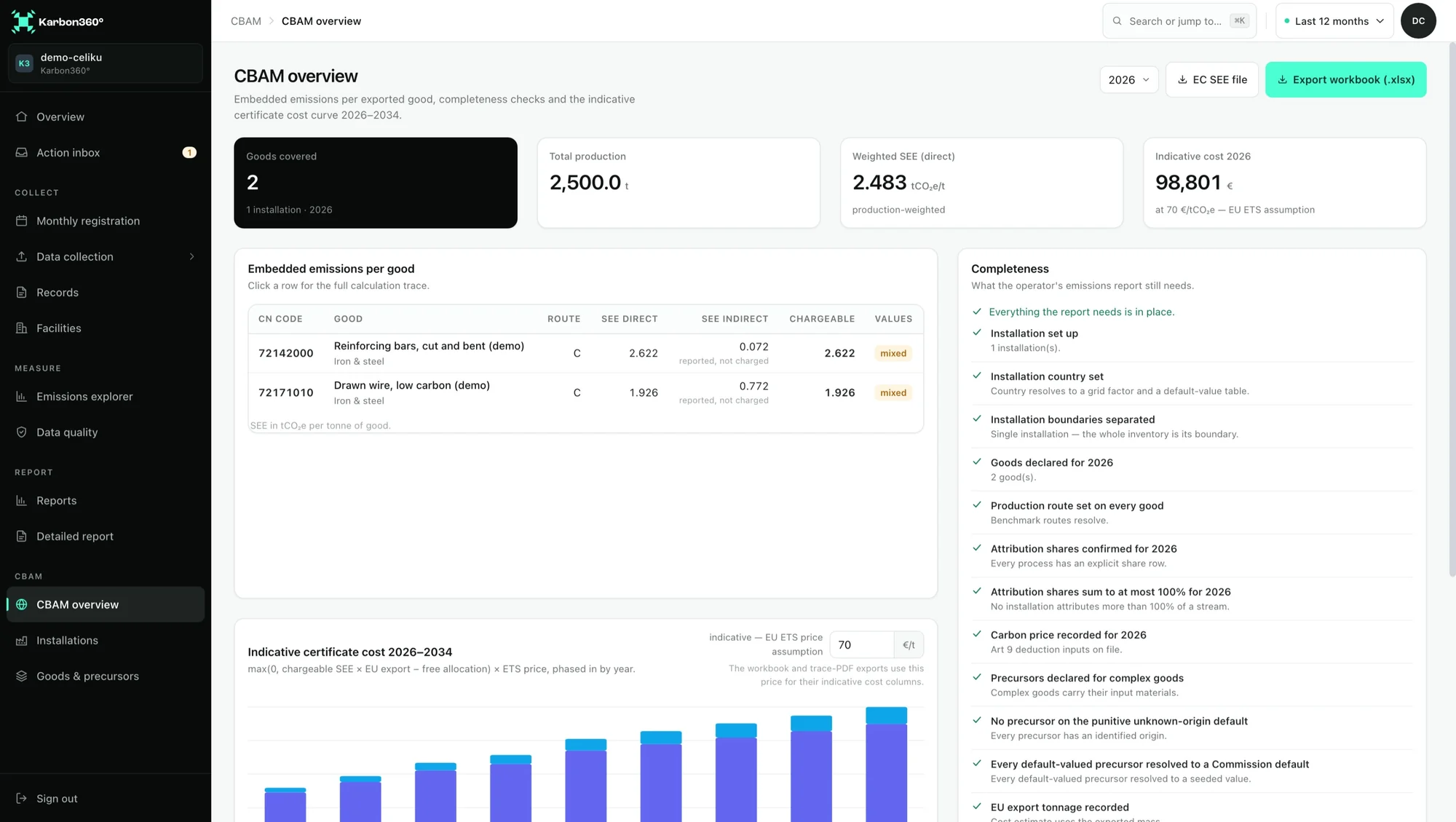
That gap is the case for actual data. In the demo steel plant in our screenshots, the actual specific embedded emissions for CN 7214 20 00 are 2.622 tCO₂e/t, calculated from the plant’s own records.
Iron and steel defaults that apply to Kosovo.
From the “Other countries and territories” table. Route (C) is carbon steel from a blast furnace and basic oxygen furnace. Indirect emissions are N/A for iron and steel.
Iron and steel (tCO₂e per tonne of good)
Other countries table| CN code | Good | Default (tCO₂e/t) | 2026 · +10% | 2027 · +20% | 2028+ · +30% | Route |
|---|---|---|---|---|---|---|
7206 10 00 | Ingots of iron and non-alloy steel | 3.750 | 4.125 | 4.500 | 4.875 | (C) |
7208 | Flat-rolled, hot-rolled, not coated (600 mm and wider) | 4.049 | 4.454 | 4.859 | 5.264 | (C) |
7210 | Flat-rolled, clad, plated or coated (600 mm and wider) | 4.101 | 4.511 | 4.921 | 5.331 | (C) |
7213 | Wire rod, hot-rolled, in coils | 3.996 | 4.396 | 4.795 | 5.195 | (C) |
7214 10 00 | Bars and rods, forged | 4.053 | 4.458 | 4.864 | 5.269 | (C) |
7214 20 00 | Reinforcing bar (ribbed, deformed in rolling) | 3.996 | 4.396 | 4.795 | 5.195 | (C) |
7216 | Angles, shapes and sections | 3.996 | 4.396 | 4.795 | 5.195 | (C) |
7217 10 | Wire, not plated or coated | 3.996 | 4.396 | 4.795 | 5.195 | (C) |
7301 | Sheet piling; welded angles and sections | 4.063 | 4.469 | 4.876 | 5.282 | (C) |
7306 30 80 | Welded circular tubes (168.3–406.4 mm) | 4.141 | 4.555 | 4.969 | 5.383 | (C) |
7308 | Structures and parts of structures | 5.064 | 5.570 | 6.077 | 6.583 | (C) |
7318 15 | Threaded screws and bolts | 4.801 | 5.281 | 5.761 | 6.241 | (C) |
7326 90 98 | Other articles of iron or steel | 4.151 | 4.566 | 4.981 | 5.396 | (C) |
Ferro-alloy defaults that apply to Kosovo, including ferro-nickel.
Ferro-alloys under CN 7202 are CBAM goods in their own right and precursors in steel. Direct emissions only.
Ferro-alloys (tCO₂e per tonne of good)
Other countries table| CN code | Good | Default (tCO₂e/t) | 2026 · +10% | 2027 · +20% | 2028+ · +30% | Route |
|---|---|---|---|---|---|---|
7202 11 | Ferro-manganese, over 2% carbon | 1.690 | 1.859 | 2.028 | 2.197 | — |
7202 19 | Ferro-manganese, 2% carbon or less | 5.590 | 6.149 | 6.708 | 7.267 | — |
7202 41 | Ferro-chromium, over 4% carbon | 2.350 | 2.585 | 2.820 | 3.055 | — |
7202 49 | Ferro-chromium, 4% carbon or less | 2.870 | 3.157 | 3.444 | 3.731 | — |
7202 60 00 | Ferro-nickel | 4.014 | 4.415 | 4.817 | 5.218 | — |
Aluminium defaults that apply to Kosovo.
Route (K) is primary aluminium. Direct emissions only.
Aluminium (tCO₂e per tonne of good)
Other countries table| CN code | Good | Default (tCO₂e/t) | 2026 · +10% | 2027 · +20% | 2028+ · +30% | Route |
|---|---|---|---|---|---|---|
7601 | Unwrought aluminium | 2.203 | 2.423 | 2.644 | 2.864 | (K) |
7604 10 10 | Bars and rods | 3.233 | 3.556 | 3.880 | 4.203 | (K) |
7604 10 90 | Profiles | 3.251 | 3.576 | 3.901 | 4.226 | (K) |
7606 | Plates, sheets and strip (over 0.2 mm) | 3.717 | 4.089 | 4.460 | 4.832 | (K) |
7608 | Tubes and pipes | 3.220 | 3.542 | 3.864 | 4.186 | (K) |
7610 10 00 | Doors, windows and their frames | 3.212 | 3.533 | 3.854 | 4.176 | (K) |
7610 90 90 | Other structures and parts | 3.212 | 3.533 | 3.854 | 4.176 | (K) |
7616 99 90 | Other articles of aluminium | 3.891 | 4.280 | 4.669 | 5.058 | (K) |
Cement defaults that apply to Kosovo.
Cement is charged on direct plus indirect emissions. Route (A) is grey clinker and cement, (B) white.
Cement (tCO₂e per tonne of good)
Other countries table| CN / TARIC | Good | Direct | Indirect | Total | 2026 · +10% | 2027 · +20% | 2028+ · +30% | Route |
|---|---|---|---|---|---|---|---|---|
2523 10 00 90 | Grey clinker (and other clinker) | 1.370 | 0.050 | 1.410 | 1.551 | 1.692 | 1.833 | (A) |
2523 29 00 | Grey Portland cement | 1.360 | 0.080 | 1.440 | 1.584 | 1.728 | 1.872 | — |
2523 90 00 90 | Grey hydraulic cements (and other) | 1.280 | 0.090 | 1.370 | 1.507 | 1.644 | 1.781 | (A) |
2523 10 00 10 | White clinker | 1.320 | 0.060 | 1.370 | 1.507 | 1.644 | 1.781 | (B) |
2523 21 00 | White Portland cement | 1.300 | 0.140 | 1.450 | 1.595 | 1.740 | 1.885 | — |
Replace 3.996 with your own number.
Karbon360 calculates the specific embedded emissions of each good from your installation’s records, under Implementing Regulation (EU) 2025/2547, and shows the other countries default beside it, marked up for the year. Your buyer’s verifier gets the trace for every figure.
- Kosovo goods resolved to the other countries table automatically
- Supplier actuals or defaults for each precursor, labelled in the trace
- Operator’s emissions report workbook and trace PDF
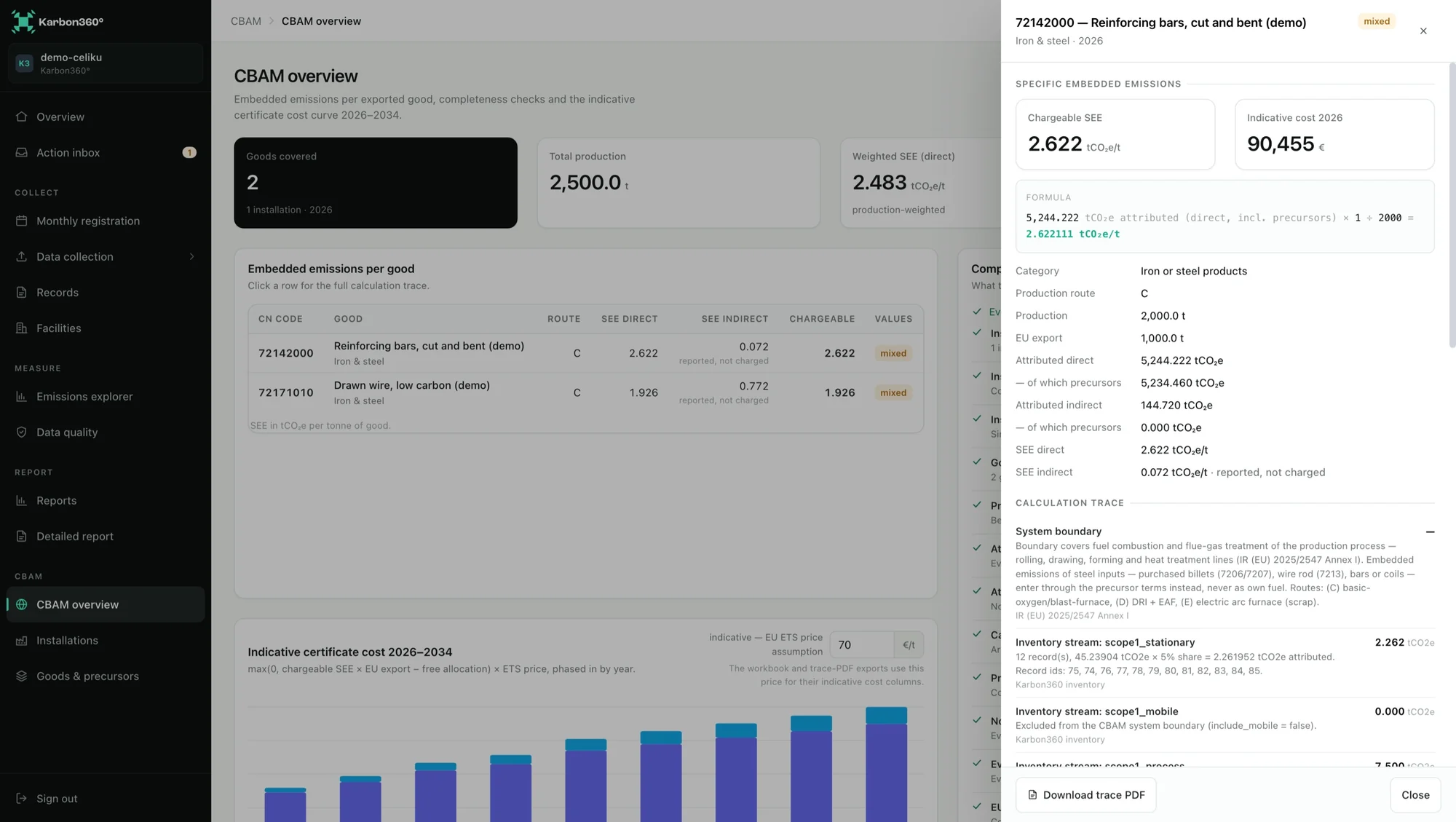
= 2.622111 tCO₂e/t
Frequently asked questions
Does Kosovo have CBAM default values?
Not in its own name. Kosovo is not listed in Annex I of Implementing Regulation (EU) 2025/2621, including the corrected annex of August 2026. Kosovo goods therefore use the “Other countries and territories” values.
What is the CBAM default for Kosovo rebar?
CN 7214 20 00 takes 3.996 tCO₂e per tonne on route (C). With the mark-up the importer declares 4.396 in 2026, 4.795 in 2027 and 5.195 from 2028.
What is the CBAM default value for ferro-nickel from Kosovo?
CN 7202 60 00 takes 4.014 tCO₂e per tonne from the other countries table, 4.415 with the 2026 mark-up.
Is Kosovo electricity covered?
Electricity imported into the EU is a CBAM good, and Kosovo is listed by name in Annex III, which sets default values for imported electricity. We do not reprint that value because it comes from IEA data under a non-commercial licence; see Annex III on EUR-Lex.
What grid factor does Karbon360 use for Kosovo?
For Scope 2, 1.34 kgCO₂e per kWh, the Kosovo national grid factor (World Bank / Grütter Consulting, 2016), location-based. See electricity emission factors by country.
- Implementing Regulation (EU) 2025/2621 — CBAM default values, including Annexes II and III (EUR-Lex)
- Implementing Regulation (EU) 2026/1740 — correction of Annexes I and IV (EUR-Lex)
- Regulation (EU) 2023/956 establishing the CBAM (EUR-Lex)
- Implementing Regulation (EU) 2025/2547 — calculation of embedded emissions (EUR-Lex)
- European Commission — Carbon Border Adjustment Mechanism
Kosovo has no default table. Give your buyer a real number.
Your installation’s records, the other countries default for each CN code and the mark-up for each year, side by side, with the trace attached. Karbon360 is built in Kosovo.