CBAM default values for Montenegro. Aluminium and ferro-alloys, by CN code.
Montenegro’s table in Annex I covers aluminium and three ferro-alloys. Its aluminium values are the lowest in the region for most products. Iron and steel products, cement, fertilisers and hydrogen have no Montenegrin rows, so they take the “other countries” values.
Last updated: 4 November 2026 · Values checked on EUR-Lex
How the Montenegro table works.
What the Montenegro table covers
The table lists aluminium from unwrought metal (CN 7601) to finished articles (7616), all on route (K), primary aluminium. Under iron and steel it lists ferro-manganese, ferro-chromium and ferro-nickel. Low-carbon ferro-manganese (7202 19) and low-carbon ferro-chromium (7202 49) show “–”.
Every other good falls back to the “Other countries and territories” table: iron and steel products, clinker and cement, fertilisers and hydrogen.
Aluminium: a low default still has a mark-up
Montenegro’s aluminium profiles carry 2.290 tCO₂e/t, against 3.059 for Bosnia and Herzegovina and 3.251 in the other countries table. The mark-up still applies: 2.519 in 2026, 2.748 in 2027 and 2.977 from 2028. A fabricator whose actual direct emissions and precursors come in lower than that has a reason to send actual data.
Steel and cement fall back
With no Montenegrin rows, reinforcing bar takes 3.996 tCO₂e/t and grey clinker 1.410, the other countries values. Those are the numbers an importer declares for Montenegrin steel and cement without actual data.
Aluminium default values, Montenegro.
Direct emissions only; the Annex shows indirect emissions as N/A for aluminium.
Aluminium (tCO₂e per tonne of good)
Montenegro table| CN code | Good | Default (tCO₂e/t) | 2026 · +10% | 2027 · +20% | 2028+ · +30% | Route |
|---|---|---|---|---|---|---|
7601 | Unwrought aluminium | 1.700 | 1.870 | 2.040 | 2.210 | (K) |
7603 | Aluminium powders and flakes | 2.050 | 2.255 | 2.460 | 2.665 | (K) |
7604 10 10 | Bars and rods | 2.280 | 2.508 | 2.736 | 2.964 | (K) |
7604 10 90 | Profiles | 2.290 | 2.519 | 2.748 | 2.977 | (K) |
7604 21 00 | Hollow profiles | 2.290 | 2.519 | 2.748 | 2.977 | (K) |
7605 | Aluminium wire | 2.280 | 2.508 | 2.736 | 2.964 | (K) |
7606 | Plates, sheets and strip (over 0.2 mm) | 2.730 | 3.003 | 3.276 | 3.549 | (K) |
7607 | Aluminium foil | 2.730 | 3.003 | 3.276 | 3.549 | (K) |
7608 | Tubes and pipes | 2.290 | 2.519 | 2.748 | 2.977 | (K) |
7610 10 00 | Doors, windows and their frames | 2.290 | 2.519 | 2.748 | 2.977 | (K) |
7610 90 90 | Other structures and parts | 2.290 | 2.519 | 2.748 | 2.977 | (K) |
7614 | Stranded wire and cables (not insulated) | 2.280 | 2.508 | 2.736 | 2.964 | (K) |
7616 99 10 | Other articles, cast | 2.050 | 2.255 | 2.460 | 2.665 | (K) |
7616 99 90 | Other articles of aluminium | 2.730 | 3.003 | 3.276 | 3.549 | (K) |
Ferro-alloy default values, Montenegro.
Low-carbon ferro-manganese and ferro-chromium show “–” and fall back to the other countries table (5.590 and 2.870).
Ferro-alloys (tCO₂e per tonne of good)
Montenegro table| CN code | Good | Default (tCO₂e/t) | 2026 · +10% | 2027 · +20% | 2028+ · +30% | Route |
|---|---|---|---|---|---|---|
7202 11 | Ferro-manganese, over 2% carbon | 1.690 | 1.859 | 2.028 | 2.197 | — |
7202 41 | Ferro-chromium, over 4% carbon | 2.350 | 2.585 | 2.820 | 3.055 | — |
7202 60 00 | Ferro-nickel | 3.480 | 3.828 | 4.176 | 4.524 | — |
Montenegrin steel uses the other countries table.
No Montenegrin rows exist for iron and steel products, so these values apply. Direct emissions only.
Iron and steel (tCO₂e per tonne of good)
Other countries table| CN code | Good | Default (tCO₂e/t) | 2026 · +10% | 2027 · +20% | 2028+ · +30% | Route |
|---|---|---|---|---|---|---|
7206 10 00 | Ingots of iron and non-alloy steel | 3.750 | 4.125 | 4.500 | 4.875 | (C) |
7213 | Wire rod, hot-rolled, in coils | 3.996 | 4.396 | 4.795 | 5.195 | (C) |
7214 20 00 | Reinforcing bar (ribbed, deformed in rolling) | 3.996 | 4.396 | 4.795 | 5.195 | (C) |
7216 | Angles, shapes and sections | 3.996 | 4.396 | 4.795 | 5.195 | (C) |
7308 | Structures and parts of structures | 5.064 | 5.570 | 6.077 | 6.583 | (C) |
Montenegrin cement uses the other countries table.
Cement is charged on direct plus indirect emissions. No Montenegrin rows exist, so these values apply.
Cement (tCO₂e per tonne of good)
Other countries table| CN / TARIC | Good | Direct | Indirect | Total | 2026 · +10% | 2027 · +20% | 2028+ · +30% | Route |
|---|---|---|---|---|---|---|---|---|
2523 10 00 90 | Grey clinker (and other clinker) | 1.370 | 0.050 | 1.410 | 1.551 | 1.692 | 1.833 | (A) |
2523 29 00 | Grey Portland cement | 1.360 | 0.080 | 1.440 | 1.584 | 1.728 | 1.872 | — |
2523 90 00 90 | Grey hydraulic cements (and other) | 1.280 | 0.090 | 1.370 | 1.507 | 1.644 | 1.781 | (A) |
Your actual SEE, next to the Montenegro default.
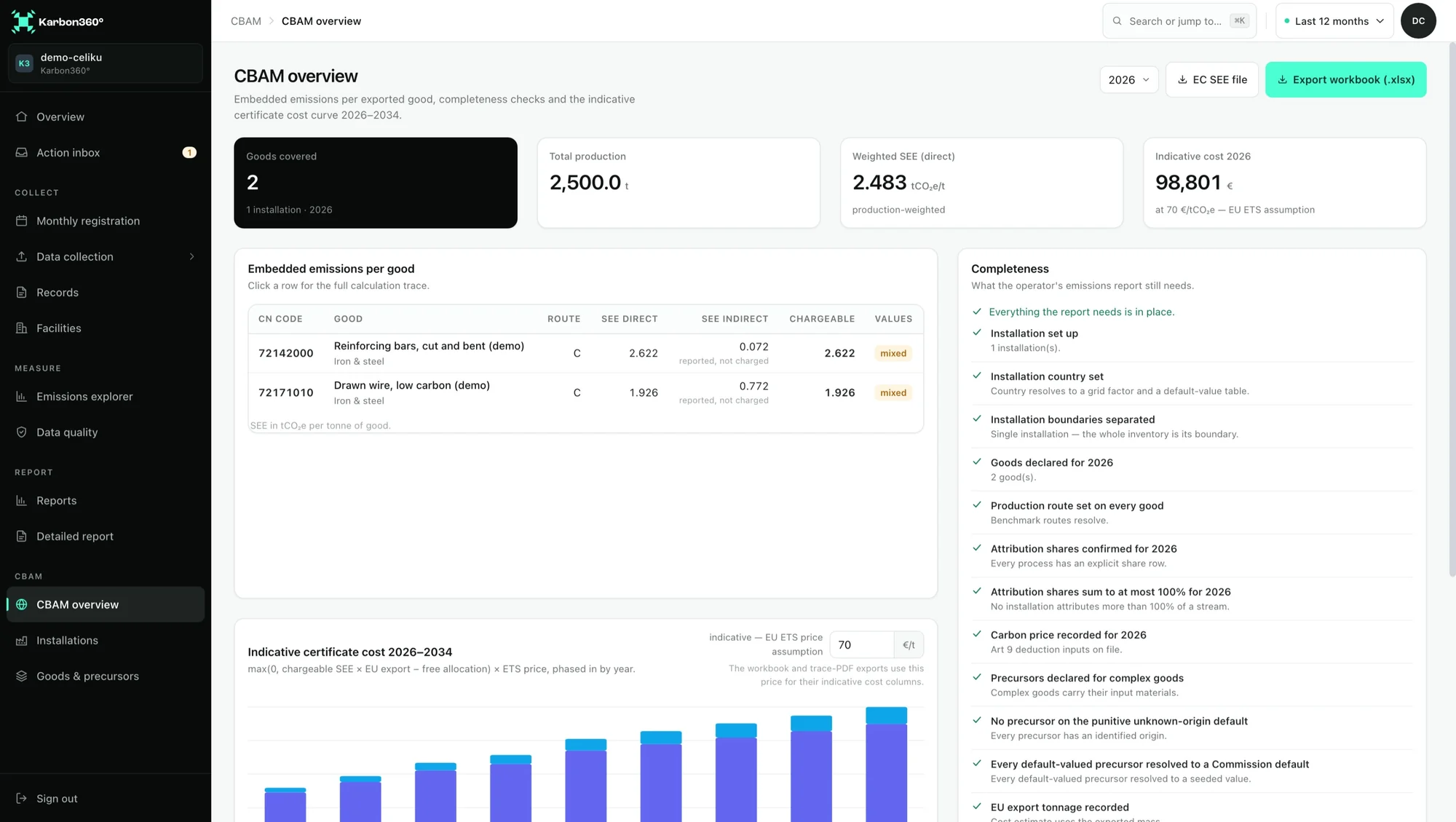
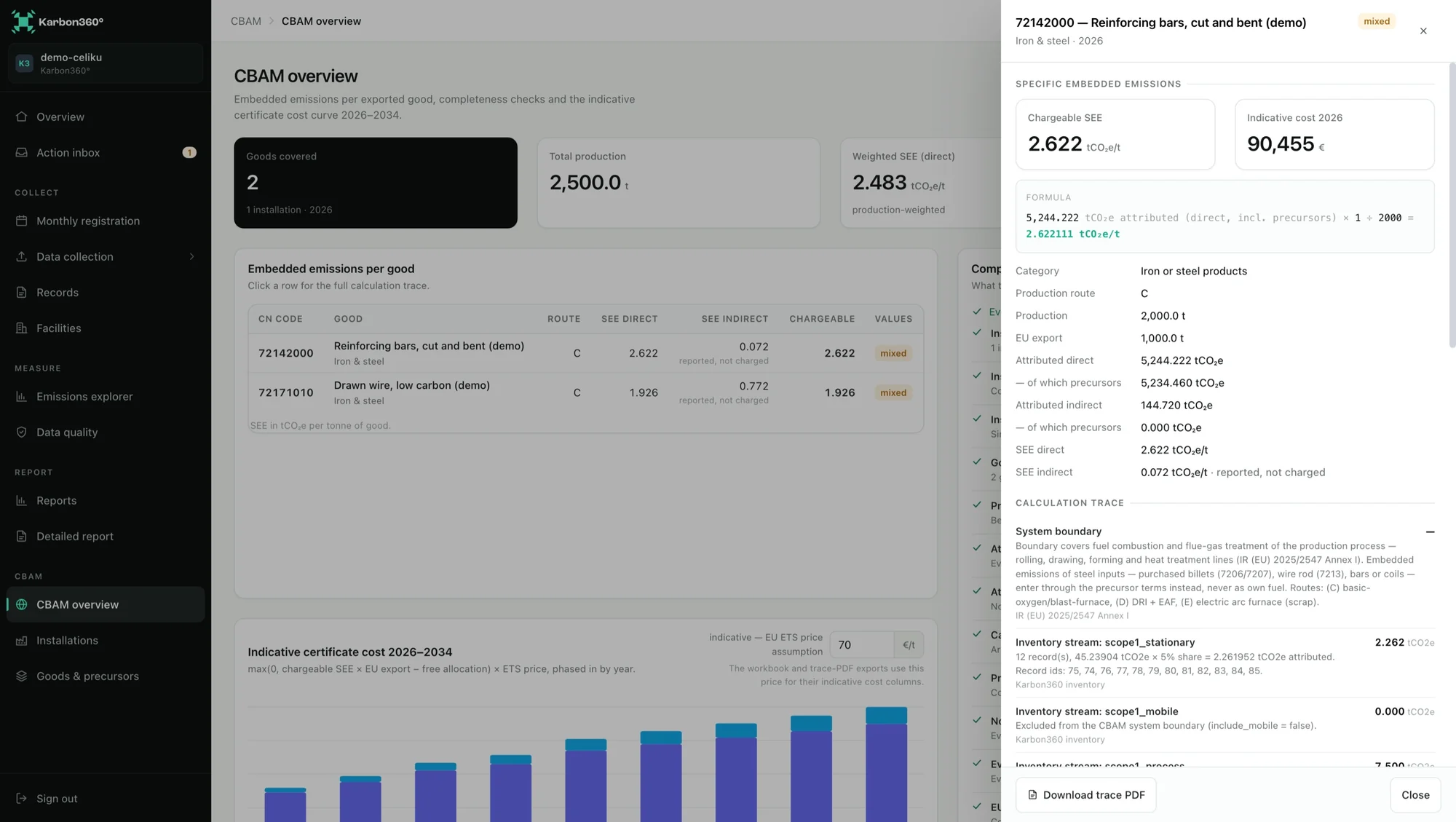
Karbon360 calculates specific embedded emissions per CN code from your installation’s records, under Implementing Regulation (EU) 2025/2547, and shows the default that applies to your good beside it, from the Montenegro table or the other countries table.
- Montenegro and other countries defaults built in
- Precursors on supplier actuals or on defaults, labelled in the trace
- Trace PDF for your buyer’s verifier
Frequently asked questions
What is the CBAM default value for Montenegrin aluminium?
Unwrought aluminium (CN 7601) carries 1.700 tCO₂e per tonne. Profiles, tubes and doors and windows carry 2.290, and plates, sheets and foil 2.730, all before the mark-up.
Does Montenegro have default values for steel?
Only for ferro-alloys: ferro-manganese over 2% carbon, ferro-chromium over 4% carbon and ferro-nickel. Other iron and steel products take the “Other countries and territories” values, for example 3.996 for reinforcing bar.
What is the default for Montenegrin cement?
Montenegro has no cement rows, so grey clinker takes 1.410 tCO₂e per tonne and grey Portland cement 1.440, the other countries values.
How much is the mark-up in 2027?
20% on the total-emissions value for aluminium, steel, cement and hydrogen. For Montenegrin aluminium profiles that turns 2.290 into 2.748 tCO₂e per tonne.
See where your plant sits against the Montenegro default.
Your installation’s records, the default for each CN code and the mark-up for each year, side by side, with the trace attached.