






PACT v3.0 conformance tests passed · 41 of 41

Carbon management software for CBAM, CSRD and green lending.Your buyer asked for emissions data.Answer it.

Karbon360° turns the invoices you already hold into a greenhouse-gas inventory a bank, customer or reviewer will accept — with locally accurate factors and a calculation trace behind every figure.

Scope 1, 2 and 3CBAM embedded emissions per goodProduct footprints over PACT
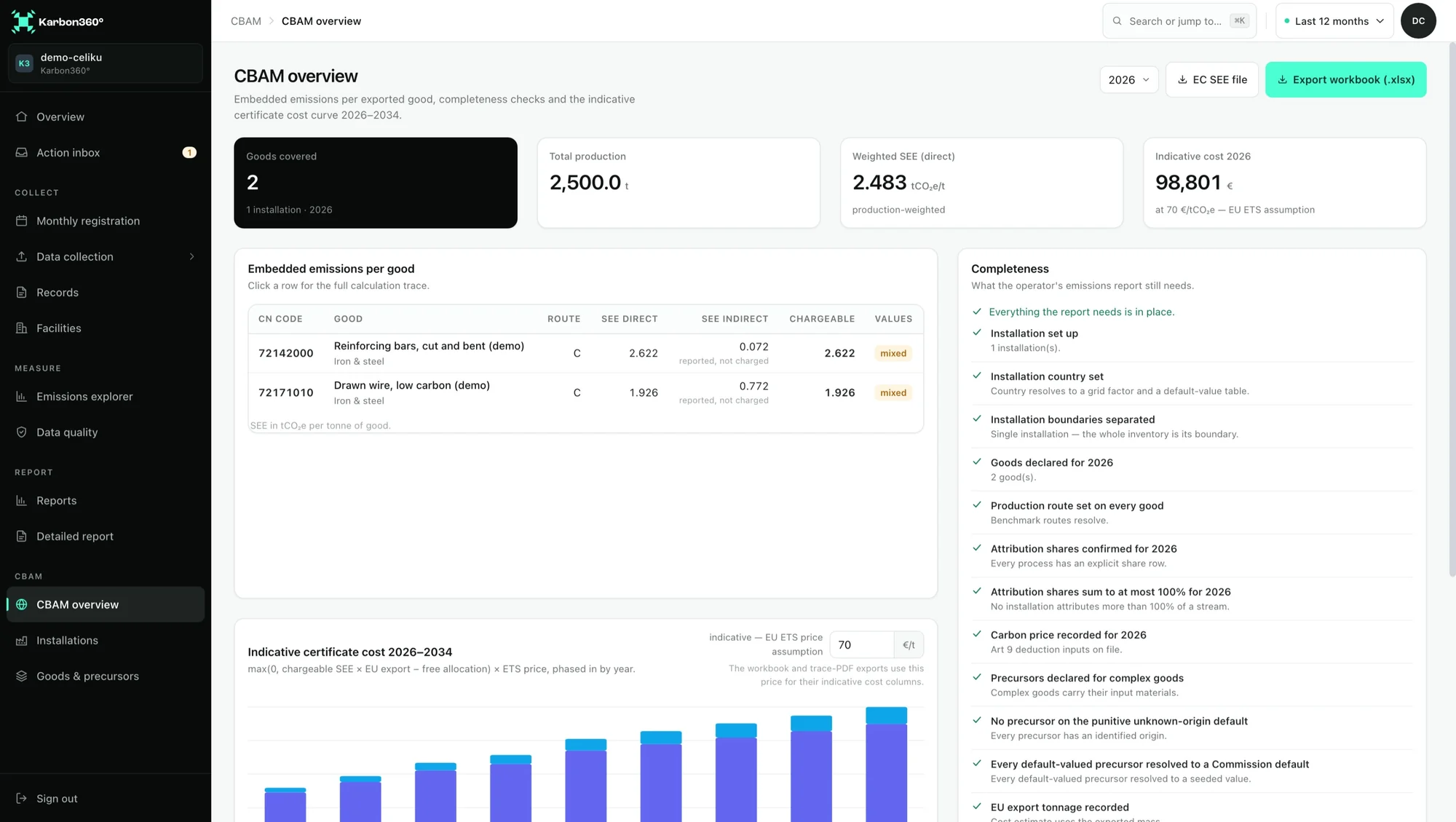
The Karbon360 CBAM overview: goods covered, total production, weighted specific embedded emissions and the indicative certificate cost, with embedded emissions per good
Chargeable SEE · CN 72142000
2.622tCO₂e/t
Route C · trace attached
Product footprint sent to buyer
Footprint published · v3.0
Buyer request answered
Next period accruing

Organisations working with Karbon360

UNHZUMIBUShAFMeridian ExpressWander BalkansRilindja GjelbërHabitat

None of this is voluntary. The trigger is a buyer, a bank or a border.

Which is why the conversation is about acceptance, not sustainability.

01 · Why now

Three pressures, one desk.

Emissions data is reaching Balkan companies the way every compliance requirement does — from outside, with a deadline attached.

1 Jan 2026 — live

CBAM definitive regime

EU importers of steel, aluminium, cement, fertilisers, hydrogen and electricity must account for embedded emissions. They are collecting installation-level data from suppliers now; certificate purchases begin February 2027.

Trigger · a CBAM data request
2026 → rolling

CSRD value-chain requests

Large EU companies report their value chains. Simplified and rescheduled by the 2025 Omnibus, but the direction is unchanged: their suppliers receive emissions questionnaires and scorecards.

Trigger · a customer questionnaire
Every renewal

Green-lending conditions

Sustainability-linked credit lines, often IFI-backed, increasingly require a GHG baseline at application and annual updates over the life of the loan.

Trigger · a bank requirement
02 · Who buys, and why

Companies without a sustainability department.

The buyer inside the company is the CFO, the finance manager or the operations manager. They have the invoices. What they need is the calculation between the invoice and the answer to be correct and defensible.

03 · How it works

Carbon management software: invoices in, a number they accept out.

The same chain runs every month. What you already hold goes in, each step keeps its receipt, and the report comes out with the trace still attached.

01

Extract

Supplier, meter and period read from the document.

02

Apply factor

Local grid or fuel factor, at the version current for that month.

03

Recompute

Server-side, independently of what was stored.

04

Check

Coverage and reconciliation reported, gaps stated.

Scope 2 is 61% of your footprint

Grid electricity at the Ferizaj plant — the first place a reduction target will pay.

March is missing two invoices

Coverage 94%. Stated in the report rather than estimated away.

Report FY 2026CBAM packBuyer questionnaireLender filePACT footprint

Nearly every real request is a request for Scope 1 and Scope 2 done properly.

That is where the product is deepest.

04 · The platform

From an energy bill to a filed report.

Nothing here is a mock-up. These are the product’s own screens, on a demo steel installation.

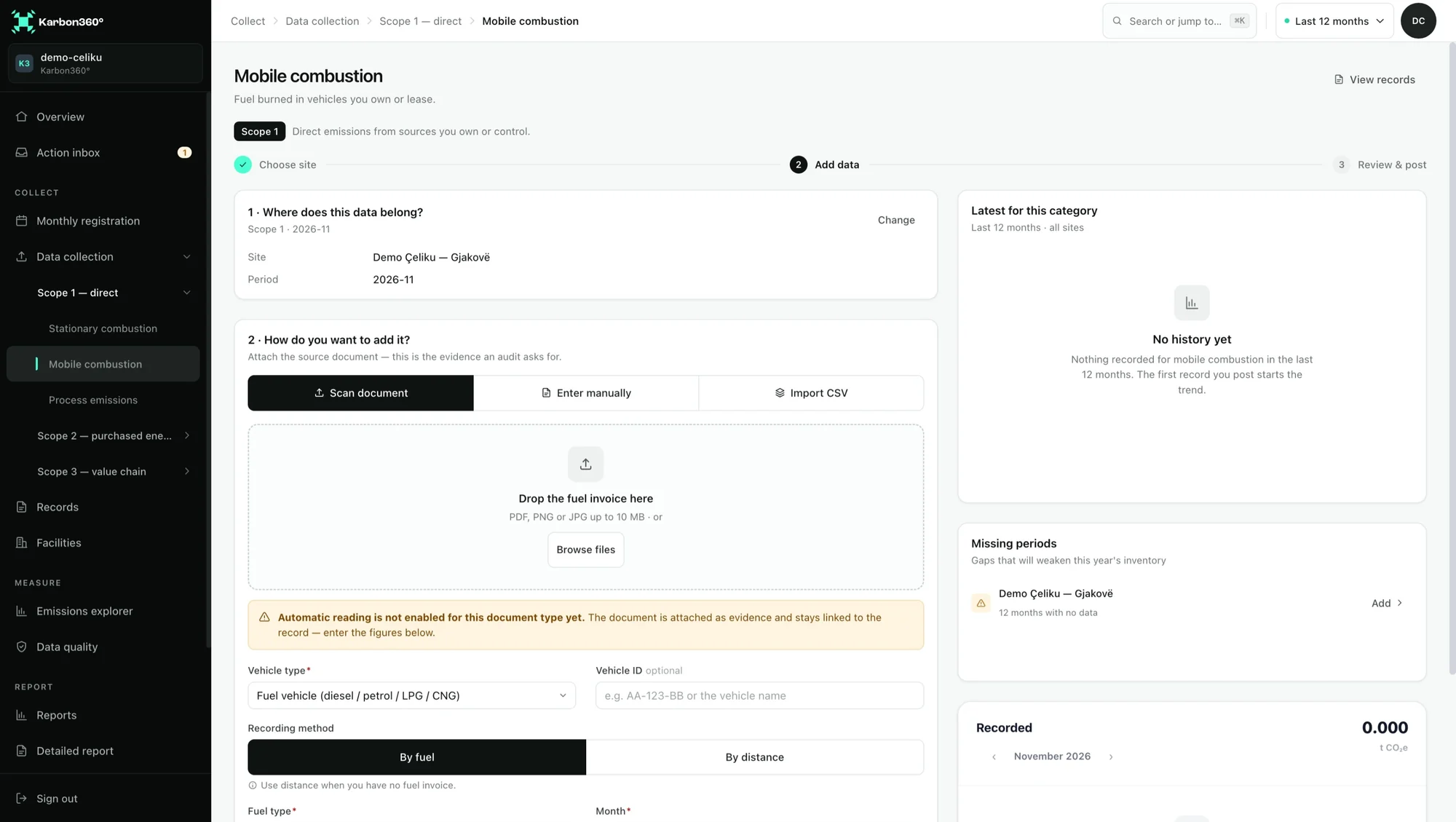
Collect01

Drop the bill. It reads the rest.

Scan a supplier bill, type it manually or import a CSV. The platform reads the supplier, the meter and the billing period, then asks you to confirm anything it is less than 90% sure about.

  • Source document stays attached — the evidence review asks for
  • Guided by scope, so nobody has to know which category a bill belongs to
  • Missing periods surfaced per facility before they become gaps
Karbon360 data collection: a three-step wizard with document scan, manual entry and CSV import, and a panel listing missing periods
Reading fuel invoice
Supplier recognised
Billing period 2026-11
1,240 L diesel
Confirm amount
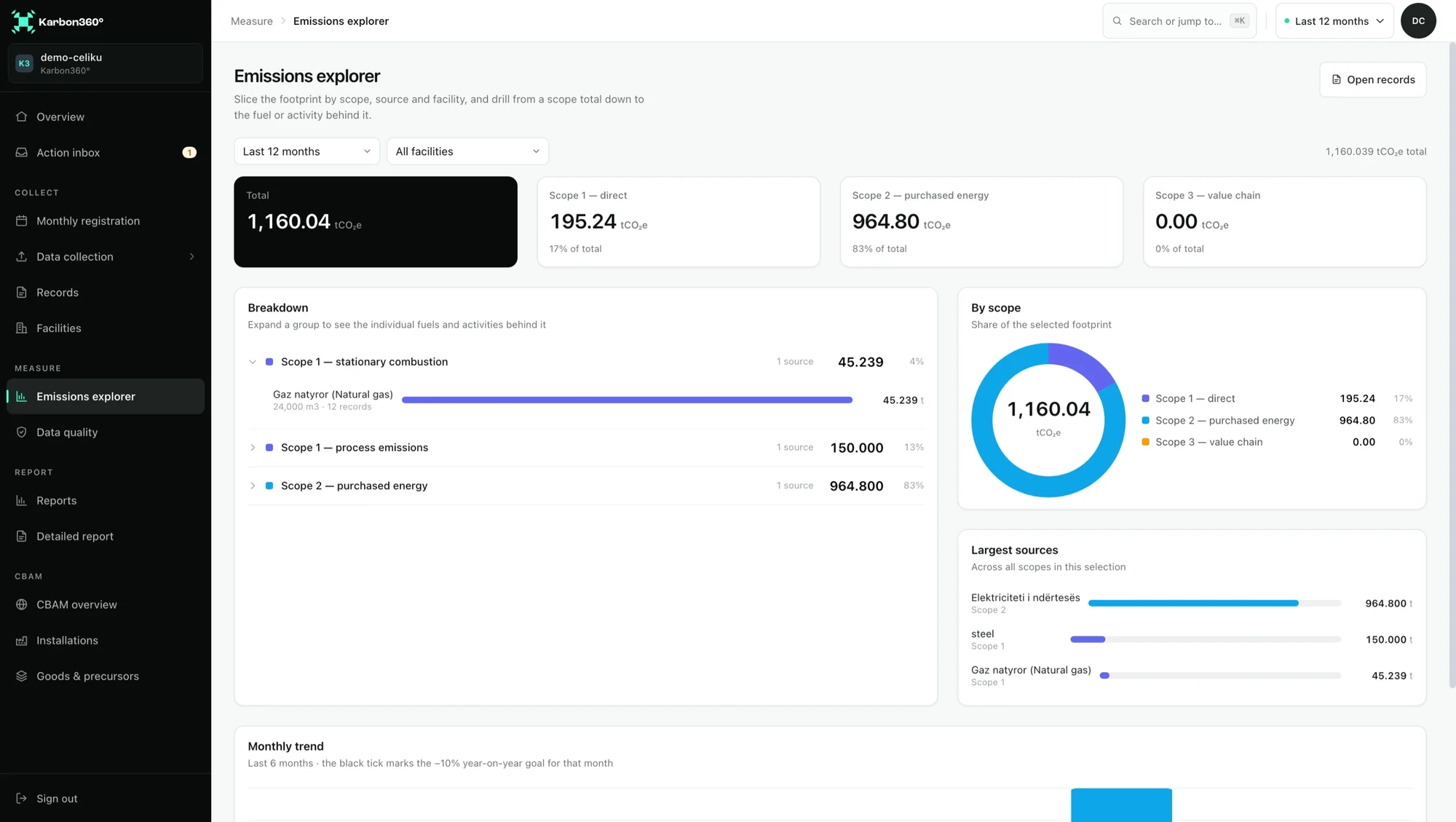
Explore02

Drill from a scope total to the litre of fuel behind it.

Slice the footprint by scope, source and facility, then open any group to see the individual fuels and activities underneath — with the record count behind each number.

  • Scope 1, 2 and 3 split, with share of total on every row
  • Largest sources ranked across the whole selection
  • Every figure links straight through to its records
Karbon360 emissions explorer: a scope breakdown expanded to individual fuels, a scope donut and the largest sources ranked
Scope 2 — purchased energy
964.80tCO₂e
83% of the selected footprint
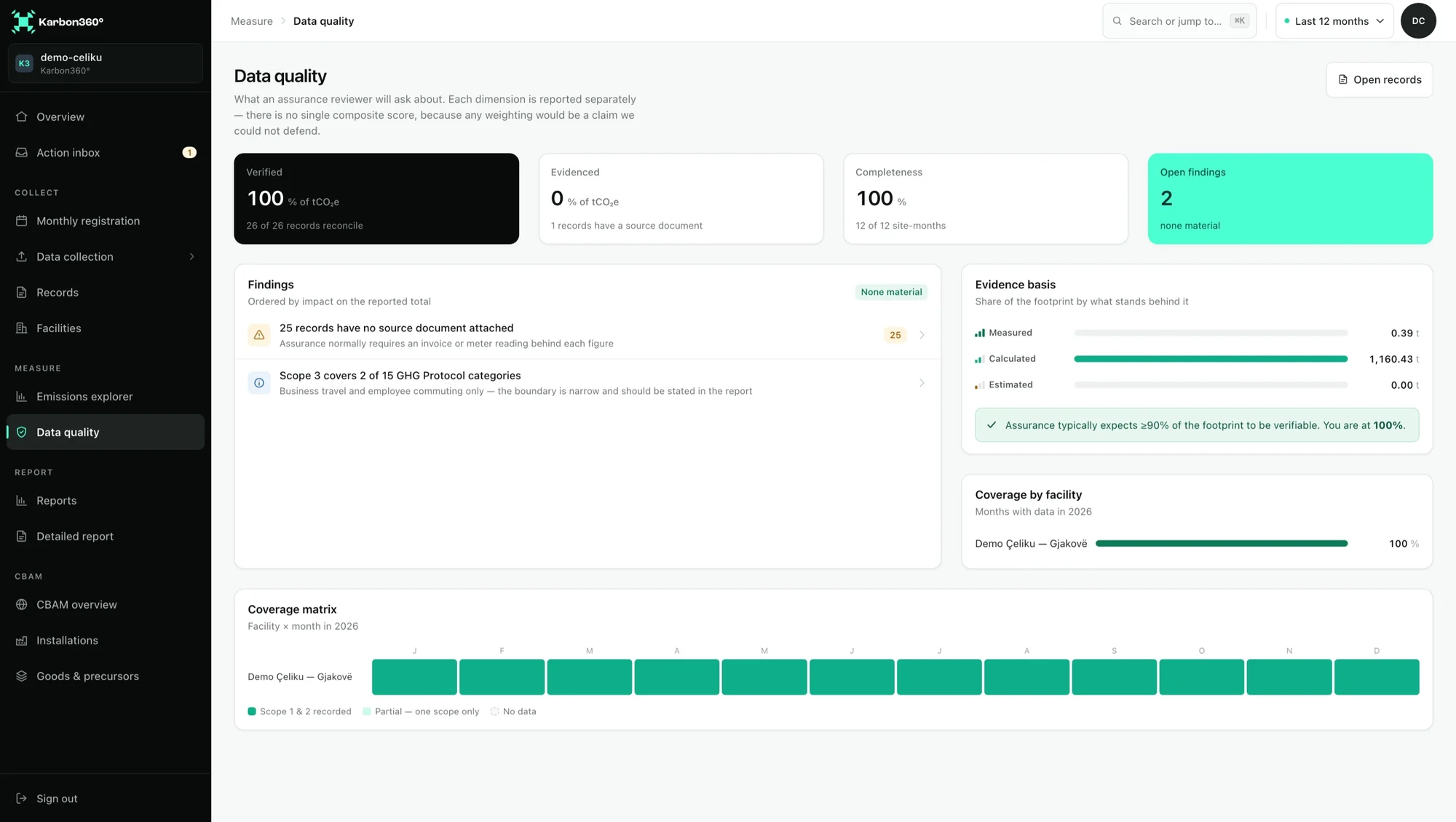
Data quality03

The number you are not supposed to like.

Data quality is reported as separate dimensions, not a single flattering score — because any weighting would be a claim we could not defend. If part of your footprint has no evidence behind it, it says so.

  • Findings ordered by impact on the reported total
  • Evidence basis split into measured, calculated and estimated
  • Coverage matrix showing every facility and month
Karbon360 data quality: reconciliation, evidence and completeness shown separately, findings ordered by impact and a facility-by-month coverage matrix
Completeness
12/ 12 months
2 findingsnone material
Trace04

Open any figure. The arithmetic is right there.

Every figure carries its calculation trace: the activity as entered, the factor and its version, the server-recomputed result — and a flag when a stored figure no longer reconciles with the factor on file.

  • Formula shown in full, not summarised
  • Factor version pinned, so old reports still reproduce
  • Discrepancies flagged for review, never silently restated
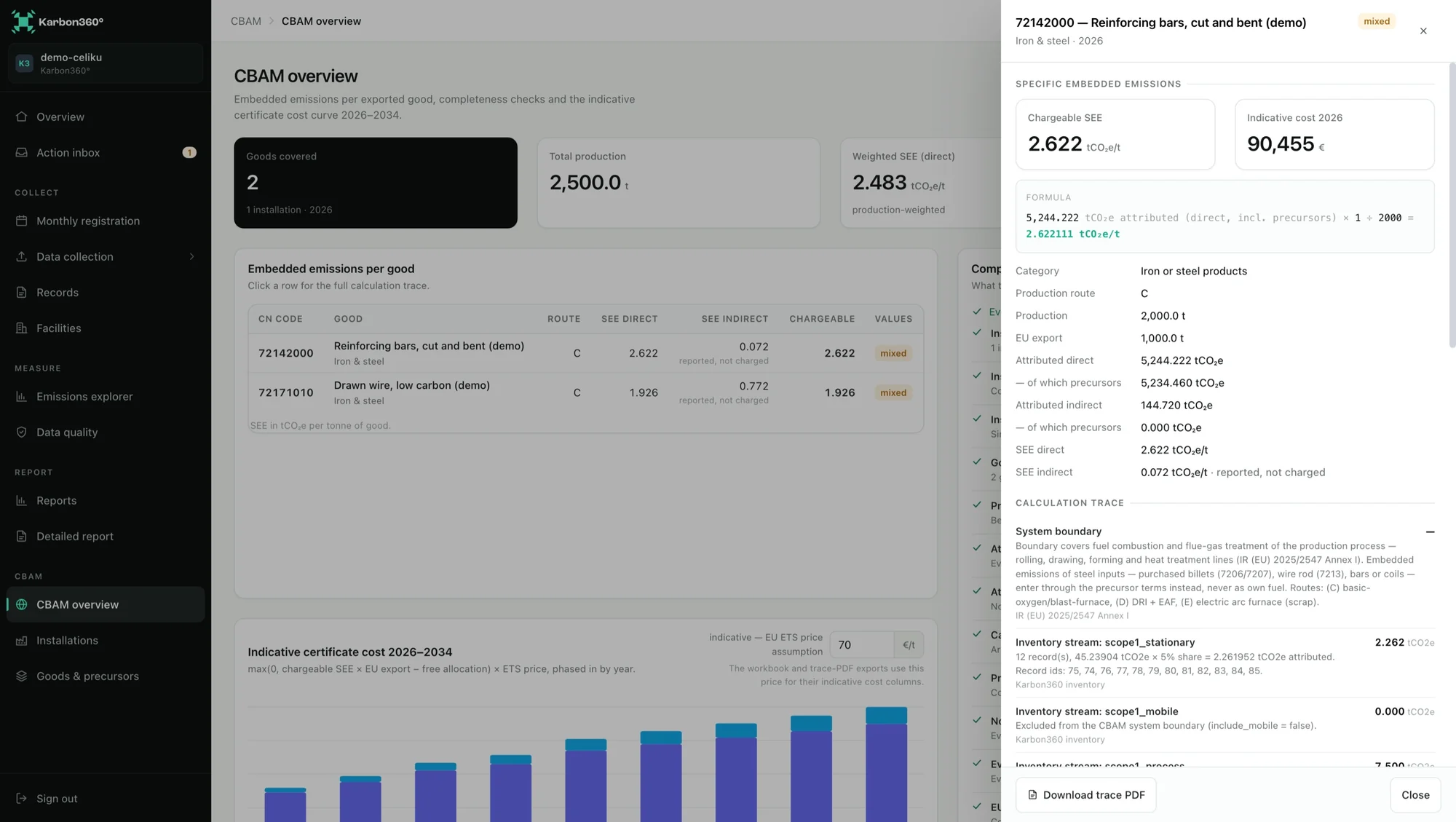
Karbon360 calculation trace for a reinforcing-bar good: specific embedded emissions, the formula, system boundary and each inventory stream
Formula
5,244.222 tCO₂e × 1 ÷ 2,000 t
= 2.622111 tCO₂e/t
CBAM05

Embedded emissions per good, in the shape your importer files.

Installations, production processes, goods and precursors per CN code. Specific embedded emissions are calculated under Implementing Regulation (EU) 2025/2547, with Commission default values built in for anything you cannot yet measure.

  • Operator’s emissions report workbook and trace PDF
  • Completeness checks before the importer asks
  • Indicative certificate cost curve to 2034
CBAM for Western Balkan exporters — what your importer needs, and when.
Karbon360 CBAM overview with embedded emissions per good and the completeness checklist
Completeness for 2026
Installation boundaries separated
Production route on every good
Precursors declared
PACT exchange06

Let your buyer’s system ask for the footprint directly.

Karbon360 passed the WBCSD PACT conformance tests for Tech Specs v3.0. Publish a product carbon footprint per good, and an EU customer’s software can request it through the standard PACT API instead of another spreadsheet.

  • Footprints published per CN code, versioned and append-only
  • Requests from buyers answered automatically
  • Boundary stated on every footprint: CBAM production boundary
GET /3/footprints · 200
status "Active"
productIds urn:pact:karbon360.tech…
classification CN 72142000
geography XK
declaredUnit kilogram
pcfExcludingBiogenic 2.690721
Conformance · v3.0
41/ 41 tests
WBCSD PACT
Languages07

The whole product, not just the buttons.

The person entering invoices is rarely the person reading EU guidance. The interface, the findings and the guidance text run in Albanian and English, and reports export in English for the EU buyer.

  • Interface, help text and exports localised
  • Reports still export in English for the EU buyer
  • Making people work in a second language is where data quality dies
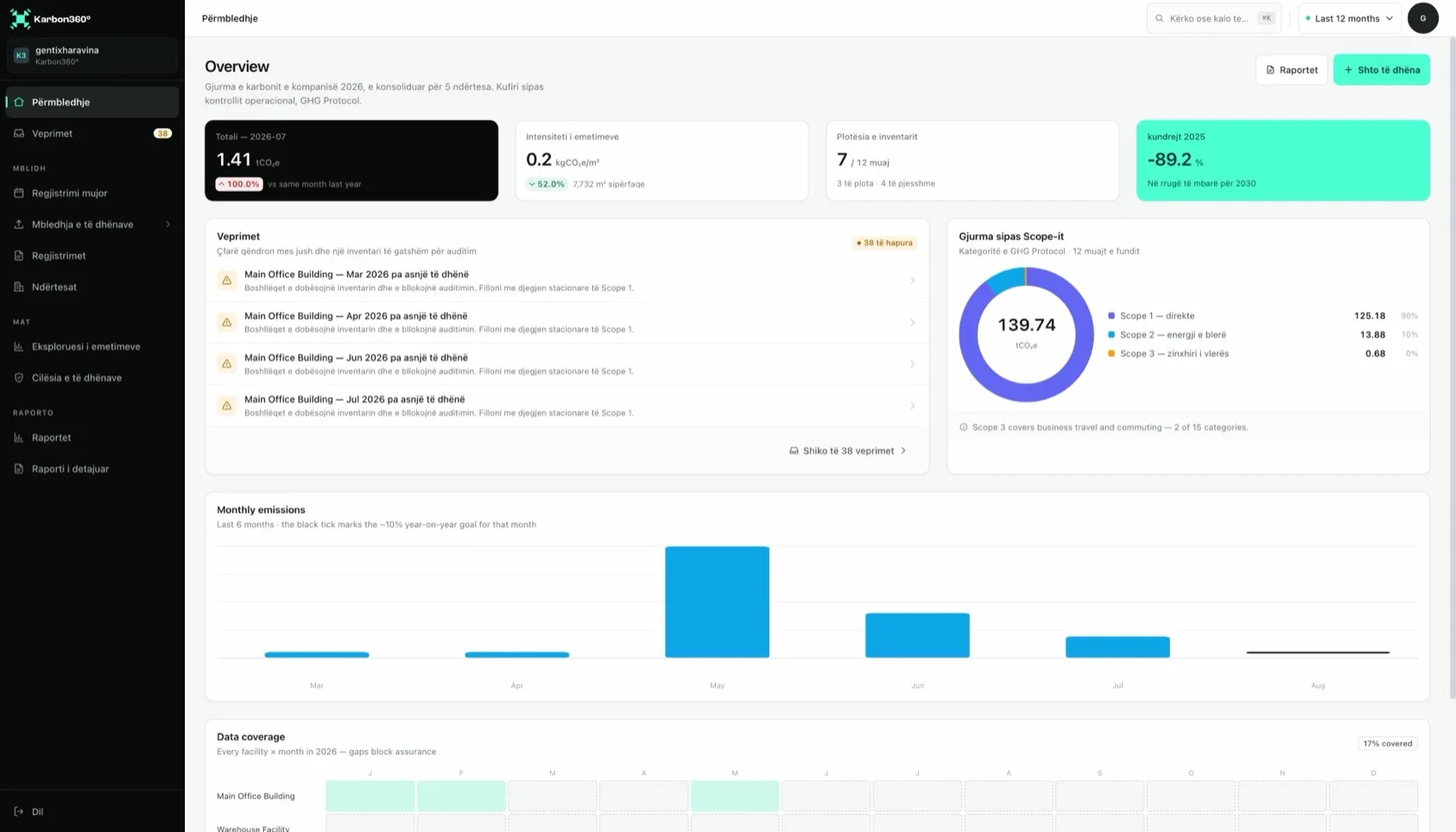
The Karbon360 overview screen in Albanian, with localised navigation, headings and guidance text
05 · Three principles

The buyer’s real question is never “is the report pretty?”

It is “will my bank or my customer accept this?” Everything in the platform serves that question.

01 — Local accuracy

Factors that match reality here

Calculations use locally accurate emission factors for the region’s grids and fuels — not international averages. On some Balkan grids a European-average factor misstates the result by multiples.

02 — Traceability

Every figure shows its work

Each record stores the exact factor used, its version and a server-side recomputation. Any number in any report traces back to the data and factor that produced it.

03 — Honesty

Data quality without vanity

Coverage and reconciliation are reported separately, never blended into a score. When something does not reconcile, the report says so plainly — because a reviewer will notice anyway.

Evidence basis

Share of the footprint by what stands behind it

Measured48.1 t
Calculated87.6 t
Estimated5.6 t

Review expects at least 90% of a footprint to be verifiable. Karbon360 tracks that share continuously, so you know where you stand months before your reviewer asks.

Calculation trace · scope1-process-1

One record, everything a reviewer asks for

Emission factorlime · 750 kgCO₂e/t
Factor versionv1 · pinned
Server recomputed0.937500 tCO₂e
Evidence tierMeasured
Source documentProduction log · Mar 2026
Reconciles. The factor version is pinned, so this record still reproduces in 2029.
PACT Conformant badge

Karbon360 is PACT conformant

Listed on the PACT Network after passing conformance testing for PACT Technical Specifications v3.0. PACT, the Partnership for Carbon Transparency, is an initiative hosted by WBCSD.

How it works
06 · Your market

Same product, a different door in each country.

Where the pressure comes from

Western Balkans · 2026
CountryRelationship to EU rulesMain pressure on companiesPriority sectors
CroatiaEU member — companies are directly in scopeDirect compliance: CBAM declarants, CSRD reporters and their suppliers, EU-bank lending conditionsImporters of steel and aluminium, construction materials, food processing, manufacturing suppliers to EU groups
AlbaniaCandidate — supplier side of EU rulesEU customers' data requests, bank baselines; a hydro-heavy grid makes correct local factors a genuine advantageTextile and footwear (fason), food exporters, construction materials, metal processing
North MacedoniaCandidate — supplier side of EU rulesCBAM exposure in metals; a coal-heavy grid makes electricity the dominant footprint lineSteel, ferroalloys, automotive components, agri-food
MontenegroCandidate — supplier side of EU rulesEU buyer requests and green-lending conditions; mixed hydro/coal gridMetals (aluminium), food, construction, hospitality supply chains
Croatia = complianceElsewhere = readinessBoth run on the same inventory
07 · Why it is different

Built where the pressure is arriving.

The tools available for answering these requests were built elsewhere. Generic international platforms calculate with European-average factors that misstate results in this region, produce polished reports whose numbers cannot be traced, and price for markets that have sustainability departments.

Built in
The region it serves

Local grid and fuel factors, and the languages your team already works in — not a translation layer over a European tool.

Markets served
4 + Kosovo

Croatia, Albania, North Macedonia, Montenegro.

Access
Subscribe online

Guided setup runs inside the app, so the first inventory is structured correctly from month one.

Boundary
Stated, always

Scope 3 covers business travel and commuting today. The rest is a roadmap decision, not a hidden gap.

08 · The clock

The bill for 2026 arrives in September 2027.

CBAM stopped being paperwork on 1 January 2026. Emissions embedded in goods imported since then carry a real price, payable in certificates. The data you need is historic — it cannot be reconstructed later.

31 Dec 2025

Transitional period ends

Quarterly reports, no cost

1 Jan 2026

Definitive period opens

Emissions begin accruing a real liability

You are here

2026 data accruing

Every unrecorded month is exposure you cannot recover

1 Feb 2027

Certificates on sale

Central common platform opens

30 Sep 2027

First surrender

Annual declaration for 2026 imports

The numbers behind the deadline

What 2026 actually costs.

€0.00
Per tonne CO₂, first published quarter
0 t
De minimis exemption threshold
0
Sectors in the first wave
0/41
PACT v3.0 conformance tests passed
09 · Keep going

Guides, manuals and answers for your next request.

Karbon360° (sometimes written Carbon360 or Carbon 360) comes with the explanations we wish every supplier had: free to read, written for people who are not carbon specialists.

10 · Questions

What exporters actually ask.

Still unsure? Schedule a call and bring your last request.

Do I have to file a CBAM report myself?

No. Only the authorised CBAM declarant files — the EU importer of record, or an indirect customs representative acting for them. A producer outside the EU never touches the registry. But the declarant cannot file without your installation-level data, which is why the request lands in your inbox rather than theirs.

My buyer is under 50 tonnes. Am I off the hook?

Through that buyer, yes. The de minimis exemption applies to the importer, not the producer, so the same factory can be exempt through one customer and fully in scope through another. Since you cannot predict which buyer will ask, the only workable position is to have the data ready before any of them do.

Does Karbon360 cover Scope 3?

Business travel and employee commuting — the two categories customers ask for first. The boundary is stated explicitly in every report. The remaining categories are a roadmap decision, and we label roadmap as roadmap rather than implying coverage we do not have.

Why does the platform show me a low data-quality score?

Because your reviewer will. Review normally expects at least 90% of the footprint to be verifiable, and most inventories start well below that. Showing you a comfortable number would only move the disappointment to the point where it costs you money.

Can we just use the Commission’s default values?

You can, and they are deliberately set high — they exist to remove any incentive to withhold real data. For most producers in the region, particularly those on hydro-heavy grids, actual installation-level figures come in materially below the default. That gap is the entire commercial argument for measuring properly.

Can our EU customer pull product footprints directly?

Yes. Karbon360 passed the WBCSD PACT conformance tests for Tech Specs v3.0, so a buyer’s system can request and receive your product carbon footprints through the standard PACT API. Each footprint states its boundary: the CBAM production boundary, direct and indirect emissions.

See it against your own invoices.

Bring one month of energy bills and one production figure. In thirty minutes you will have a traced Scope 1 and 2 number for your facility — and an honest read on how much of it would survive review.