
CBAM CN codes: the full list of CBAM products, sector by sector
CBAM covers the goods listed by Combined Nomenclature (CN) code in Annex I to Regulation (EU) 2023/956: cement and calcined clay, electricity, nitrogen fertilisers, iron and steel, aluminium, and hydrogen. If the CN code on the customs declaration is in Annex I, the good is in scope; if it is not, it is not. Below is every code in force on 6 November 2026, the goods that are carved out, and where the proposed extension to downstream products stands.
Published 6 November 2026 · Legislative status of the downstream extension checked 6 November 2026
How CBAM scope follows the CN code.
Which goods are CBAM products
Article 2 of the CBAM Regulation applies to goods listed in Annex I that originate in a third country and are imported into the EU. Annex I identifies goods only by CN code, the EU’s eight-digit version of the Harmonised System, under Regulation (EEC) No 2658/87. Coverage follows the classification on the customs declaration, not the name of the industry, so one plant can be in scope for one product line and out of scope for another.
The first six digits of a CN code are the HS code. A four-digit heading in Annex I, such as 7318 or 7604, covers every CN code beneath it. An entry marked “ex” covers only part of the code: for ex 2507 00 80, only calcined kaolinic clays.
Goods from these countries are out
Goods originating in Iceland, Liechtenstein, Norway and Switzerland, and in Büsingen, Heligoland, Livigno, Ceuta and Melilla, are outside CBAM (Annex III). Origin is decided by the EU’s non-preferential rules of origin. Goods from Kosovo, Albania, North Macedonia, Montenegro and Bosnia and Herzegovina are in scope.
Why the sector matters for the number
Annex II lists the goods for which only direct emissions count: iron and steel, aluminium, hydrogen and electricity. For cement and fertiliser goods, and for agglomerated iron ore (2601 12 00), which is not in Annex II, the embedded emissions also include indirect emissions from the electricity consumed. More on this in our guide to CBAM indirect emissions.
CBAM CN codes for cement
Annex I · Cement
CO₂| CN code | Description | Greenhouse gas | Emissions counted |
|---|---|---|---|
| ex 2507 00 80 | Other kaolinic clays, except non-calcined kaolinic clays | Carbon dioxide | Direct and indirect |
| 2523 10 00 | Cement clinkers | Carbon dioxide | Direct and indirect |
| 2523 21 00 | White Portland cement, whether or not artificially coloured | Carbon dioxide | Direct and indirect |
| 2523 29 00 | Other Portland cement | Carbon dioxide | Direct and indirect |
| 2523 30 00 | Aluminous cement | Carbon dioxide | Direct and indirect |
| 2523 90 00 | Other hydraulic cements | Carbon dioxide | Direct and indirect |
CBAM CN codes for fertilisers
Annex I · Fertilisers
CO₂ · N₂O| CN code | Description | Greenhouse gas | Emissions counted |
|---|---|---|---|
| 2808 00 00 | Nitric acid; sulphonitric acids | Carbon dioxide and nitrous oxide | Direct and indirect |
| 2814 | Ammonia, anhydrous or in aqueous solution | Carbon dioxide | Direct and indirect |
| 2834 21 00 | Nitrates of potassium | Carbon dioxide and nitrous oxide | Direct and indirect |
| 3102 | Mineral or chemical fertilisers, nitrogenous | Carbon dioxide and nitrous oxide | Direct and indirect |
| 3105 | Mineral or chemical fertilisers containing two or three of the elements nitrogen, phosphorus and potassium; other fertilisers; goods of this chapter in tablets or packages of a gross weight up to 10 kg. Except 3105 60 00, fertilisers containing only phosphorus and potassium | Carbon dioxide and nitrous oxide | Direct and indirect |
CBAM CN codes for iron and steel
The widest sector: the whole of CN chapter 72 with listed exceptions, agglomerated iron ore, and a set of steel articles from chapter 73.
Annex I · Iron and steel
CO₂| CN code | Description | Greenhouse gas | Emissions counted |
|---|---|---|---|
| 72 | Iron and steel: the whole chapter, including pig iron, the in-scope ferro-alloys, direct reduced iron, crude steel, semi-finished products, flat-rolled products, bars, rods, angles, shapes and wire. Except the ferro-alloys and scrap listed in the next table | Carbon dioxide | Direct only |
| 2601 12 00 | Agglomerated iron ores and concentrates, other than roasted iron pyrites | Carbon dioxide | Direct and indirect |
| 7301 | Sheet piling of iron or steel; welded angles, shapes and sections | Carbon dioxide | Direct only |
| 7302 | Railway or tramway track construction material of iron or steel: rails, check-rails, switch blades, crossing frogs, sleepers, fish-plates, chairs, sole plates, rail clips and similar | Carbon dioxide | Direct only |
| 7303 00 | Tubes, pipes and hollow profiles, of cast iron | Carbon dioxide | Direct only |
| 7304 | Tubes, pipes and hollow profiles, seamless, of iron (other than cast iron) or steel | Carbon dioxide | Direct only |
| 7305 | Other tubes and pipes with circular cross-section and external diameter above 406.4 mm, of iron or steel | Carbon dioxide | Direct only |
| 7306 | Other tubes, pipes and hollow profiles (open seam, welded, riveted or similarly closed), of iron or steel | Carbon dioxide | Direct only |
| 7307 | Tube or pipe fittings (couplings, elbows, sleeves), of iron or steel | Carbon dioxide | Direct only |
| 7308 | Structures and parts of structures (bridges, towers, lattice masts, roofs, doors, windows, pillars and columns), and plates, rods, angles, shapes and tubes prepared for use in structures, of iron or steel; excluding prefabricated buildings of heading 9406 | Carbon dioxide | Direct only |
| 7309 00 | Reservoirs, tanks and vats of iron or steel, above 300 l, not fitted with mechanical or thermal equipment | Carbon dioxide | Direct only |
| 7310 | Tanks, casks, drums, cans and boxes of iron or steel, up to 300 l, not fitted with mechanical or thermal equipment | Carbon dioxide | Direct only |
| 7311 00 | Containers for compressed or liquefied gas, of iron or steel | Carbon dioxide | Direct only |
| 7318 | Screws, bolts, nuts, coach screws, screw hooks, rivets, cotters, cotter pins, washers and similar articles, of iron or steel | Carbon dioxide | Direct only |
| 7326 | Other articles of iron or steel | Carbon dioxide | Direct only |
Iron and steel codes that are not CBAM goods
Annex I excludes these codes from chapter 72. Only three ferro-alloy families stay in scope: ferro-manganese (7202 1), ferro-chromium (7202 4) and ferro-nickel (7202 60 00).
Annex I · exceptions to chapter 72
Out of scope| CN code | Description |
|---|---|
| 7202 2 | Ferro-silicon |
| 7202 30 00 | Ferro-silico-manganese |
| 7202 50 00 | Ferro-silico-chromium |
| 7202 70 00 | Ferro-molybdenum |
| 7202 80 00 | Ferro-tungsten and ferro-silico-tungsten |
| 7202 91 00 | Ferro-titanium and ferro-silico-titanium |
| 7202 92 00 | Ferro-vanadium |
| 7202 93 00 | Ferro-niobium |
| 7202 99 10 | Ferro-phosphorus |
| 7202 99 30 | Ferro-silico-magnesium |
| 7202 99 80 | Other ferro-alloys of 7202 99 |
| 7204 | Ferrous waste and scrap; remelting scrap ingots of iron or steel |
CBAM CN codes for aluminium
Annex I · Aluminium
CO₂ · PFCs| CN code | Description | Greenhouse gas | Emissions counted |
|---|---|---|---|
| 7601 | Unwrought aluminium | Carbon dioxide and perfluorocarbons | Direct only |
| 7603 | Aluminium powders and flakes | Carbon dioxide and perfluorocarbons | Direct only |
| 7604 | Aluminium bars, rods and profiles | Carbon dioxide and perfluorocarbons | Direct only |
| 7605 | Aluminium wire | Carbon dioxide and perfluorocarbons | Direct only |
| 7606 | Aluminium plates, sheets and strip, of a thickness exceeding 0.2 mm | Carbon dioxide and perfluorocarbons | Direct only |
| 7607 | Aluminium foil of a thickness (excluding any backing) not exceeding 0.2 mm | Carbon dioxide and perfluorocarbons | Direct only |
| 7608 | Aluminium tubes and pipes | Carbon dioxide and perfluorocarbons | Direct only |
| 7609 00 00 | Aluminium tube or pipe fittings (couplings, elbows, sleeves) | Carbon dioxide and perfluorocarbons | Direct only |
| 7610 | Aluminium structures and parts of structures, and plates, rods, profiles and tubes prepared for use in structures; excluding prefabricated buildings of heading 9406 | Carbon dioxide and perfluorocarbons | Direct only |
| 7611 00 00 | Aluminium reservoirs, tanks and vats above 300 litres, not fitted with mechanical or thermal equipment | Carbon dioxide and perfluorocarbons | Direct only |
| 7612 | Aluminium casks, drums, cans, boxes and similar containers up to 300 litres, including rigid or collapsible tubular containers | Carbon dioxide and perfluorocarbons | Direct only |
| 7613 00 00 | Aluminium containers for compressed or liquefied gas | Carbon dioxide and perfluorocarbons | Direct only |
| 7614 | Stranded wire, cables, plaited bands and the like, of aluminium, not electrically insulated | Carbon dioxide and perfluorocarbons | Direct only |
| 7616 | Other articles of aluminium | Carbon dioxide and perfluorocarbons | Direct only |
CBAM CN codes for electricity and hydrogen
One code each. Neither counts towards the 50-tonne threshold: Article 2a does not apply to electricity or hydrogen.
Annex I · Electricity and chemicals
CO₂| CN code | Description | Greenhouse gas | Emissions counted |
|---|---|---|---|
| 2716 00 00 | Electrical energy | Carbon dioxide | Direct only |
| 2804 10 00 | Hydrogen | Carbon dioxide | Direct only |
Precursors, and what is out of scope.
Precursors: CBAM goods inside other CBAM goods
Many CBAM goods are made from other CBAM goods. Clinker goes into cement, ammonia and nitric acid into fertilisers, hydrogen into ammonia, pig iron and ferro-alloys into crude steel, and unwrought aluminium into aluminium products. The embedded emissions of these precursors are added to those of the final good, under the rules of Implementing Regulation (EU) 2025/2547.
The Commission’s guidance for non-EU operators makes the practical point: your products are affected by CBAM even if you never ship to the EU yourself, when your customer uses them as precursors for CBAM goods it exports to the EU, or when a trader sells them on to EU customers. In both cases someone in the chain will ask you for embedded emissions.
What the CBAM products list does not cover
- Codes not listed. Many steel articles in chapter 73 are not in Annex I today, for example stranded wire and cables of heading 7312, chain (7315), nails (7317), springs (7320) and household articles (7323), as well as aluminium household articles (7615). Several of them are candidates in the downstream proposal.
- Scrap. Ferrous waste and scrap (7204) and aluminium waste and scrap (7602).
- Excluded ferro-alloys. Ferro-silicon, ferro-silico-manganese and the other codes in the exceptions table above.
- Excluded origins. Goods originating in the countries and territories of Annex III.
- Military goods. Goods moved or used in the context of military activities.
- Small importers. Goods are still CBAM goods below 50 tonnes a year, but an importer that stays under the threshold is exempt from the obligations.
CBAM downstream products: the proposed extension.
What the Commission proposed
On 17 December 2025 the Commission proposed COM(2025) 989, which would extend CBAM from 1 January 2028 to 180 downstream products that are steel- and aluminium-intensive. According to the Commission, they carry a high carbon leakage risk, contain on average 79% steel or aluminium, and represent about 15% of the volume of CBAM goods already in scope.
- Affected sectors include machinery, hardware and fabrications, vehicle components, domestic appliances and construction equipment. The Commission’s examples range from stranded wire, ropes and cables of more than 95% stainless steel to washing machines.
- Only the emissions of the steel and aluminium inputs would count, not those of fabrication or assembly. A car door would carry the emissions of the steel plates used to make it.
- Default values for downstream goods would have no mark-up, because actual values are hard to establish for multi-input goods.
- Pre-consumer steel and aluminium scrap would become a CBAM precursor, and anti-circumvention rules would be strengthened with additional reporting where emission intensities may be misdeclared.
Where the CBAM scope extension stands in November 2026
The Council agreed its position on 12 June 2026. The European Parliament adopted its amendments on 15 September 2026, by 464 votes to 50 with 159 abstentions, going beyond the Commission’s list with finished steel and aluminium goods such as fasteners, wire, springs and household articles, and referred the file back to committee for interinstitutional negotiations.
As of 6 November 2026 the extension is not law. The final list of products and the start date depend on the agreement between Parliament and Council. Until then, the Annex I list above is the one that applies.
What it means for a Balkan supplier
If you make fabricated steel or aluminium products that are outside Annex I today, your buyers may start asking for the embedded emissions of the steel and aluminium you use. That data comes from your own suppliers of steel and aluminium, so the request will travel up the chain. Keeping purchase records of metal inputs by supplier, CN code and country of origin is the step that costs nothing now.
One good per CN code, with its own number.
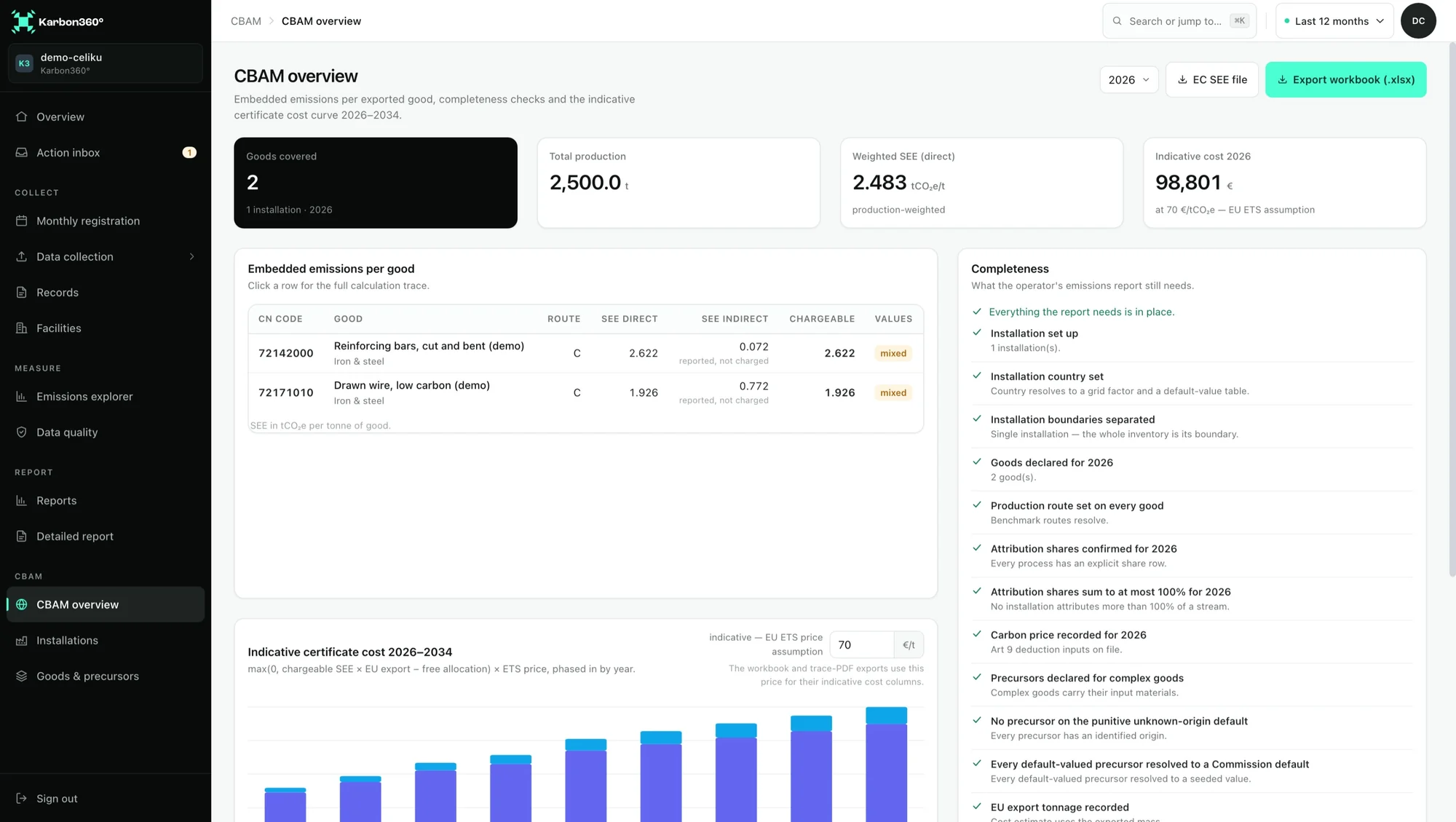
Karbon360’s CBAM module holds each of your goods by eight-digit CN code, assigns it to its production process, records precursors with their origin and whether each value is actual or a Commission default, and calculates specific embedded emissions per good under IR (EU) 2025/2547, with the trace your buyer’s verifier will follow.
- Specific embedded emissions per CN code with the full trace
- Precursors with origin and actual-or-default status
- Commission default values built in for what you cannot yet measure
CBAM CN codes: common questions
Where is the official list of CBAM CN codes?
In Annex I to Regulation (EU) 2023/956. The consolidated text of 20 October 2025 on EUR-Lex includes the amendment made by Regulation (EU) 2025/2083. The tables on this page reproduce that annex.
Which products are covered by CBAM?
Cement and clinker, calcined kaolinic clays, electricity, nitric acid, ammonia, potassium nitrates and nitrogen fertilisers, iron and steel (CN chapter 72 with exceptions, agglomerated iron ore and certain articles of chapter 73), aluminium (unwrought aluminium and certain products and articles of chapter 76), and hydrogen.
Is scrap covered by CBAM?
No. Ferrous waste and scrap (7204) is expressly excluded, and aluminium waste and scrap (7602) is not listed. The Commission’s December 2025 proposal would make pre-consumer steel and aluminium scrap a precursor, but that is not law yet.
Are screws and bolts covered by CBAM?
Yes. Heading 7318, screws, bolts, nuts, rivets, washers and similar articles of iron or steel, is in Annex I. Other fasteners such as nails (7317) are not listed today.
What are CBAM downstream products?
Goods made from CBAM steel and aluminium further down the value chain, such as machinery parts and appliances. The Commission proposed adding 180 of them from 1 January 2028. As of November 2026 the proposal is in negotiation between Parliament and Council.
Is ferro-silicon covered by CBAM?
No. Ferro-silicon (7202 2) is one of the ferro-alloys excluded from chapter 72. Only ferro-manganese, ferro-chromium and ferro-nickel are CBAM goods.
My product is not in Annex I. Can CBAM still affect me?
Yes, if you sell to a producer who uses your product as a precursor for a CBAM good exported to the EU. And if the downstream extension is adopted, products made from steel and aluminium may come into scope themselves.
- Regulation (EU) 2023/956, consolidated text of 20 October 2025, Annexes I to III (EUR-Lex)
- European Commission — Guidance No. 2, quick guide for non-EU operators (14 August 2026)
- European Commission — Commission strengthens the Carbon Border Adjustment Mechanism (17 December 2025)
- European Commission — Questions and answers on CBAM (17 December 2025)
- European Commission — Commission welcomes Council agreement on strengthening CBAM (12 June 2026)
- European Parliament Legislative Observatory — 2025/0419(COD), plenary of 15 September 2026
- Implementing Regulation (EU) 2025/2547 on the methods for calculating embedded emissions (EUR-Lex)
Related guides
Know which of your goods are in scope, and what each one carries.
Your goods mapped by CN code, embedded emissions per good and a trace behind every figure. Start with a free estimate, or schedule a call about your product list.