
UK CBAM: a second carbon border, from 1 January 2027.
The UK CBAM is a tax on the direct emissions embodied in aluminium, cement, fertiliser, hydrogen and iron and steel goods imported into the UK on or after 1 January 2027. It is set out in Part 5 of the Finance Act 2026 and run by HMRC. The UK importer pays once its CBAM goods reach £50,000 in 12 months, and the first return and payment, covering all of 2027, are due by 31 May 2028.
Published 6 November 2026 · Reflects the HMRC policy summary updated 2 November 2026
A steel, aluminium or cement plant in the Western Balkans that sells to the EU and the UK now answers to two carbon borders — both built on the same installation data.
How the UK CBAM works.
What the UK CBAM is and where it is set out
The UK carbon border adjustment mechanism puts a carbon price on specified goods imported from sectors at risk of carbon leakage, so that they face a price comparable to what UK producers pay under the UK Emissions Trading Scheme (UK ETS). The primary legislation is Part 5 of the Finance Act 2026. The detail sits in regulations made in 2026, among them the CBAM (Calculation of CBAM Rate and Determination of Carbon Price Relief) Regulations 2026, the CBAM (Administrative Provisions) Regulations 2026 and the CBAM (Emissions and Verification) Regulations 2026, together with force of law notices and HMRC guidance on GOV.UK.
It is a tax, administered by HMRC. Unlike the EU CBAM there are no certificates to buy and surrender: the importer files a return and pays the CBAM liability.
Which goods are covered
Five sectors are in scope from 1 January 2027: aluminium, cement, fertiliser, hydrogen, and iron and steel. HMRC publishes the commodity codes in its guidance on checking which goods are in scope.
- Glass and ceramics are out. Both were in the original proposals. The government’s response of 30 October 2024 confirmed that products from the glass and ceramics sectors will not be in scope from 2027.
- Direct emissions only. The charge is based on the direct emissions embodied in the goods, including the emissions embodied in relevant precursor goods. HMRC’s technical guidance states that CBAM does not include indirect emissions from the use of electricity; their inclusion was delayed at Budget 2025.
- Electricity is not a UK CBAM good. The EU CBAM covers imported electricity; the UK CBAM does not.
Who is liable, and the £50,000 threshold
The liable person is the importer of the CBAM goods: the person named on the import declaration where customs duty is payable, even if an agent, freight forwarder or customs broker makes the declaration. Importers established outside the UK can be liable too. An exporter outside the UK is never the liable person, but it is the only source of actual emissions data.
An importer must register with HMRC when the value of CBAM goods it imports reaches the threshold of £50,000, under either of two tests:
- Backward test: on the first day of each month, CBAM goods imported in the previous 12 months total £50,000 or more.
- Forward test: it expects to import CBAM goods worth £50,000 or more within the next 30 days.
Imports before 1 January 2027 do not count. Registration opens on 1 January 2028, and for the first calendar year businesses have until 31 January 2028 to register. A business that becomes liable before registration opens must keep records of all CBAM goods it imports from 1 January 2027.
First return and payment dates
The first accounting period is 12 months long. After that, returns move to quarters.
| Accounting period | Return and payment due |
|---|---|
| 1 January to 31 December 2027 | 31 May 2028 |
| Q1 2028 | 31 July 2028 |
| Q2 2028 | 29 September 2028 |
| Q3 2028 | 30 November 2028 |
| Q4 2028 | 28 February 2029 |
Dates as given in the HMRC policy summary, which describes a gradual move to a two-month return and payment window. Penalties for late registration, late returns, late payment and errors follow HMRC’s existing regimes, and criminal offences apply to fraudulent evasion.
How the UK CBAM rate is set
There is no single headline rate. The government calculates a rate per sector, in pounds per tonne of CO₂e, and publishes it at the start of each quarter from 1 January 2027. The rate that applies depends on the sector of the good and the quarter in which it is imported.
The rate starts from the UK ETS: the mean of UK ETS auction clearing prices over a reference quarter. It is then reduced to reflect the free allowances UK producers in that sector still receive, using a baseline free allocation percentage and a phase-out reduction factor:
CBAM rate = average UK ETS price × [1 − (baseline free allocation % × reduction factor)]
The liability for a consignment is its weight × its emissions intensity (actual or default, in tCO₂e per tonne) × the sector rate, less any carbon price relief.
How embodied emissions are calculated, and when default values apply
For each import, the importer reports an emissions intensity in tCO₂e per tonne of good. It has two choices:
- Actual verified emissions from the overseas installation, monitored over a calendar year (1 January to 31 December) and backed by a verification report, or a good-specific verification summary, from an eligible accredited verifier. For goods imported in 2027 the importer uses the most recently verified intensity for 2027, or the previous calendar year if that is not available. From 2028 it may use the most recent verified figure from either of the two calendar years before import.
- Default values published by the government. There is one default value per CBAM good, regardless of origin, in tCO₂e per tonne. Actual data cannot be used for precursors where the default value is used for the final good.
Verification under the UK rules requires a verifier accredited by a body that is a full member of the Global Accreditation Cooperation, against ISO/IEC 17029:2019 and ISO 14065:2020. HMRC’s technical guidance requires a physical site visit to the installation at least once in the verification process, with narrow conditions for waiving it or replacing it with a virtual visit, and sets a materiality threshold of 5% of the good’s emissions intensity. See CBAM verification for the EU side.
Carbon price relief for carbon prices paid abroad
Where the embodied emissions were already subject to a qualifying carbon price in the country of production, the importer can claim carbon price relief. Total relief cannot exceed the CBAM liability. HMRC’s list of currently qualifying schemes, based on information as of 19 June 2026 and stated to be non-exhaustive, includes the EU ETS and the Montenegro Emissions Trading Scheme. For a Montenegrin producer that pays under its national scheme, the evidence of that payment becomes part of what a UK buyer asks for.
UK CBAM vs EU CBAM.
The two mechanisms share a method, a calendar-year monitoring period and the idea of pricing embedded emissions at the border. They differ on almost every administrative detail.
UK carbon border adjustment mechanism compared with the EU CBAM
November 2026| EU CBAM | UK CBAM | |
|---|---|---|
| Legal basis | Regulation (EU) 2023/956, amended by Regulation (EU) 2025/2083 | Finance Act 2026, Part 5, and 2026 regulations |
| Payment phase starts | 1 January 2026 (definitive period) | 1 January 2027 |
| Sectors | Iron and steel, aluminium, cement, fertilisers, hydrogen, electricity | Iron and steel, aluminium, cement, fertiliser, hydrogen. No electricity, glass or ceramics |
| Threshold | 50 tonnes of covered goods per importer per year (mass) | £50,000 of CBAM goods in 12 months, or expected in 30 days (value) |
| Who pays | Authorised CBAM declarant established in the EU | The importer, registered with HMRC; can be established outside the UK |
| Instrument | CBAM certificates bought on a central platform from February 2027 | A tax paid to HMRC with the return; no certificates |
| Price | EU ETS auction prices: quarterly averages for 2026, weekly from 2027 | Sector rate each quarter: UK ETS average less a free allocation adjustment |
| Emissions covered | Direct; indirect (electricity) as well for cement and fertilisers | Direct only, including precursors |
| Default values | Per good and country of origin, with a mark-up of 10% in 2026, 20% in 2027, 30% from 2028 | One value per good regardless of origin |
| Filing | Annual declaration by 30 September of the following year | First return for 2027 by 31 May 2028, then quarterly |
| Verification of actual data | Verifier accredited by an EU or EEA national accreditation body | Verifier accredited by a full member of the Global Accreditation Cooperation |
Will the EU and UK exempt each other?
EU–UK ETS linking talks, as of November 2026
At the UK–EU summit of 19 May 2025 the two sides agreed, in their Common Understanding, to work towards linking the UK ETS and the EU ETS, and said a link should create the conditions for goods from both jurisdictions to be exempt from each other’s CBAM. The Council of the EU authorised the Commission to open negotiations on 13 November 2025.
As of 6 November 2026 no linking agreement has been published, and HMRC’s policy summary states that no jurisdictions are currently exempt from the UK CBAM. Press reports in early November say the two sides expect to announce the conclusion of the negotiations at an EU–UK summit on 20 November 2026. Even then, the CBAM exemptions need changes to each side’s law before they apply.
Serve an EU buyer and a UK buyer from the same installation records.
Both mechanisms ask the same plant the same underlying questions: which production processes run at the installation, what fuels and raw materials went into them, how much was produced, which precursors were bought and from where, and how each figure was calculated over the calendar year. The answers differ only at the end. The UK wants direct emissions; the EU wants direct emissions and, for cement and fertilisers, indirect emissions too.
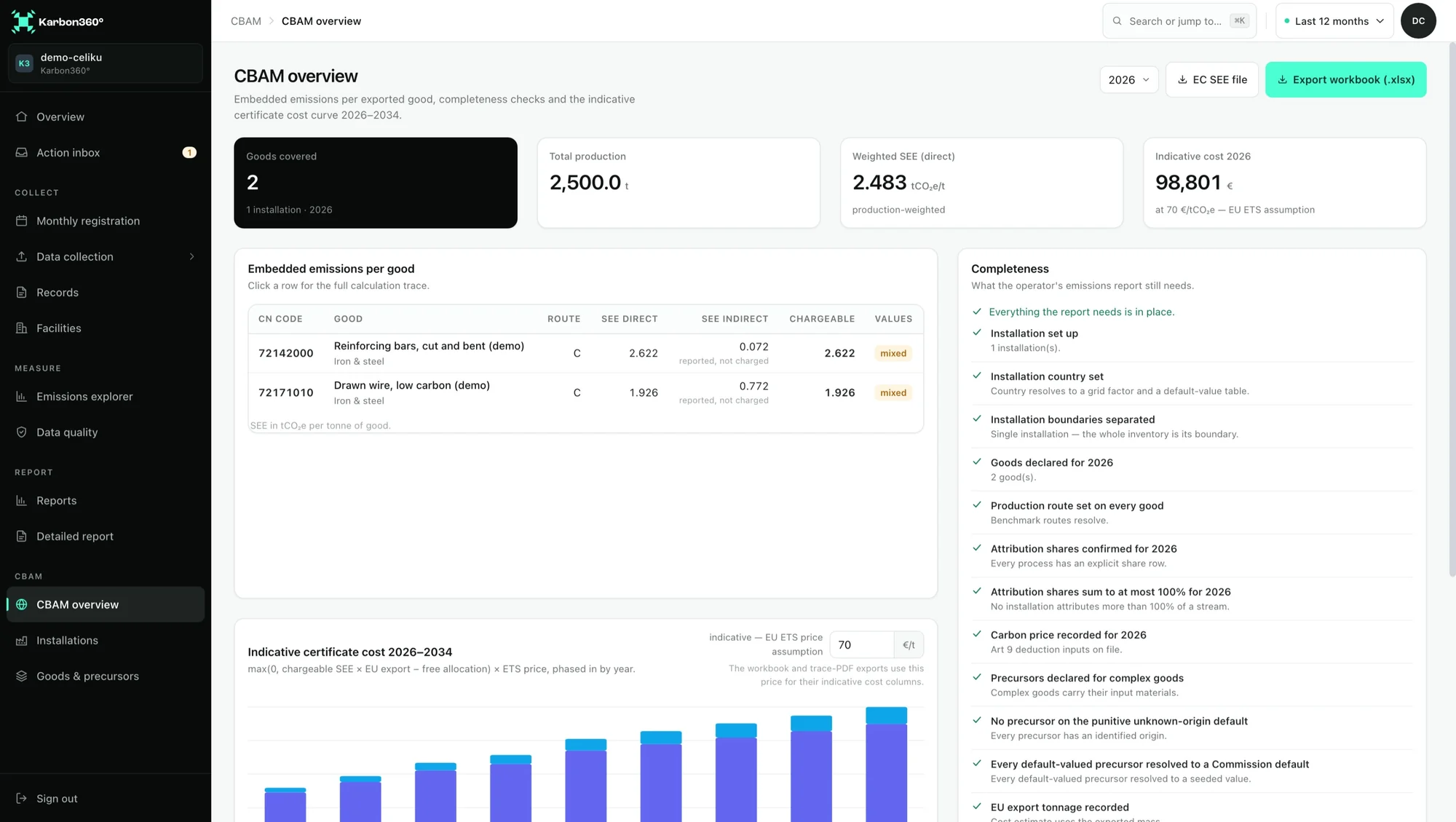
Karbon360 keeps that installation record once: processes, goods per CN code, precursors and monthly fuel, electricity and production data, with specific embedded emissions shown direct and indirect side by side and a calculation trace behind every figure. The direct-only number a UK importer needs and the figure an EU declarant files come from the same records, and both verifiers follow the same trace.
- Direct and indirect embedded emissions kept apart per good
- Calculation trace from each figure back to the invoice or meter reading
- Karbon360 does not file UK returns or EU declarations; your buyers do
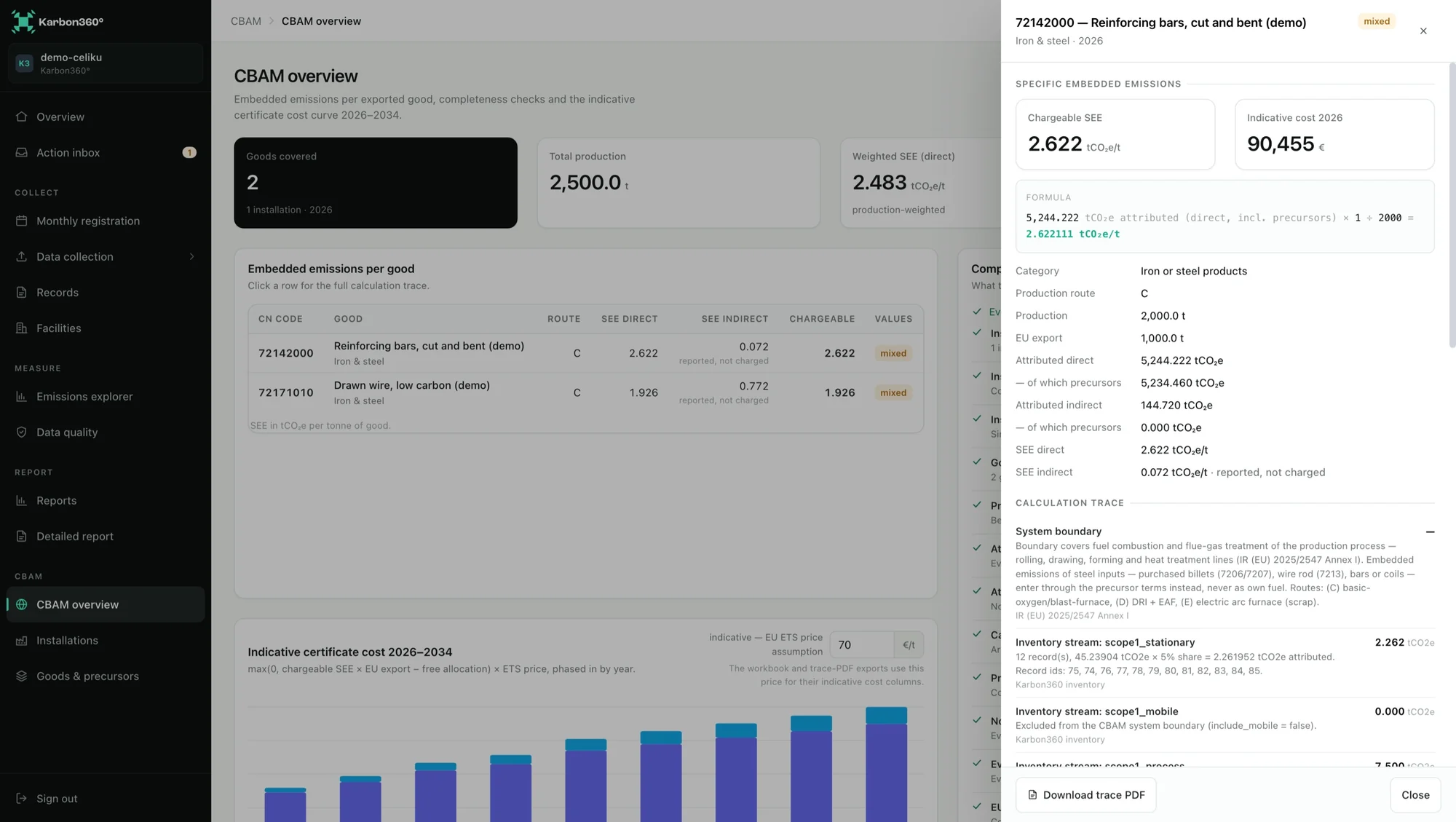
= 2.622111 tCO₂e/t
What a non-UK producer can do now.
Map the goods
Monitor 2027 by calendar year
Book verification for both
Send the summary
Frequently asked questions
When does the UK CBAM start?
It applies to CBAM goods imported into the UK on or after 1 January 2027. Registration opens on 1 January 2028, and the first return and payment, covering all 2027 imports, are due by 31 May 2028.
Which sectors does the UK CBAM cover?
Aluminium, cement, fertiliser, hydrogen, and iron and steel. Glass and ceramics were removed from scope in the government’s October 2024 response, and electricity is not covered.
Who pays the UK CBAM?
The importer of the CBAM goods, generally the person named on the import declaration, once the value of its CBAM goods reaches £50,000 in 12 months or is expected to in the next 30 days. The overseas producer does not pay, but its data decides whether the importer can use actual emissions instead of the default value.
Does the UK CBAM include indirect emissions?
No. The UK charge is based on direct emissions, including those embodied in precursors. HMRC’s technical guidance says CBAM does not include indirect emissions from electricity use, and their inclusion was delayed at Budget 2025.
Is UK CBAM data the same as EU CBAM data?
The underlying installation data is the same: processes, fuels, production and precursors over a calendar year. The outputs differ. The UK figure is direct emissions only, verified by a verifier meeting the UK accreditation criteria; the EU figure adds indirect emissions for cement and fertilisers and needs an EU-accredited verifier.
Will UK goods be exempt from the EU CBAM?
Not yet. The EU and UK are negotiating a link between their emissions trading systems, which both sides have said should lead to mutual CBAM exemptions. As of 6 November 2026 no agreement has been published or adopted. An exemption would cover EU and UK goods, not goods made in the Western Balkans.
Can Karbon360 file my UK CBAM return?
No. The UK importer files its return with HMRC. Karbon360 is used by the producer to keep the installation records and calculate embedded emissions with a trace a verifier can follow. It does not verify data.
- HMRC — Carbon border adjustment mechanism (CBAM): policy summary (updated 2 November 2026)
- GOV.UK — Prepare for the Carbon Border Adjustment Mechanism (CBAM)
- Finance Act 2026, Part 5 (legislation.gov.uk)
- HMRC — Work out the date you’ll need to register for CBAM
- HMRC — Check if you’re classed as the importer for CBAM
- HMRC — Getting the emissions intensity when importing CBAM goods
- HMRC — Illustrative CBAM rates and worked example
- HMRC — Check the default values for CBAM
- HMRC — CBAM technical guidance for monitoring, verifying and reporting emissions (16 October 2026)
- HMRC — UK CBAM: list of current qualifying carbon pricing schemes
- HM Treasury and HMRC — Factsheet: carbon border adjustment mechanism
- HM Treasury — Consultation outcome: introduction of a UK carbon border adjustment mechanism (30 October 2024)
- GOV.UK — UK–EU Summit: Common Understanding (19 May 2025)
- Council of the EU — Negotiations on linking emissions trading systems authorised (13 November 2025)
- Euronews — EU and UK set to link carbon markets (6 November 2026, press report)
- Regulation (EU) 2023/956 establishing the CBAM (EUR-Lex)
Two carbon borders. One set of installation records.
Keep processes, goods, precursors and monthly data once, with a trace behind every figure, and answer your EU declarant and your UK importer from the same numbers.