
CBAM verification: who verifies, when, and what the verifier looks at
CBAM verification is the independent check of an installation’s actual embedded emissions by a verifier accredited by an EU or EEA national accreditation body. It is required whenever an authorised CBAM declarant uses actual emissions instead of default values. The verifier assesses the operator’s monitoring plan and emissions report, visits the installation, and issues one verification report per installation, in the CBAM Registry from January 2027.
Published 6 November 2026 · Reflects the Commission’s verification guidance of 24 August 2026
This guide is for the operator of an installation outside the EU, such as a steel, aluminium or cement plant in the Western Balkans, and for the EU importer who depends on its data. It explains when verification is required in the definitive period, who can verify, what a CBAM monitoring plan is, how site visits and materiality work, what the verification report contains, and how the timing fits the annual declaration. It also covers the UK CBAM, which has its own verification rules from 2027.
When CBAM verification is required
Since the 2025 simplification, embedded emissions in goods other than electricity can be determined either from actual emissions or by reference to the Commission’s default values. Under Article 8 of Regulation (EU) 2023/956, actual embedded emissions declared by an authorised CBAM declarant must be verified by an accredited verifier. Without a positive verification report the declarant cannot use the actual values and falls back on defaults.
- Actual values: verification required, one verification report per installation, covering the reporting period. For goods imported in 2026 that period is calendar year 2026.
- Default values: no verification of embedded emissions. The declarant uses the value for the good and the country of origin, with the year’s mark-up.
- Mixed: an operator can use actual data for its own process and defaults for purchased precursors. The actual part still needs verification, and actual precursor data taken from another operator must be backed by that operator’s verification report, covering the precursor’s reporting period.
Who can be a CBAM verifier
A CBAM verifier is a legal person accredited under Article 18 of the CBAM Regulation and Commission Delegated Regulation (EU) 2025/2551, which applies from 1 January 2026. The main rules:
- Accreditation by a national accreditation body in an EU or EEA country. Verifiers established in the EU generally apply in their own Member State; verifiers established outside the EU may apply to any national accreditation body that offers CBAM accreditation. National accreditation bodies began accrediting in April 2026.
- EN ISO/IEC 17029:2019 is the standard the verification must follow, together with the procedures in Annex II to the Delegated Regulation.
- Scope by activity group. Accreditation is granted for activity groups listed in Annex I, such as cement, iron and steel, ferro-alloys, aluminium and fertilisers. A verifier may only issue reports for groups in its scope.
- Independence. A verifier must be independent of the operator and may not provide consultancy or technical assistance that helps develop the operator’s monitoring and reporting process. The firm that built your monitoring system cannot verify it.
- Rotation. A lead auditor who has carried out five annual verifications for an installation takes a three-year break from it.
- Validity. An accreditation certificate is valid for no more than five years.
- Registry. Accredited verifiers are registered in the CBAM Registry, and from 1 January 2027 they issue verification reports there.
The Commission says it will publish a list of accredited CBAM verifiers on its verification page. Until then, ask a prospective verifier for its accreditation certificate and the activity groups it covers, and check them with the accreditation body.
The CBAM monitoring plan
Article 5(5) of Implementing Regulation (EU) 2025/2547 requires the operator to design and implement a monitoring plan containing at least the elements listed in point A.5 of Annex II, from the date and version of the plan to the methods used for each production process. The plan is the document the verifier reads first: it says what is monitored, how the data is collected and checked, and how embedded emissions are calculated.
- The plan is written in English, like the operator’s emissions report.
- The methodology may be changed only if objectively justified, and the operator checks at least once a year whether better data sources have become available.
- Where data gaps occur, substitute data must be conservative estimates.
- Complete records are kept at the installation for at least six years after the reporting period.
- The operator must consider the improvement recommendations in each verification report.
The verifier assesses the methods set out in the plan and checks whether the reported data actually follows them.
Site visits by the verifier
Implementing Regulation (EU) 2025/2546 on verification principles applies from 1 January 2026 and sets out when the verifier must come in person:
- First year subject to verification: a physical site visit in all cases.
- Virtual visit instead: possible in a later year if a physical visit took place in the immediately preceding reporting period, the installation has not changed significantly, the verifier can access everything it needs remotely and its risk analysis allows it.
- No visit at all: a waiver requires physical visits in the two preceding reporting periods, on the same kind of conditions.
- Force majeure: a virtual visit is also allowed where serious, extraordinary and unforeseeable circumstances outside the operator’s control prevent a physical one.
On site the verifier looks at meters and monitoring systems, interviews staff, checks the installation boundary, the production processes and the completeness of source streams, and samples the records behind the report. The verifier must inform the operator of any decision to replace or waive a visit without delay.
Reasonable assurance and the 5% materiality level
The verifier must reach reasonable assurance that the operator’s emissions report is free from material misstatements and material non-conformities. Article 5(1) of IR (EU) 2025/2546 sets the quantitative materiality level at 5% of the total specific embedded emissions and 5% of the total specific embedded free allocation, applied per tonne of each good by CN code.
The 5% is not a safe harbour. Below it, the verifier still uses professional judgement on the nature of errors, on misstatements that add up, and on parameters the percentage does not capture.
What the CBAM verification report contains
Article 6 of IR (EU) 2025/2546 and its Annex set the content. The report is prepared in the Commission’s electronic template in the CBAM Registry and covers:
- Identification of the operator, the installation, the emissions report verified and the verifier.
- The verification itself: the team, the site visits, the basis of verification including materiality, the verification of the installation and its data, and of precursor data.
- The operator’s summary emissions report.
- For imported electricity, a declarant-specific addendum.
The verification statement says whether the verifier concludes with reasonable assurance that the report is free from material misstatements and material non-conformities. It lists the misstatements and non-conformities found and corrected, any that remain and whether they are material, any recommendations for improvement, and is dated and signed.
The operator prepares its emissions report and summary in the templates of Annex IV to IR (EU) 2025/2547 and sends them to the verifier through the CBAM Registry if registered, or by other means if not.
Timing against the annual CBAM declaration
| When | What happens |
|---|---|
| 1 Jan – 31 Dec 2026 | First reporting period of the definitive regime. The installation monitors under its monitoring plan. |
| April 2026 | National accreditation bodies start accrediting CBAM verifiers. |
| September 2026 | First verifications start, with document review and site visits, according to the Commission. |
| 15 November each year | Verifiers must give notice of their planned verifications (Delegated Regulation (EU) 2025/2551, Article 22). |
| January 2027 | Verifiers can issue the first verification reports in the CBAM Registry; operators share them with declarants. |
| February 2027 | Declarants can buy CBAM certificates for 2026 imports. |
| 30 September 2027 | First annual CBAM declaration, covering 2026 imports. |
No regulation sets a single deadline for the operator’s verification report, but the declarant needs it before it can file on actual values. Verifiers plan their work in advance, so the practical deadline is the date your verifier can fit you in.
Verification under the UK CBAM
The UK CBAM, from 1 January 2027, has its own rules. Actual emissions reported to HMRC must be verified as satisfactory by a verifier accredited by a body that is a full member of the Global Accreditation Cooperation, against ISO/IEC 17029:2019 and ISO 14065:2020. HMRC’s technical guidance requires a physical site visit at least once in the verification process, with limited conditions for a virtual visit or a waiver, and a materiality threshold of 5% of the good’s emissions intensity. Monitoring covers a calendar year, and the UK charge covers direct emissions only.
The EU and UK accreditation requirements are separate. If you sell to both, ask your verifier whether it is accredited for both regimes. See UK CBAM for the full comparison.
Where Karbon360 fits, and where it does not
Karbon360 does not verify, certify or approve emissions, and it is not a verifier. It is carbon management software used by the operator to keep the data a verifier reviews in the shape the verifier reviews it:
| What a verifier asks for | Where it sits in Karbon360 |
|---|---|
| Installation boundary, production processes, goods and routes | The installation set-up: processes, goods per CN code, purchased and in-house precursors |
| Activity data and the document behind it | Monthly fuel, electricity and production records, with the invoice or meter reading attached |
| Emission factors and where they came from | Factor, value, version and source stored with each record |
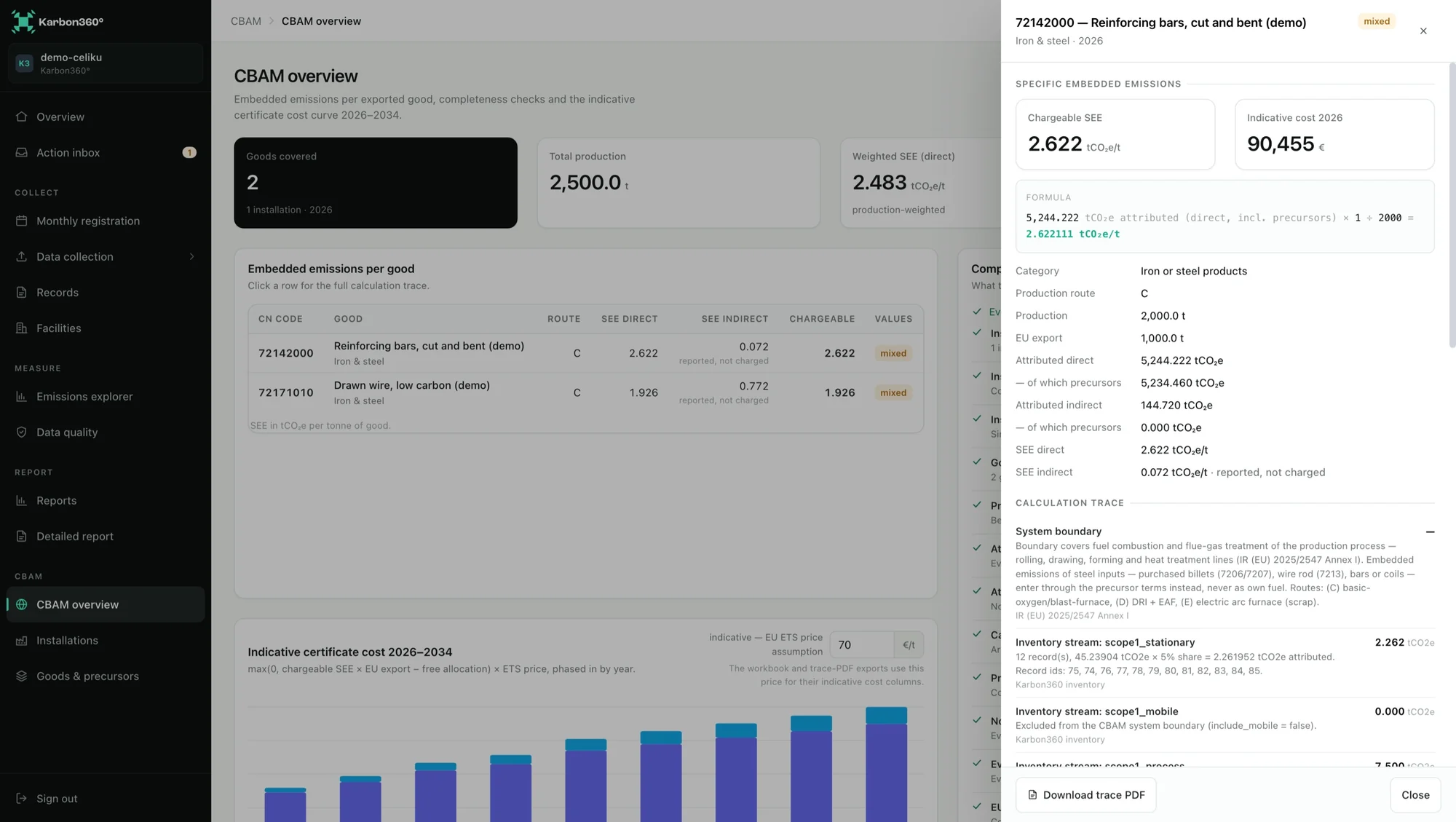
| The calculation from data to tCO₂e per tonne | A calculation trace per good: formula, system boundary, inventory streams, precursors and a server-side recomputation |
| Completeness and gaps | Completeness check by site and month, with defaults marked wherever they stand in for actual data |
| The operator’s emissions report | The workbook in the official 2026 shape and a trace PDF per good |
The monitoring plan remains the operator’s document. Karbon360 holds the records the plan describes, so the plan and the data say the same thing. How figures are produced is set out in the methodology.
A short verification is one where every sampled figure leads back to its source document without a phone call. That is the standard the trace is built to.
Frequently asked questions
Is CBAM verification mandatory?
Only for actual emissions. An authorised CBAM declarant that uses actual embedded emissions from an installation must have them verified by an accredited verifier. A declarant using the Commission’s default values does not need verification of embedded emissions.
Who can verify CBAM emissions?
A verifier accredited for CBAM by a national accreditation body in an EU or EEA country, under Delegated Regulation (EU) 2025/2551 and EN ISO/IEC 17029:2019, for the activity group of your goods. Verifiers outside the EU can apply to any national accreditation body that offers the service.
Can the consultant who prepared our CBAM data also verify it?
No. The verifier must be independent of the operator, and providing consultancy or technical assistance that helps develop the operator’s monitoring and reporting process is an unacceptable risk to impartiality under Delegated Regulation (EU) 2025/2551.
Does a CBAM verifier have to visit the plant?
In the first year subject to verification, yes, in person. In later years the verifier may switch to a virtual visit or waive the visit only if physical visits took place in the preceding period or periods and the other conditions in IR (EU) 2025/2546 are met.
What is a CBAM monitoring plan?
The operator’s document describing how the installation monitors and calculates embedded emissions, with at least the elements in Annex II, point A.5, of IR (EU) 2025/2547. It is written in English, kept up to date, and is the first thing a verifier assesses.
When does 2026 data need to be verified?
Before the declarant files the first annual declaration, due by 30 September 2027. Verifiers can issue reports in the CBAM Registry from January 2027, so an operator that wants its buyers on actual values should have a verifier booked well before then.
Does Karbon360 verify CBAM data?
No. Verification is done by an independent accredited verifier. Karbon360 prepares the installation data, the calculation and the trace to source documents so the verifier’s review is efficient.
- European Commission — Verification of CBAM emissions
- European Commission — CBAM legislation and guidance
- Regulation (EU) 2023/956 establishing the CBAM (EUR-Lex)
- Implementing Regulation (EU) 2025/2546 on verification principles (EUR-Lex)
- Delegated Regulation (EU) 2025/2551 on accreditation and verification (EUR-Lex)
- Implementing Regulation (EU) 2025/2547, the Methodology Act (EUR-Lex)
- HMRC — Verifying emissions data for CBAM goods
- HMRC — CBAM policy summary
- HMRC — CBAM technical guidance for monitoring, verifying and reporting emissions
Give your verifier a short day on site.
Installation records, factors with their versions and a trace from every figure to its source document, kept monthly so the 2026 report is ready when your verifier is.