
CBAM Registry: who logs in, through which portal, and what goes in it
The CBAM Registry is the European Commission’s electronic system for the definitive period of CBAM. EU importers apply in it for the status of authorised CBAM declarant, hold their CBAM certificate account and submit the annual CBAM declaration. Operators of installations outside the EU can register in its O3CI portal and share verified embedded emissions with every declarant that imports their goods.
Published 6 November 2026 · Reflects Regulation (EU) 2023/956 as amended by Regulation (EU) 2025/2083
What the CBAM Registry is.
What is the CBAM Registry?
Article 14 of Regulation (EU) 2023/956 requires the Commission to run a CBAM registry of authorised CBAM declarants: a standardised electronic database holding the data on their CBAM certificates, available automatically and in real time to customs authorities and national competent authorities. Its infrastructure and procedures are set by Implementing Regulation (EU) 2024/3210 on the CBAM registry, amended by Implementing Regulation (EU) 2025/2550.
Each declarant’s account holds its name, address and contact details, its EORI number, its CBAM account number, and for every certificate the identification number, sale price, date of sale and date of surrender, repurchase or cancellation.
A separate section of the Registry holds the operators and installations in third countries registered under Article 10 and the accredited verifiers registered under Article 10a. The definitive Registry replaces the CBAM Transitional Registry used for the quarterly reports of October 2023 to December 2025.
CBAM Registry or CBAM portal?
People search for the “CBAM portal”, but there is no separate portal: the CBAM Registry is one Commission system made of modules, each with its own entry point and users. The modules the Commission describes are:
- Authorisation Management Module (AMM): where importers and indirect customs representatives apply for the status of authorised CBAM declarant, and where amendments, revocations and guarantees are handled.
- Declarants portal: the declarant’s working area. The Commission published its user manual on 21 August 2026.
- Data reconciliation for monitoring and control (DRMC): a view of imported goods, emissions, certificates and penalties, which helps a declarant anticipate the quarterly 50% holding rule.
- O3CI portal (Operators of Third-Country Installations): reserved for operators of installations outside the EU, and used by accredited verifiers to review operators’ data and issue verification reports. Operators of EU-established companies use the AMM instead.
What the public can see
Registry information is confidential, with exceptions set in Article 14(4): the names, addresses, registration numbers and contact details of operators, the location of their installations and the information on accredited verifiers are public. An operator may choose not to have its name, address, registration number, contact details and installation locations made public.
The Commission also publishes each year, for each good in Annex I, the aggregated emissions embedded in imported goods.
Who uses the CBAM Registry, and for what
Every party in the CBAM chain has a role in the same system. Knowing which module is yours tells you which login and which documents you need.
CBAM Registry users in the definitive period
Reg. (EU) 2023/956| User | Module | What they do there |
|---|---|---|
| EU importer or indirect customs representative | AMM | Applies for the status of authorised CBAM declarant in its Member State of establishment (Article 5). |
| Authorised CBAM declarant | Declarants portal, DRMC | Submits the CBAM declaration by 30 September (Article 6), keeps enough certificates on its account and surrenders them (Article 22). |
| Operator of a non-EU installation | O3CI | Registers the company and its installations (Article 10), uploads emissions data once and shares it with declarants. |
| Accredited verifier | O3CI | Registers through the competent authority of its accreditation country, reviews operators’ emissions data and issues verification reports. |
| National competent authority | AMM and the Registry | Decides on authorisations, notifies declarants that fall short of the holding rule, reviews declarations and imposes penalties. |
| Customs authorities | Real-time access | Check the CBAM account number on customs declarations for CBAM goods. |
CBAM Registry login.
CBAM Registry login for EU importers and declarants
An importer signs in through the Commission’s TAXUD authentication portal, choosing a domain, its country and the actor type, and is then sent to its own Member State’s identification scheme. The domain and the national credential differ by Member State:
- In Ireland, the national competent authority tells applicants to open the AMM at cbam.ec.europa.eu/authorised-declarant, select the domain “Customs”, the country and the actor “Economic Operator”, and sign in with a Revenue ROS certificate linked to the company’s EORI number.
- In Croatia, access runs through the Customs Administration’s G2B service and the CBAM2 business system, with a FINA business certificate. See our Croatian guide to the CBAM registar.
Every applicant needs an EORI number and applies in the Member State where it is established. The national competent authority has 120 days to decide on an application, and 180 days where it asks for more information. The full procedure is on our page on the CBAM authorised declarant.
CBAM Registry login for non-EU operators and verifiers
Operators of installations outside the EU and accredited verifiers sign in with an EU Login account protected by two-factor authentication (the EU Login app, a QR code or a FIDO2 key). Each user registers individually, preferably with a company email address. The operator portal is at cbam.ec.europa.eu/o3cinstallation.
The onboarding form identifies the company by an official identifier that must match its registration certificate. For countries it does not list separately, the Commission suggests the business or trade register number, the tax identification number or the Legal Entity Identifier.
Registering a non-EU installation in the O3CI portal
Registration is voluntary and recommended by the Commission. These are the steps of the Commission’s registration guide for non-EU operators.
EU Login
Access request
One PDF
Approval
What goes into the CBAM Registry.
What a registered operator records
Under Article 10(2) the registration request contains:
- the name, address, registration number and contact details of the operator and, where applicable, of its controlling entities including the parent company, with supporting documents;
- the location of each installation: the complete address and geographical coordinates to six decimals;
- the main economic activity of each installation.
Once registered, the operator must, under Article 10(5), determine embedded emissions by type of good using the methods of Annex IV, have them verified by an accredited verifier, keep the verification report and the records behind the calculation for four years after verification, and, where it applies, upload evidence of a carbon price paid in its own country. It must report changes without delay and may ask to be deregistered at any time.
What a declarant files
- The application for authorisation and any later amendments (Articles 5 and 17).
- The annual CBAM declaration (Article 6): the quantity of each type of good imported in the previous year, including goods below the 50-tonne threshold, the total embedded emissions, the number of certificates to surrender after the carbon price paid abroad and the free allocation adjustment, and copies of verification reports where actual emissions are used.
- Certificates: bought on the common central platform from 1 February 2027 and recorded on the declarant’s account, surrendered via the Registry by 30 September (Articles 20 and 22). From 2027, the certificates on the account at the end of each quarter must cover at least 50% of the embedded emissions imported since the start of the year. Excess certificates can be repurchased on request by 31 October; those bought for 2026 can be repurchased only in 2027.
How an operator shares data with its importers
Article 10(7) lets a registered operator disclose its verified embedded emissions, and any carbon price paid, to an authorised CBAM declarant, and Article 8(2) lets the declarant use that information to meet its verification obligation. The Commission’s Guidance No. 2 for non-EU operators describes the practice: the operator uploads its emissions data for each installation once, and after verification can share it with every declarant that imports its goods. The declarant sees a summary of the emissions report, not the confidential detail. To find the operator’s data, the declarant gives the supplier its EORI number outside the Registry.
In 2027 the Registry is to be extended so that operators can also share emissions data with other operators that use their goods as precursors.
An operator that does not register can still supply actual data, in the same operator’s emissions report template. It then deals with each declarant separately, and each declarant must request the complete emissions and verification reports for its records.
CBAM Registry dates for 2026 and 2027
Definitive period opens
Above 50 t, CBAM goods may be imported only by an authorised declarant
Verifiers join
Accredited verifiers get access to the Registry
November 2026
2026 production data must be complete and verified in time for importers
Certificate sales open
Common central platform, for 2026 imports
First declaration
Annual declaration and surrender for 2026 imports
Cancellation
Certificates bought for 2026 emissions and still on the account are cancelled
Register the installation. Bring data a verifier can follow.
A producer in Kosovo, Albania, North Macedonia, Montenegro or Bosnia and Herzegovina can register its installation in the O3CI portal and share verified embedded emissions with all of its EU importers at once. The registration is made by the company’s own representatives with EU Login. What the Registry then needs is the data.
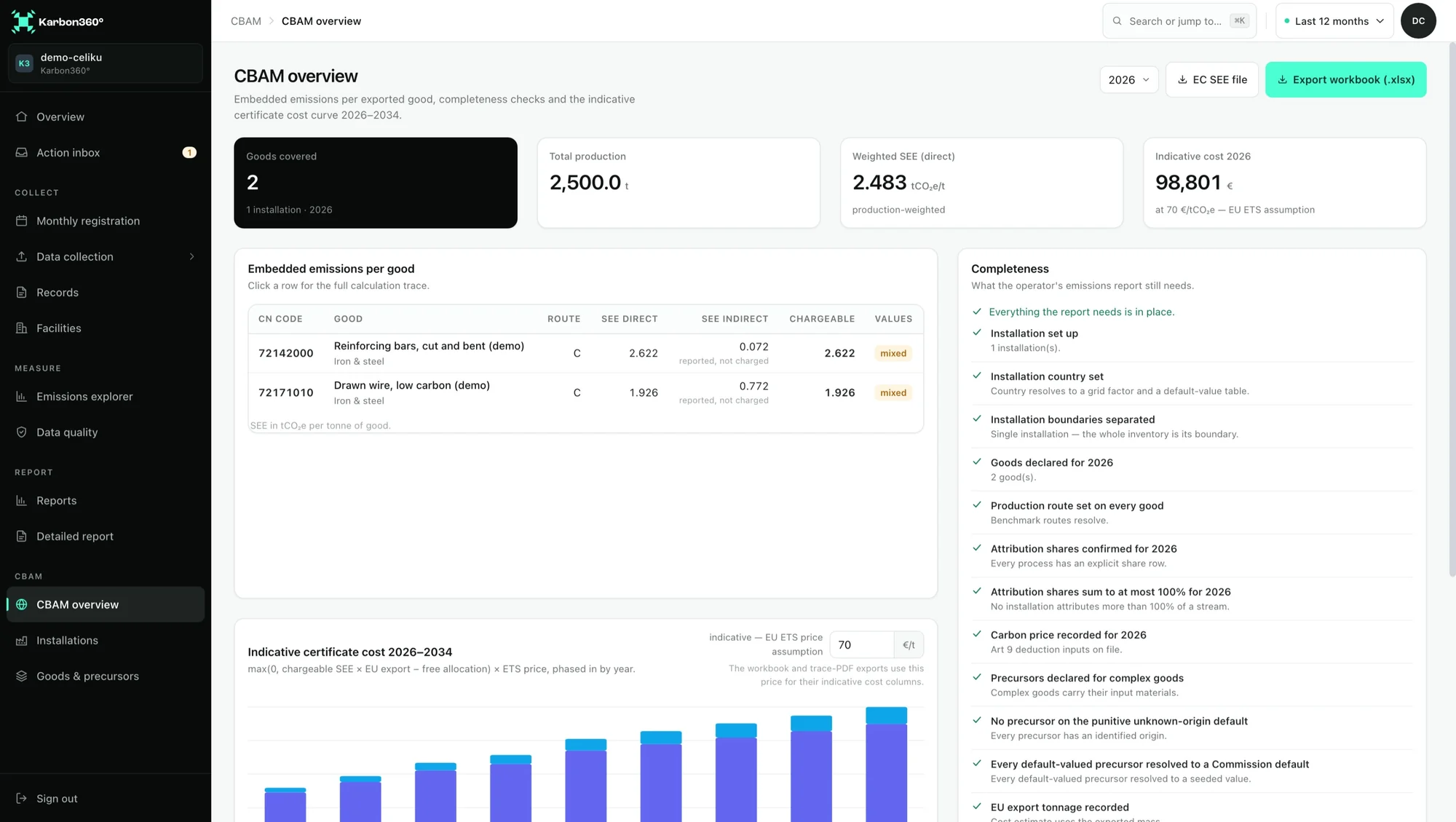
Karbon360 prepares it: specific embedded emissions per CN code under Implementing Regulation (EU) 2025/2547, the operator’s emissions report in the Commission template, and a calculation trace from every figure to the invoice or meter reading behind it, ready for the accredited verifier.
- Operator’s emissions report workbook in the official 2026 shape
- Trace PDF for the verifier
- Commission default values built in for what you cannot yet measure
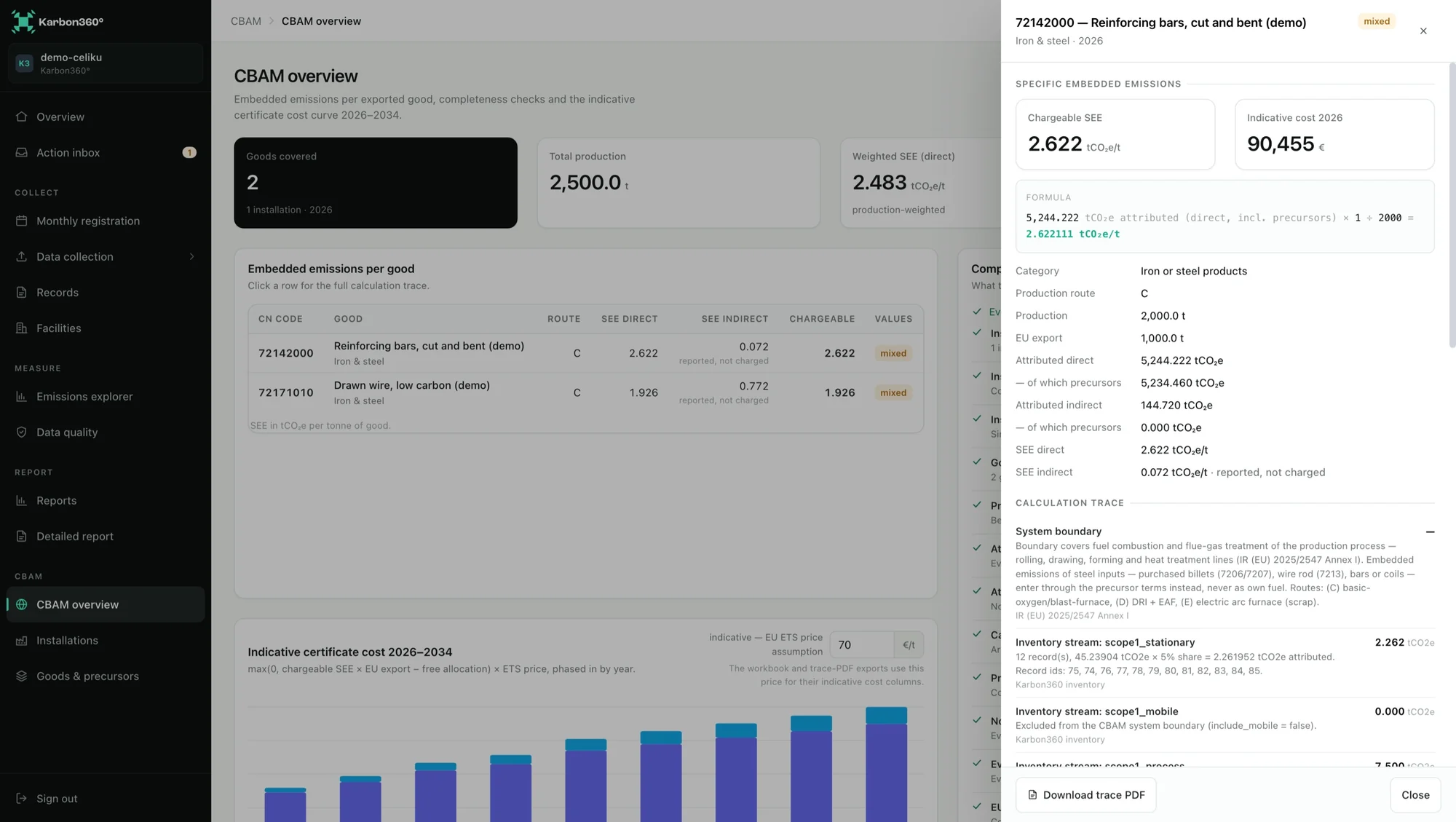
= 2.622111 tCO₂e/t
CBAM Registry: common questions
What is the CBAM Registry?
The European Commission’s electronic system for the CBAM definitive period. Importers apply in it for authorised CBAM declarant status, declarants hold their certificate accounts and file the annual CBAM declaration there, and non-EU operators and accredited verifiers register installations and verification reports in its O3CI portal.
How do I log in to the CBAM Registry?
It depends on who you are. EU importers sign in through the TAXUD authentication portal with their Member State’s identification scheme and their EORI number; the national competent authority publishes the exact steps. Non-EU operators and accredited verifiers sign in with an EU Login account and two-factor authentication.
Is the CBAM portal the same as the CBAM Registry?
Yes, in practice. “CBAM portal” usually means one of the Registry’s modules: the Authorisation Management Module for applications, the declarants portal, or the O3CI portal for operators of installations outside the EU.
Does a producer outside the EU have to register in the CBAM Registry?
No. Registration is voluntary, and the Commission recommends it. A registered operator uploads its data once, shares it with every declarant after verification and keeps confidential detail out of view. An unregistered operator sends the same report template to each declarant separately.
How long does operator registration take, and how long is it valid?
The Commission notes that approving an O3CI access request may take several weeks. A registration is valid for five years from the date the operator is notified, and the operator must report changes to its details without delay.
Can anyone see my installation in the CBAM Registry?
Operator names, addresses, registration numbers, contact details and installation locations are public by default, but an operator may choose not to make them public. Emissions data and everything else in the Registry is confidential.
Can Karbon360 file in the CBAM Registry for my customer?
No. The CBAM declaration is filed by the EU importer’s authorised declarant. Karbon360 prepares the operator side: embedded emissions per good, the operator’s emissions report and the trace an accredited verifier works from.
- European Commission — CBAM Registry and reporting
- European Commission — CBAM Registration guide for non-EU operators (February 2026)
- European Commission — Guidance No. 2, quick guide for non-EU operators (14 August 2026)
- European Commission — CBAM communication and news
- Regulation (EU) 2023/956, consolidated text of 20 October 2025 (EUR-Lex)
- Implementing Regulation (EU) 2024/3210 on the CBAM registry (EUR-Lex)
- EPA Ireland (national competent authority) — applying for and managing your authorisation
- Carinska uprava — CBAM registar, access through G2B and CBAM2
Related guides
Bring the Registry data a verifier can follow.
Embedded emissions per CN code under IR (EU) 2025/2547, the operator’s emissions report and a trace behind every figure. Start with a free estimate, or tell us about your installation.