
ISO 14064: the three parts, the six categories and what “certification” really means.
ISO 14064 is the ISO series for quantifying, reporting and verifying greenhouse gas emissions. ISO 14064-1:2018 covers an organisation’s GHG inventory, ISO 14064-2:2019 covers projects that reduce emissions or increase removals, and ISO 14064-3:2019 sets out how GHG statements are verified and validated. No one issues an ISO certificate for an inventory. What a company receives is a verification statement from an independent body, ideally one accredited against ISO 14065.
Published 6 November 2026 · Status of each standard as listed on iso.org on that date
ISO does not certify anyone. An ISO 14064 inventory is “certified” only in the sense that an independent body has verified it.
What each part of ISO 14064 covers.
ISO 14064-1:2018: the organisation’s GHG inventory
ISO 14064-1 specifies principles and requirements at the organisation level for quantifying and reporting greenhouse gas emissions and removals. It covers the design, development, management, reporting and verification of an organisation’s GHG inventory. This is the part people mean when they say “ISO 14064” about a company footprint.
The current text is ISO 14064-1:2018, the second edition, published in December 2018. It replaced the 2006 edition. ISO last reviewed and confirmed it in 2024, so it remains current. Its status on iso.org is now “to be revised”, and a replacement is at working-draft stage.
Like the rest of the series, ISO 14064-1 is GHG programme neutral. If a programme such as a regulator’s scheme applies, its requirements come on top of the standard.
ISO 14064-2:2019: GHG reduction and removal projects
ISO 14064-2 works at project level. It covers the quantification, monitoring and reporting of activities intended to reduce emissions or increase removals: planning the project, identifying the sources, sinks and reservoirs that are relevant to the project and its baseline scenario, monitoring, documenting performance and managing data quality.
A manufacturer needs part 2 when it develops a specific project whose reductions it wants to quantify against a baseline, not to report its annual footprint. The current edition was published in April 2019, was confirmed in 2024 and is also listed as “to be revised”.
ISO 14064-3:2019: verification and validation
ISO 14064-3 specifies principles and requirements for verifying and validating GHG statements, whether they relate to an organisation, a project or a product. Verification looks back at a statement about emissions that have already happened. Validation assesses a statement about the future, such as the projected reductions of a planned project.
A verifier working to ISO 14064-3 agrees the level of assurance with the client, limited or reasonable, plans the work around the risk of material misstatement, tests the data and calculations, and issues a verification statement. The current edition is from April 2019 and is listed on iso.org as confirmed.
ISO 14065:2020: the rules for verifiers
ISO 14065 sets the principles and requirements for bodies that validate and verify environmental information statements. It is a sector application of ISO/IEC 17029:2019, the general standard for the competence, consistent operation and impartiality of validation and verification bodies. The third edition was published in December 2020 and was confirmed by ISO in 2026.
ISO 14064-3 describes how the verification is done. ISO 14065 describes who may do it and how that body must operate.
ISO 14064-1:2018’s six categories against GHG Protocol Scopes 1, 2 and 3.
The 2018 edition replaced the old direct and indirect split with six reporting categories. Category 1 corresponds to Scope 1 and category 2 to Scope 2. Categories 3 to 6 together cover the ground of Scope 3, grouped by subject rather than by the 15 Scope 3 categories.
ISO 14064-1:2018 categories and the GHG Protocol
Common mapping| ISO 14064-1:2018 category | GHG Protocol equivalent | Typical sources at a factory |
|---|---|---|
| 1 · Direct GHG emissions and removals | Scope 1 | Fuel burned in boilers, furnaces, kilns, generators and company vehicles; process emissions; refrigerant leaks |
| 2 · Indirect GHG emissions from imported energy | Scope 2 | Purchased electricity, heat, steam and cooling |
| 3 · Indirect GHG emissions from transportation | Scope 3: upstream and downstream transport (4, 9), business travel (6), employee commuting (7) | Inbound raw materials, outbound deliveries, flights, staff travel to work |
| 4 · Indirect GHG emissions from products used by the organisation | Scope 3: purchased goods and services (1), capital goods (2), fuel- and energy-related activities (3), waste (5), upstream leased assets (8) | Steel, scrap, chemicals, packaging, machinery, upstream emissions of fuels and electricity, waste treatment |
| 5 · Indirect GHG emissions associated with the use of products from the organisation | Scope 3: use of sold products (11), end-of-life of sold products (12), and related downstream categories | Energy your product uses in service, disposal or recycling at end of life |
| 6 · Indirect GHG emissions from other sources | Anything not covered by categories 1 to 5 | Sources specific to the organisation that fit nowhere else |
Two standards, mostly the same inventory.
Where ISO 14064-1 and the GHG Protocol differ
The GHG Protocol Corporate Standard and ISO 14064-1 share the same foundations: an organisational boundary, a base year, documented methods and a report. In practice an inventory built properly on one can usually be presented under the other. The differences that matter:
- Structure. The GHG Protocol uses three scopes. ISO 14064-1:2018 uses six categories.
- Indirect emissions. The GHG Protocol Corporate Standard requires Scope 1 and Scope 2 and leaves Scope 3 optional. ISO 14064-1 asks the organisation to decide, with documented criteria, which indirect emissions are significant, and to quantify and report those.
- Removals. ISO 14064-1 covers emissions and removals in the same inventory, starting with category 1.
- Verification. The ISO series includes its own verification standard in part 3, and its own standard for verifiers in ISO 14065. The GHG Protocol does not verify or accredit anyone.
Some schemes accept both. The EcoVadis Carbon Rating, for example, is built on the GHG Protocol and also recognises reporting under ISO 14064, as described in how EcoVadis scores the carbon questions.
The GHG Protocol and ISO are merging their corporate standards
In September 2025 the GHG Protocol and ISO announced a partnership to co-develop greenhouse gas accounting standards. For companies, the work covers ISO 14064-1 together with the GHG Protocol Corporate Standard, Scope 2 Guidance and Scope 3 Standard.
According to the GHG Protocol’s standard development plan of 29 July 2026, the result will be one consolidated corporate standard, expected to be jointly published and co-branded with ISO. The plan estimates a public consultation on the full draft in the second quarter of 2027 and publication of the final standard in the fourth quarter of 2028. Until then, ISO 14064-1:2018 and the current GHG Protocol standards remain the ones in use.
What “ISO 14064 certification” really means.
Verification, not certification
ISO develops standards. It does not certify organisations or issue certificates, and a company cannot be certified by ISO. For greenhouse gas statements the correct word is verification: an independent body checks your GHG statement against ISO 14064-1 using the method in ISO 14064-3, and issues a verification statement saying what it checked and with what level of assurance.
When a customer or bank asks for “ISO 14064 certification”, what they usually want is that statement, issued by a body accredited against ISO 14065 by a national accreditation body. Accreditation is the formal recognition that the verifier operates to the international standard. ISO points to the Global Accreditation Cooperation (Global ACI), which has taken over the roles of the IAF and ILAC, as the international framework for accreditation of validation and verification bodies.
Limited or reasonable assurance
ISO 14064-3 allows two levels. Limited assurance relies mainly on inquiry and analytical procedures, and its conclusion is negative: nothing has come to the verifier’s attention suggesting the statement is materially misstated. Reasonable assurance involves more extensive testing and gives a positive opinion that the statement is fairly stated. The level, the materiality threshold and the intended users are agreed with the verifier at the start, and your customer or programme may already specify them.
Getting an ISO 14064-1 inventory verified
Set the boundary
Quantify with evidence
Write the GHG report
Appoint a verifier
How ISO 14064 relates to CBAM and CSRD.
ISO 14064 and CBAM
CBAM does not use ISO 14064. It has its own method in Implementing Regulation (EU) 2025/2547, which calculates specific embedded emissions per good, by CN code and installation, not a company footprint. It also has its own verification rules: Implementing Regulation (EU) 2025/2546 on verification principles and Delegated Regulation (EU) 2025/2551 on accreditation and verification.
Only national accreditation bodies in EU or EEA countries can accredit CBAM verifiers. The Commission expected the first CBAM accreditations around September 2026, with accredited verifiers issuing their first verification reports from January 2027. A verification statement under ISO 14064-3 is not a CBAM verification report.
The data underneath is shared, though. The same fuel invoices, electricity meter readings and production records feed a corporate inventory and a CBAM operator’s emissions report. Collecting them once, with the evidence attached, serves both.
ISO 14064 and CSRD / ESRS E1
Companies reporting under the CSRD disclose gross Scope 1, Scope 2 and Scope 3 emissions under ESRS E1. Application requirement AR 39 of ESRS E1 says the company shall consider the GHG Protocol Corporate Standard (2004 version) and may also consider EN ISO 14064-1:2018. EFRAG has clarified that a company applying ISO 14064-1 must still meet the ESRS requirements, for example on reporting boundaries and on disclosing market-based Scope 2.
The rules are moving. The Omnibus I Directive (EU) 2026/470, in force since 18 March 2026, narrowed the CSRD to the largest companies and introduced protections for companies in their value chain with up to 1,000 employees, so that the reporting standards do not require reporters to obtain more from them than the voluntary reporting standard covers. A revised set of ESRS, adopted by the Commission in July 2026, is to apply to financial years from 1 January 2027 if the Parliament and Council do not object. For a supplier in the Western Balkans, the CSRD arrives as a customer’s Scope 3 request, and what it asks for is a defensible Scope 1 and Scope 2 figure. The CSRD supplier guide covers that path.
The data, factors and trace a verifier needs.
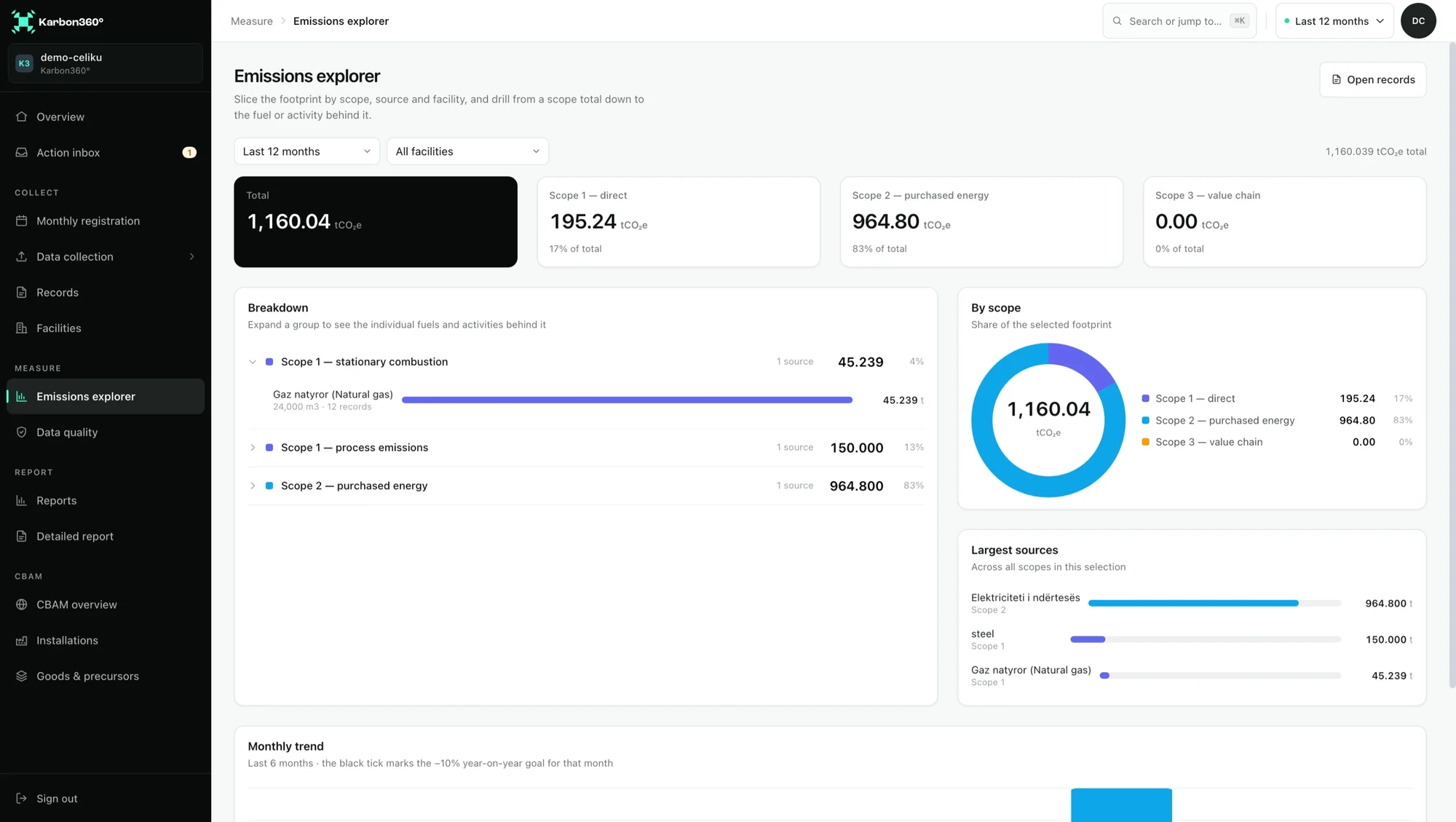
Karbon360 builds the GHG inventory on the GHG Protocol Corporate Standard. It does not claim conformance with ISO 14064, it does not issue certificates and it does not verify. Verification is done by an independent body you appoint.
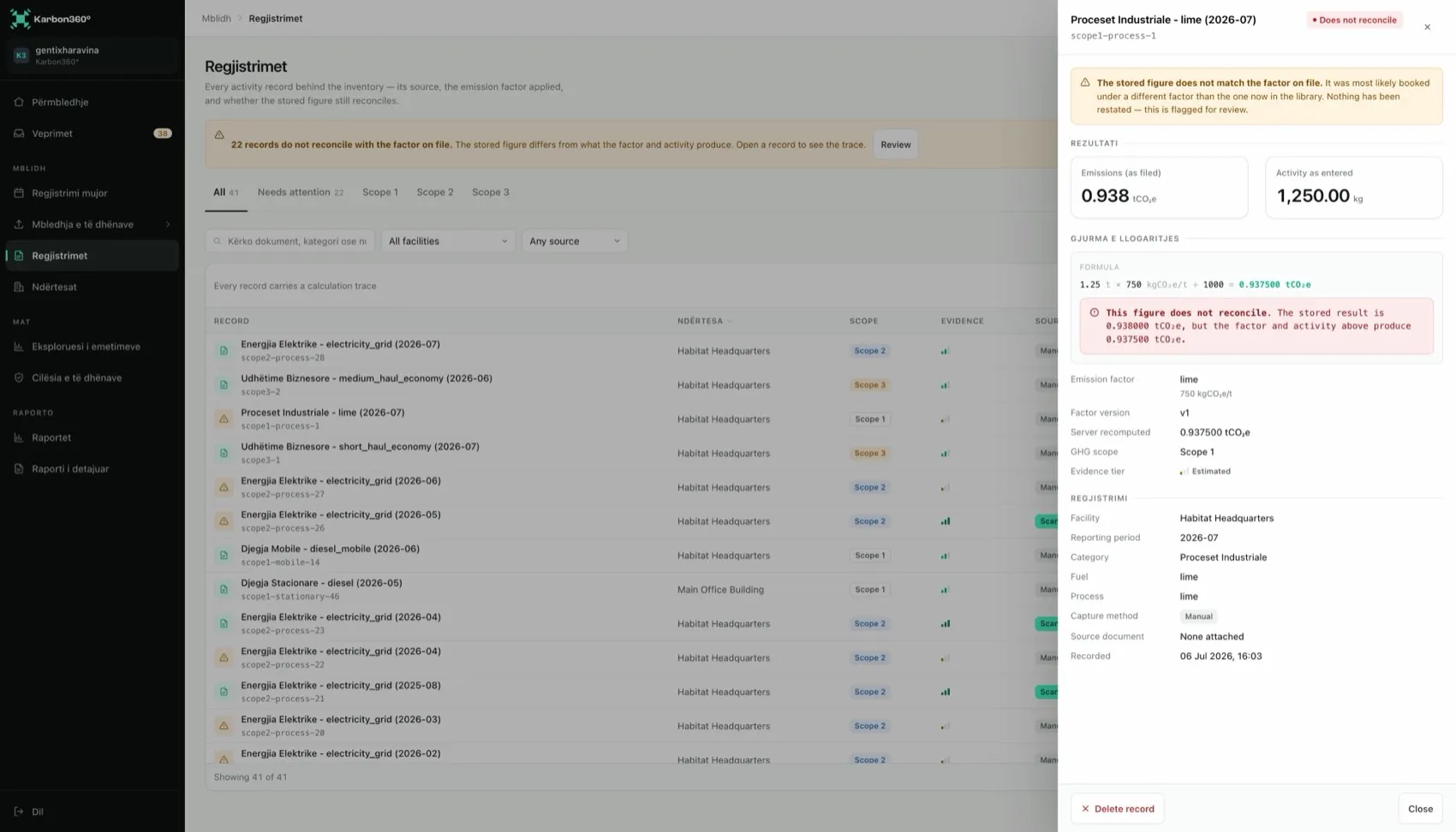
What Karbon360 does is keep what that verifier asks for. Every figure carries the invoice or meter reading it came from, the emission factor, the factor version and a server-side recomputation, in the calculation trace. Completeness is tracked per site and month, and versions are retained, so the inventory the verifier tests is the one you reported.
The boundary is stated in every report. Scope 1 covers stationary combustion, mobile combustion and process emissions. Scope 2 is location-based, using the grid factor for each facility’s country. Scope 3 covers business travel and employee commuting. In ISO terms that is categories 1 and 2 and part of category 3, so if your customer or programme needs market-based Scope 2 or other indirect categories, plan for those separately.
- Source document behind every figure
- Emission factor, version and source on each record
- Server-side recomputation a verifier can re-trace
- Read access for your verifier, with the report
Frequently asked questions
What is ISO 14064?
A series of ISO standards for greenhouse gases. Part 1 covers quantifying and reporting an organisation’s emissions and removals, part 2 covers GHG reduction and removal projects, and part 3 covers verifying and validating GHG statements.
What is the difference between ISO 14064-1, 14064-2 and 14064-3?
ISO 14064-1 is for an organisation’s annual inventory. ISO 14064-2 is for a specific project that reduces emissions or increases removals against a baseline. ISO 14064-3 is the method a verifier or validator uses to check statements made under either, or about a product.
Is ISO 14064-1:2018 still current?
Yes. ISO reviewed and confirmed it in 2024, and iso.org lists it as published and current, with a revision under way. Separately, the GHG Protocol and ISO plan a consolidated corporate standard, with publication estimated for the fourth quarter of 2028.
How do I get ISO 14064 certification?
Strictly, you do not: ISO does not certify, and inventories are verified rather than certified. Prepare an ISO 14064-1 inventory and GHG report, then appoint an independent verification body, preferably accredited against ISO 14065, to verify it under ISO 14064-3. The result is a verification statement at limited or reasonable assurance.
What is the difference between ISO 14064 and the GHG Protocol?
The GHG Protocol reports in three scopes; ISO 14064-1:2018 reports in six categories. ISO requires a documented decision on which indirect emissions are significant, and the ISO series includes verification standards. Both rest on the same principles, and the two bodies are now developing a joint corporate standard.
Is ISO 14064 required for CBAM?
No. CBAM uses its own calculation method, Implementing Regulation (EU) 2025/2547, and its own accredited CBAM verifiers. An ISO 14064 verification statement does not replace a CBAM verification report, although the underlying fuel, electricity and production data are the same.
Does Karbon360 provide ISO 14064 certification?
No. Karbon360 builds the inventory on the GHG Protocol Corporate Standard and keeps the documents, factors and calculation trace a verifier needs. It does not claim ISO 14064 conformance and does not verify or certify emissions.
- ISO 14064-1:2018 — Specification with guidance at the organization level (iso.org)
- ISO 14064-2:2019 — Specification with guidance at the project level (iso.org)
- ISO 14064-3:2019 — Verification and validation of greenhouse gas statements (iso.org)
- ISO 14065:2020 — Requirements for bodies validating and verifying environmental information (iso.org)
- ISO — Certification (ISO does not perform certification)
- GHG Protocol — Standards and guidance update process and the ISO partnership
- GHG Protocol — Consolidated Corporate Standard, Standard Development Plan (29 July 2026)
- European Commission — CBAM verification
- Implementing Regulation (EU) 2025/2547, the CBAM Methodology Act (EUR-Lex)
- Directive (EU) 2026/470, Omnibus I amendments to the CSRD (EUR-Lex)
- EFRAG — ESRS Q&A on ESRS E1 AR 39 and EN ISO 14064-1:2018
- EFRAG — Commission publishes delegated act on revised ESRS (3 July 2026)
Build the inventory once, so a verifier can follow it.
Karbon360 turns your invoices and meter readings into a GHG Protocol inventory with the document, the factor and its version behind every figure. You choose the verifier.