
EcoVadis rating: how the carbon questions are scored and what to prepare.
An EcoVadis rating is a 0–100 score of how well your company manages sustainability across four themes: Environment, Labour & Human Rights, Ethics and Sustainable Procurement. Medals go to companies in the top 35% of everyone EcoVadis rated in the previous 12 months, provided no theme scores below 30. Only answers backed by a document earn points, so the carbon questions are won with a GHG inventory, targets and dated evidence.
Published 6 November 2026 · Based on the methodology documents EcoVadis publishes for rated companies
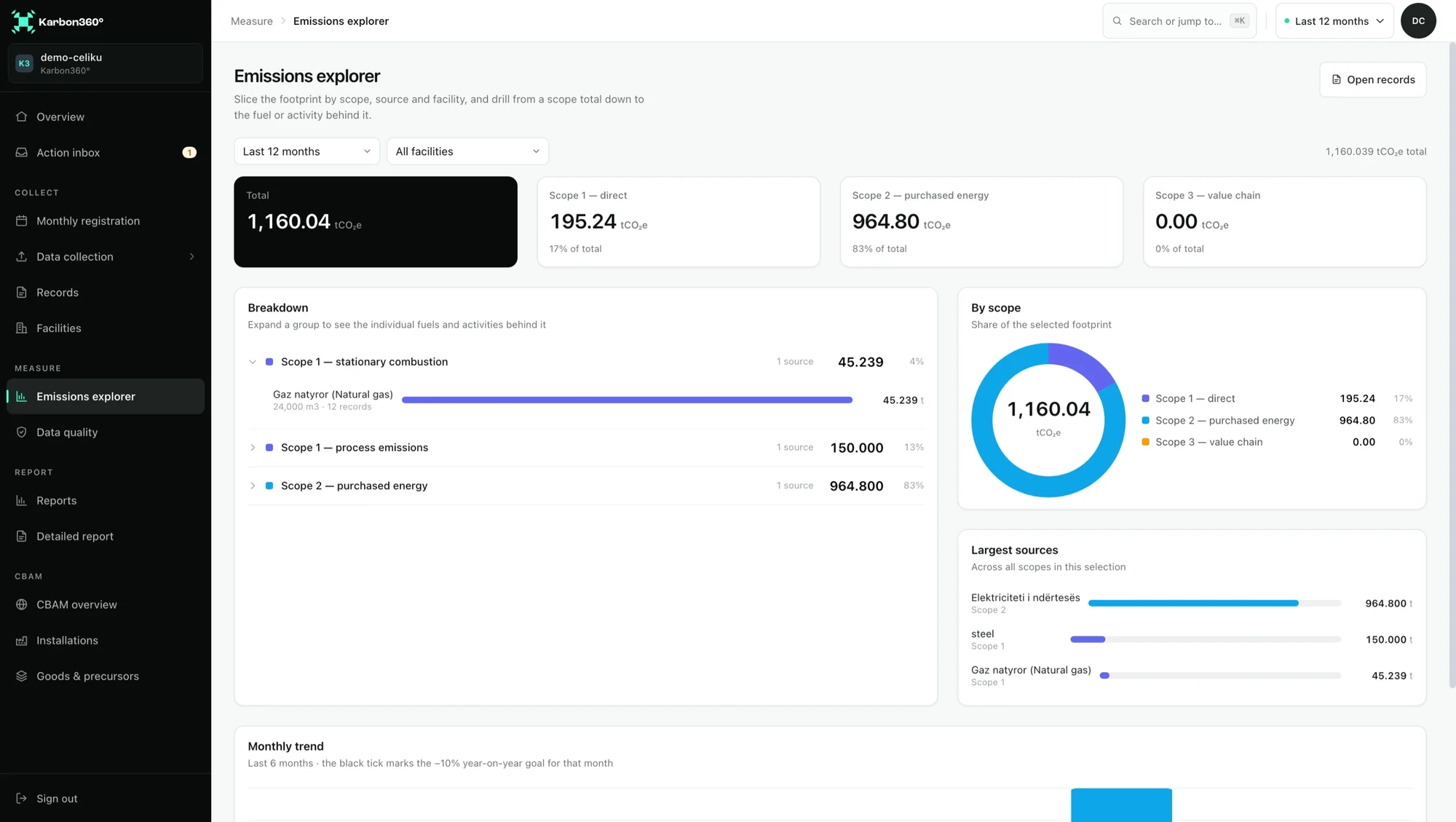
EcoVadis credits a declaration only when a document backs it. For the carbon questions, that document is your GHG inventory and the evidence behind it.
How the EcoVadis assessment works.
EcoVadis is a separate rating provider based in Paris. Karbon360 has no partnership or affiliation with EcoVadis. Everything below comes from EcoVadis’s own public methodology documents and help pages.
The EcoVadis assessment, step by step
The EcoVadis assessment is a paid service, organised in four stages:
- Registration. You give the legal entity name, the scope of the assessment (group, entity or site), the country, company size and industry. If an EU customer invited you, register through the link in their email so your results are shared with them automatically.
- Questionnaire. EcoVadis builds a questionnaire for your size, industry and location. Of its 21 sustainability criteria, only the ones relevant to your profile are activated. You attach supporting documents to your answers, up to a limit of 55 files.
- Expert analysis. Analysts check each document against the answer it supports and screen public sources for news about your company. Publishing the results typically takes 6 to 8 weeks after you submit.
- Results. You get 48 hours to preview the scorecard and raise factual errors before your customers can see it. The scorecard is valid for 12 months from publication.
How the EcoVadis score is calculated
Each theme is scored on seven management indicators, grouped into policies, actions and results:
- Policy: your commitments and quantitative targets.
- Endorsement: formal public commitment to external sustainability initiatives.
- Measures: the actions you have put in place.
- Certifications: valid certificates, labels and third-party audits from independent, accredited bodies.
- Coverage: how far actions reach across your workforce and sites. Scored only for companies with 1,000 or more employees.
- Reporting: the quality of what you report on your key figures.
- 360° Watch: what NGOs, unions, authorities and the media have published about you.
The raw theme score is then adjusted for company size and country risk. Companies with 1 to 25 employees get +13.75 and a simplified formula, 26 to 99 employees get +15, 100 to 999 employees get +10, and large companies get nothing. A company headquartered in a country EcoVadis classes as high risk loses 6 points. A company with operations in low-risk countries only gains 3.
The result places you in one of five performance levels:
| Score | Performance level | What EcoVadis says it means |
|---|---|---|
| 85–100 | Outstanding | Mature, comprehensive and proactive management system |
| 65–84 | Advanced | Well-defined policies, concrete actions and measurable results |
| 45–64 | Good | Structured policies and practical actions, with some gaps |
| 25–44 | Partial | Foundational efforts, with significant gaps in policies, actions or reporting |
| 0–24 | Insufficient | High risk, or no structured management system |
EcoVadis medals: platinum, gold, silver and bronze
Medals are not tied to a fixed score. They depend on your percentile rank against every company EcoVadis rated in the 12 months before your scorecard was published. So the score needed for EcoVadis gold or silver moves as the rated population changes.
A company cannot receive a medal if any of these apply:
- One of the four theme scores is below 30/100.
- Its 360° Watch score is 0/100 in at least one theme or 25/100 in at least two, unless the exceptions in the methodology apply.
- It works in an excluded industry, such as tobacco, weapons and ammunition, or coal and lignite mining, or takes more than 20% of its revenue from coal.
Companies that do not reach a medal can earn one of two badges. Committed requires a score of at least 45. Fast Mover requires a score of 34 to 44 and an improvement of at least 6 points on the previous assessment within 18 months. Medals and badges are valid for as long as the scorecard: 12 months. EcoVadis itself says a medal is not a certification of the company or its products.
EcoVadis medals and badges.
Medal and badge thresholds
Methodology v2.0 · 2026| Recognition | Threshold | Condition |
|---|---|---|
| Platinum | Top 1% (99th percentile and above) | No theme below 30, no disqualifying 360° findings, eligible industry |
| Gold | Top 5% (95th percentile and above) | Same as above |
| Silver | Top 15% (85th percentile and above) | Same as above |
| Bronze | Top 35% (65th percentile and above) | Same as above |
| Committed badge | Score of 45 or more | No medal; no severe 360° finding in the past 5 years (7 for Ethics) |
| Fast Mover badge | Score of 34 to 44 | At least 6 points better than the previous assessment within 18 months |
What EcoVadis asks about carbon.
Energy and greenhouse gas questions in the Environment theme
Energy Consumption & Greenhouse Gas Emissions is one of nine criteria in the Environment theme. The others are water, biodiversity, air pollution, materials, chemicals and waste, product use, product end-of-life, customer health and safety, and environmental services and advocacy. Which criteria are activated for you depends on your industry, size and location; the list is on the Industry Risk Profile in your EcoVadis account. Where energy and GHG is activated, it is scored on the same seven indicators:
- Policy. A formal energy or climate policy, ideally with quantitative reduction targets. EcoVadis asks whether you have carbon reduction targets.
- Measures. Evidence that you act on it: energy audits, efficiency projects, fuel switching, renewable supply. Each piece of evidence must be a real, dated document from your management system.
- Certifications. Valid certificates from an independent, accredited body. Analysts check them against certification body databases before awarding points.
- Reporting. Your energy and GHG figures. They count only if they cover at least 95% of the assessed scope. Reporting that has been verified by a third party scores higher than unverified reporting.
Documents also expire for rating purposes. A policy or action stays valid for 8 years, but a report on key figures only counts for 2 years. Last year’s inventory helps you; one from 2022 does not.
EcoVadis carbon: the Carbon Action Manager and the carbon scorecard
The Carbon Action Manager, formerly the Carbon Action Module, is the EcoVadis product buyers use to collect Scope 1, 2 and 3 data and product carbon footprints from their suppliers. Since March 2024 it can be bought separately from the full rating. If your customer uses it, you may be asked for a Carbon Rating rather than, or as well as, the full EcoVadis rating. The Carbon Rating assesses your greenhouse gas management only and produces a carbon scorecard with your strengths, improvement areas and maturity level.
- Companies need at least 25 employees to be eligible.
- Its twelve indicators include targets, governance, action plans, Scope 1+2 actions, Scope 3 actions, performance review, monitoring system, monitoring coverage, supply chain monitoring and reporting practices. Your GHG emissions are disclosed but not scored.
- Overall, commitments count for 25% of the score, actions for 25% and reporting on results for 50%.
- The methodology follows the GHG Protocol Corporate Standard: Scope 1, Scope 2 and the 15 Scope 3 categories. It also accepts reporting prepared under other standards, such as ISO 14064.
- GHG monitoring is credited only if it covers at least 95% of your operational boundary.
When suppliers report emissions through the Carbon Action Manager, EcoVadis also grades the data with its Data Reliability Levels: third-party verified, high (validated and aligned with the GHG Protocol), medium and low.
The five Carbon Rating maturity levels.
EcoVadis Carbon Rating performance levels
Carbon Rating v2.0| Score | Level | What it requires |
|---|---|---|
| 0 | Insufficient | No information on your GHG management system |
| 1–20 | Beginner | Minimal management or reporting practices |
| 21–50 | Intermediate | Core GHG management practices in place |
| 51–75 | Advanced | A comprehensive GHG management system, including public reporting of third-party verified emissions |
| 76–100 | Leader | Everything at Advanced, plus formal absolute Scope 1 and Scope 2 reduction targets and science-aligned targets, for example validated by the SBTi |
Each carbon question, and the document that answers it.
Gather these before you open the questionnaire. EcoVadis accepts documents in .pdf, .docx, .xlsx, .jpg or .png under 30 MB. They must be complete, dated, clearly your company’s and machine-readable. A scanned photo of a page does not count.
Carbon question types mapped to evidence
Supplier preparation| Question type | What earns points | Document or data you need | Who produces it |
|---|---|---|---|
| Energy and climate policy | A formal, dated policy that applies to the rated entity | Signed energy or climate policy with an issue or review date | Management |
| Reduction targets | Quantitative, time-bound targets against a base year | Target statement with base year, baseline tCO₂e and target year | Management, using the base-year inventory |
| Scope 1 emissions | Reported figures covering at least 95% of the assessed scope | GHG inventory report with fuels, vehicles and process emissions per site | Your GHG inventory (Scope 1) |
| Scope 2 emissions | Same 95% coverage rule | Electricity and heat by site and month, with the grid factor used | Your GHG inventory (Scope 2) |
| Energy consumption | Energy figures covering at least 95% of the assessed scope | kWh and fuel quantities taken from invoices and meter readings | Invoices, meters, the inventory’s activity data |
| Scope 3 emissions | The categories you report, with your stated boundary | Category-by-category figures and the method used for each | Your inventory for the categories it covers; other sources for the rest |
| Monitoring system | A documented way of collecting and checking carbon data | Data collection procedure and the records it produces | Operations and finance |
| Reduction actions | Dated evidence of projects actually carried out | Energy audit, efficiency project records, renewable supply contract | Engineering and procurement |
| Third-party verification | Verified reporting scores higher; needed for the Advanced carbon level | Verification statement from an independent verifier | An independent verification body |
| Science-based target | Required for the Leader carbon level | SBTi validation or an equivalent science-aligned target | Management, with the SBTi |
Why suppliers score lower than they expected.
Answers without documents
EcoVadis treats a missing document as a missing practice. A “yes” with nothing attached, or with a document linked to the wrong question, earns nothing. Its methodology accepts that this can be a documentation gap rather than a lack of action, but the score falls either way.
Documents written for the assessment fail too. EcoVadis runs checks, including a plagiarism tool, to find documents prepared only for the rating that do not reflect a real management system. Inauthentic documents are flagged on the scorecard, and your customers will see that.
Carbon figures that miss part of the business
Energy and GHG figures need to cover 95% of the assessed scope. An inventory for the main plant that leaves out a second site, the warehouse or the vehicle fleet can lose the reporting points entirely. Make sure the boundary of your inventory matches the scope you registered: group, entity or site.
Group documents raise the same issue. If your policies sit with a parent company, you have to show they apply to the entity being rated.
Old, unverified or unreadable reporting
- Key figures count for two years. A 2023 inventory submitted in 2026 earns nothing.
- Scans and photos are not machine-readable and are rejected.
- Unverified figures score lower than verified ones, and the Advanced carbon level needs third-party verified emissions reported publicly.
- A score below 30 in any theme blocks a medal. A strong Environment score does not make up for a neglected Ethics or Sustainable Procurement theme.
The GHG inventory and the evidence trail the carbon questions ask for.
Karbon360 does not fill in or submit the EcoVadis questionnaire, and it has no link with EcoVadis. It produces the documents you upload: a GHG inventory on the GHG Protocol Corporate Standard, built from your invoices and meter readings, with the document, the emission factor and its version behind every figure.
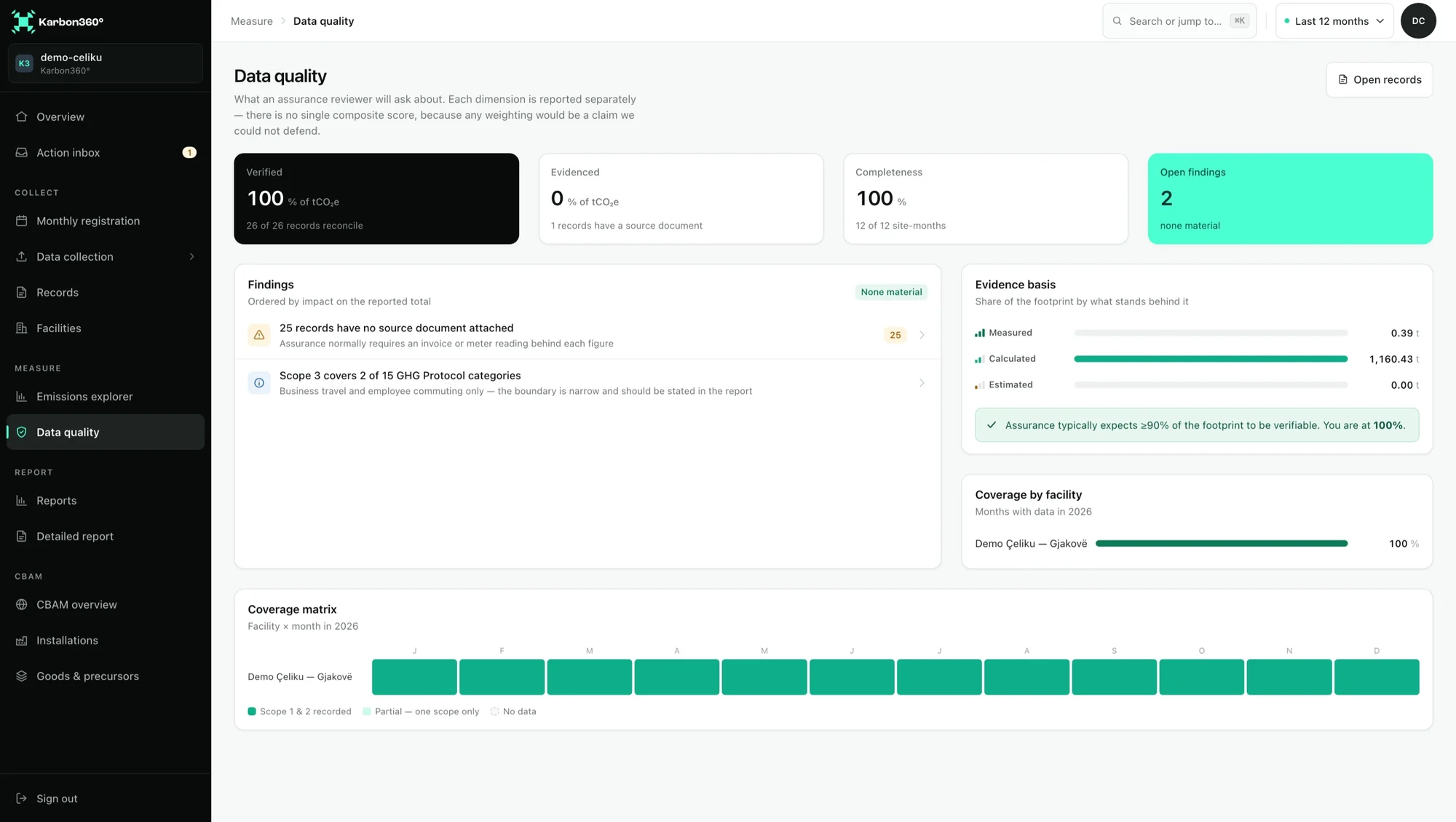
The data quality view shows completeness per site and month, so you can see whether your figures reach the 95% coverage EcoVadis requires before you submit. The calculation trace is what an independent verifier works from if your customer asks for verified figures. Karbon360 does not verify or certify emissions.
Scope 2 is calculated with the location-based method, using the grid factor for each facility’s country. Scope 3 covers business travel and employee commuting. Every report states that boundary, so your answer to the Scope 3 question says exactly what is included.
- Scope 1 and Scope 2 per site and month, from invoices and meter data
- Completeness per site-month, to check coverage before you submit
- English report and CSV exports to attach as evidence
- Calculation trace for the verifier, if your customer asks for verified figures
Before you submit the questionnaire
Match the scope
Close the inventory
Write it down
Link every answer
Frequently asked questions
What is a good EcoVadis score?
EcoVadis calls 45–64 “Good”, 65–84 “Advanced” and 85–100 “Outstanding”. A score of 45 also qualifies for the Committed badge if you do not reach a medal. Whether a score earns a medal depends on your percentile rank, not on the number alone.
How are EcoVadis medals awarded?
By percentile rank against all companies rated in the previous 12 months: Bronze for the top 35%, Silver for the top 15%, Gold for the top 5% and Platinum for the top 1%. No theme may score below 30, and serious 360° Watch findings or an excluded industry rule a company out.
What score do you need for EcoVadis gold?
EcoVadis does not set a fixed score for gold. You need to be at or above the 95th percentile of companies rated in the 12 months before your scorecard is published, so the score required moves over time. The percentile appears on your scorecard.
What is the EcoVadis Carbon Action Manager?
It is the EcoVadis product buyers use to collect Scope 1, 2 and 3 emissions data and product carbon footprints from suppliers. Suppliers in it receive a Carbon Rating and a carbon scorecard that places them on one of five maturity levels, from Insufficient to Leader.
Does EcoVadis require Scope 3 emissions?
The Carbon Rating follows the GHG Protocol and recognises Scope 1, Scope 2 and all 15 Scope 3 categories. How much Scope 3 counts depends on your profile. For small and medium companies with non-office activities, such as most factories, the scoring formula covers Scope 1+2 actions but not Scope 3 actions. Large companies are also scored on Scope 3 actions and on collecting data from their own suppliers. Report the categories you have, state your boundary, and do not estimate the rest just to fill a box.
How long does an EcoVadis assessment take?
Filling in the questionnaire takes from a few hours to a few days, depending on your size and how easy the documents are to find. After you submit, results typically take 6 to 8 weeks to publish. The scorecard is then valid for 12 months.
Is Karbon360 an EcoVadis partner?
No. EcoVadis is a separate rating provider, and Karbon360 has no partnership or affiliation with it. Karbon360 produces the GHG inventory and evidence you attach to your answers. EcoVadis analysts do the scoring.
- EcoVadis — Sustainability Rating methodology disclosure document (2026)
- EcoVadis — Medals methodology disclosure document (v2.0, January 2026)
- EcoVadis — Carbon Rating methodology disclosure document (v2.0, January 2026)
- EcoVadis — Medals and badges
- EcoVadis Help Center — What is the EcoVadis assessment process?
- EcoVadis — Carbon Action Manager
- EcoVadis — Introducing the Carbon Action Manager (March 2024)
- EcoVadis — Carbon Data Reliability Levels
Answer the carbon questions with documents that score.
Bring twelve months of invoices. Karbon360 turns them into a Scope 1 and Scope 2 inventory with the document, the factor and its version behind every figure, ready to attach to your EcoVadis answers.