What is a GHG inventory?
A GHG inventory is a company's structured account of the greenhouse gases it emits during a period, broken down by scope and source, with a stated boundary and method. It is what a bank means by a GHG baseline and what a customer means when a questionnaire asks for your emissions.
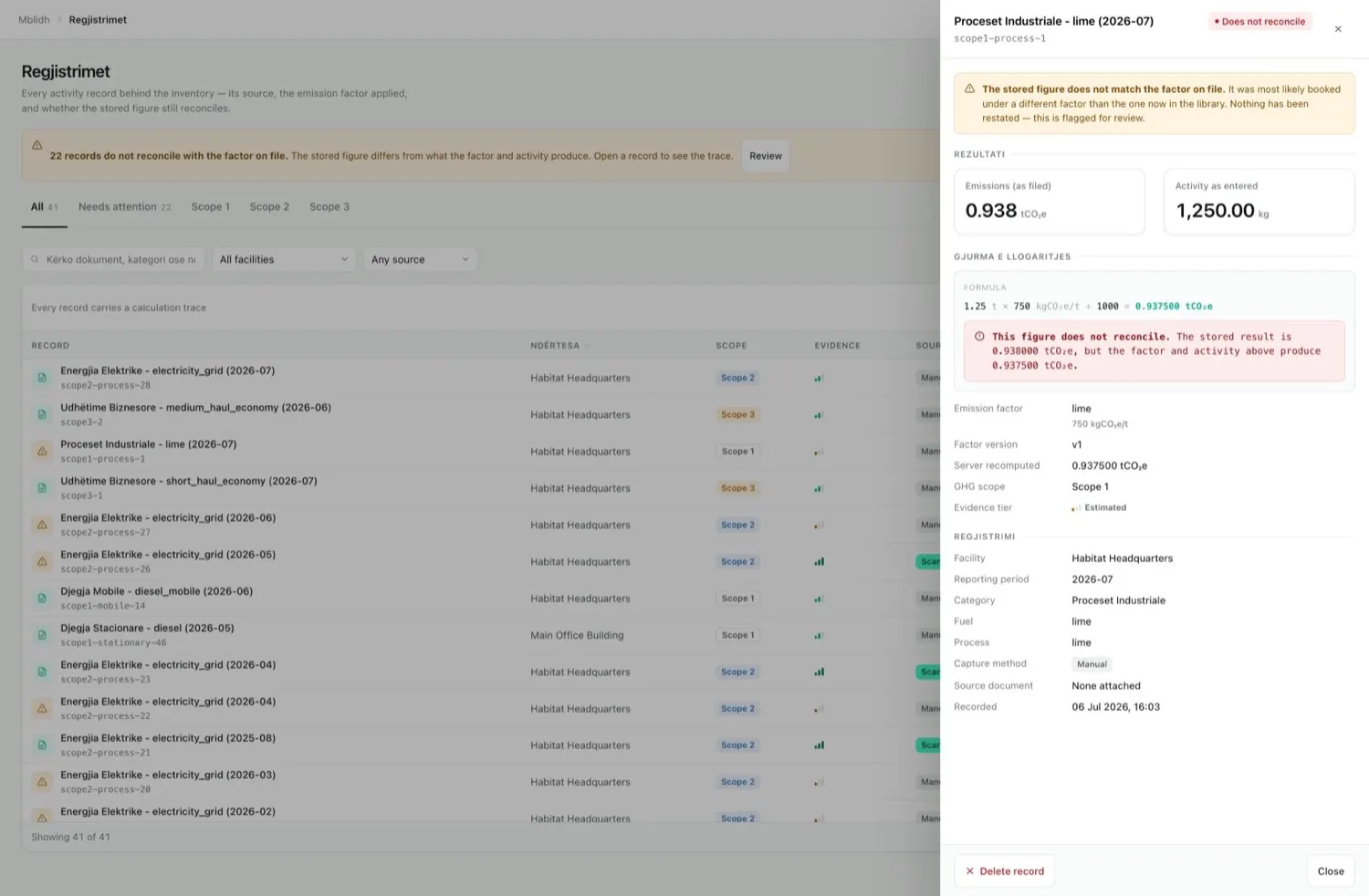
What a GHG inventory contains
- A boundary — which facilities, activities and categories are in, and which are out.
- Activity data — the quantities behind the emissions: kWh, litres, cubic metres, tonnes, kilometres.
- Emission factors — the sourced conversions from those quantities to CO₂e, with their versions.
- Results by scope — Scope 1, Scope 2 and any Scope 3 categories included.
- A baseline year — the reference that later years are compared against.
What reviewers expect from a GHG inventory
That every figure can be re-derived from evidence, that the boundary is stated rather than implied, and that gaps are disclosed. A reviewer does not need the number to be low. They need it to be checkable.
How a GHG inventory is built
Each record multiplies activity data by an emission factor, for one facility in one month. Records roll up by facility, scope and category into the totals a report shows. The inventory is only as good as the weakest link in that chain, which is why the evidence behind each record and the version of each factor are kept with it.
A GHG inventory is not a footprint calculator
A calculator gives a rough number from a few inputs and cannot be checked. An inventory is built from documents, has a stated boundary, and can be re-derived record by record. A free estimate is a good first look at the size of the problem; an inventory is what you hand to a bank, a customer or a verifier.
Who asks for a GHG inventory
- Banks attach a GHG baseline to a green credit line, with annual updates over the life of the loan.
- EU customers send supplier questionnaires that ask for Scope 1 and 2, and sometimes Scope 3.
- CBAM importers need installation-level emissions data for covered goods.
Keep reading
- GHG inventory checklist — what to collect and check
- How to use Karbon360 — build the inventory step by step
- The GHG Protocol Corporate Standard — the standard behind it